


Tóm Tắt Nội Dung Bài Viết
In the context of global integration, English has become an indispensable tool. Preparing for the future by earning an IELTS certification early—specifically during middle school—is becoming a trend that many parents and students are prioritizing. So, why should you start early, and how can you build an effective study roadmap? This article by ECE English provides a comprehensive overview.
I. Why middle school is the “golden age” for IELTS preparation

Many believe that starting IELTS in middle school is too early. However, educational experts and real-life success stories have proven otherwise. The age range of 11 to 15 is considered the “golden age” for the following reasons:
- Superior absorption: At this age, students’ brains are developing rapidly, allowing them to learn and acquire new languages naturally. Learning English during this phase helps them get accustomed to new ways of thinking, intonation, and standard pronunciation much more easily than adults.
- Comprehensive cognitive development: The IELTS curriculum does not just train the four skills of Listening, Speaking, Reading, and Writing; it also requires students to think logically, analyze, and debate academic and social topics. This fosters well-rounded cognitive development, helping them become more confident and mature than their peers.
- No time pressure: Starting IELTS in middle school gives students plenty of time to build a solid foundation without the pressure of high-stakes grades or the time constraints faced by high school seniors. This creates an environment where they can learn comfortably, proactively, and effectively.
II. The major benefits of earning an IELTS certificate early
Earning a strong IELTS score as early as middle school provides numerous advantages, not only for current studies but also for long-term future prospects.
- Opportunities for specialized schools and direct university admission: Many top specialized high schools in Vietnam prioritize direct admission or bonus points for students with an IELTS certificate. Similarly, at major universities, an IELTS score is a key criterion for direct entry, helping students reduce exam pressure and opening up more options for their future.
- Exemption from the high school graduation English exam: According to regulations from the Ministry of Education and Training, students with an IELTS score of 4.0 or higher are exempt from the English portion of the high school graduation exam, allowing them to focus their time on other subjects.
- Enhancing study abroad applications and scholarship prospects: IELTS is a mandatory requirement for studying abroad in almost all English-speaking countries. Having a high IELTS score early makes applications stand out, increasing the chances of securing valuable scholarships from prestigious universities worldwide.
- Improving academic capacity: Skills honed during IELTS preparation, such as reading specialized materials, writing essays, and giving presentations, provide a solid foundation for excelling in other high school and university subjects, especially when engaging with academic materials in English.
III. An intensive IELTS roadmap for middle school students
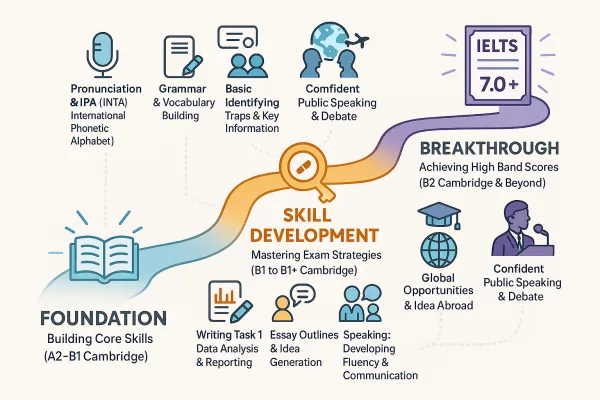
To achieve the best results, IELTS preparation must follow a structured and scientific roadmap, moving from foundational knowledge to advanced proficiency. Below is a detailed roadmap tailored for middle school students.
1. Phase 1: Building a solid foundation (Goal: Pre-IELTS level)
This phase is for students just starting out with a basic level of English. The primary goal is to consolidate all foundational knowledge to prepare for higher levels. Learning during this phase will help students confidently tackle basic IELTS question types.
- English foundation: Students will get acquainted with and reinforce standard pronunciation using the International Phonetic Alphabet (IPA), build vocabulary across 15 common topics (academic, daily life, abstract), and master basic grammar (tenses, compound-complex sentence structures). This is crucial as it forms the core knowledge that directly affects expression and accuracy across all four IELTS skills.
- Reading skills: Approach short passages of about 300 words, practice identifying main ideas, analyzing information, and flexibly using skimming and scanning techniques. These skills are the prerequisite for handling longer and more complex texts in the IELTS Reading section.
- Listening skills: Get familiar with short 3-5 minute audio clips, focus on identifying keywords and synonyms, and begin practicing the ability to predict information before listening. This is the first step in getting used to the speed and information structure of IELTS listening tests.
- Writing skills: Learn basic writing formats such as letters and event narratives of about 100 words. This helps students get used to structuring a piece of writing, organizing ideas, and using appropriate vocabulary and grammar—the foundation for both Writing Task 1 and Task 2.
- Speaking skills: Practice answering daily questions and expanding ideas into 2-3 sentences. Get used to short 1-minute talks with preparation. This phase helps students build confidence, improve pronunciation, and increase fluency, which are decisive factors for the Speaking score.
2. Phase 2: Advancing proficiency (Goal: Getting familiar with IELTS)
Once a solid foundation is established, students move to the advanced phase, familiarizing themselves with more complex question types to increase accuracy and speed.
- English foundation: Expand vocabulary to an intermediate level, learning in phrases rather than single words. Consolidate and review advanced grammar such as idiomatic expressions, reported speech, and conditional sentences. Using complex sentence structures and rich vocabulary will help students score higher in the Grammar and Vocabulary criteria for Speaking and Writing.
- Reading skills: Approach longer passages of about 500 words with distracting information, requiring inference and context-based guessing. Exercises focus on identifying synonyms and solving questions related to inference or comparisons between paragraphs—core skills for handling “Matching Headings” or “True/False/Not Given” questions in IELTS Reading.
- Listening skills: Get familiar with more complex audio containing more vocabulary “traps.” Focus on quick note-taking and processing information under time pressure. Students will be guided through specific strategies for each question type, improving their ability to read questions and predict content to optimize time during the Listening test.
- Writing skills: Perfect academic paragraph writing (120-150 words) and transition to full argumentative essays (about 250 words). Writing focuses on expressing opinions, using diverse approaches, and reinforcing clear, tight structures—key requirements for Writing Task 2.
- Speaking skills: Engage in deeper discussions with abstract questions and social arguments. Practice quick and effective outlining, improving fluency and reflex speed. Students will practice presenting personal opinions, comparing viewpoints, and responding flexibly to difficult topics—exactly what examiners expect from an IELTS Speaking candidate.
3. Phase 3: Acceleration and the finish line (Goal: Breaking through band scores)
This is the final phase, focusing on perfecting skills and getting used to real exam pressure. Students will practice difficult question types intensively and fix errors to reach their target band score.
- English foundation: Add over 200 advanced vocabulary words, focusing on deep social and academic topics. Expand on complex grammar structures like inversions and reduced clauses. Using these structures flexibly helps students achieve high band scores in the Lexical Resource and Grammatical Range and Accuracy criteria for Writing and Speaking.
- Reading skills: Practice with long passages of up to 1,000 words, including abstract topics or those with scientific and cultural elements. Students learn to use logical deduction to eliminate wrong answers, combined with effective scanning and skimming to grasp the main idea in a single read. This helps students confidently handle complex texts in the IELTS Reading exam with speed and high accuracy.
- Listening skills: Practice advanced listening with multiple parallel questions, requiring maximum focus and effective information processing. These exercises train the ability to predict and process information after listening to ensure no answers are missed, thereby boosting the Listening score.
- Writing skills: Students continue to practice writing complete argumentative essays covering personal opinions, discussions, and problem-solving. Exercises focus on developing ideas effectively, building clear structures, and using appropriate tone. This phase helps students perfect their writing to meet the strict grading criteria of IELTS Writing.
- Speaking skills: Students focus on in-depth discussion, enhancing debate skills, and public speaking. Speaking exercises require students to develop ideas quickly and extend their responses effectively using expansion strategies. Students practice quick reflexes, confidently handling any topic, and delivering responses up to 2 minutes long, helping them achieve high scores in Speaking Part 2 and Part 3.
IV. Practical tips from middle school IELTS “experts”
Success stories from students who have achieved high scores are the best proof of the effectiveness of starting IELTS early. Most share these valuable experiences:
- Don’t study aimlessly: Instead of learning everything, focus on a structured roadmap designed specifically for your age and level. This saves time and ensures skills are developed systematically.
- Combine study with entertainment: Learning English through movies, music, podcasts, or international YouTube channels is an effective way to get used to natural intonation, add vocabulary, and turn learning into an enjoyable experience.
- Practice regularly: “The most effective way to improve Reading is to read English books you find interesting,” or “Listening to foreign videos and music is quite effective for practicing reflexes,” are honest tips from students who have achieved an 8.0 IELTS.
- Have a mentor: Writing and Speaking are the two hardest skills to self-study. The advice from successful students is to seek support from a teacher or a reputable center for guidance on strategies, error correction, and logical idea development.
V. Conclusion
Investing in IELTS from middle school is a strategic decision that opens doors to many future learning and development opportunities. However, the most important thing is to find a suitable study roadmap with the support and guidance of professionals. Starting early not only provides a score advantage but also equips students with a solid foundation of knowledge and critical thinking, helping them confidently step into their next chapters.





 Khai giảng Khóa học Hè cực HOT.
No comments yet!