


Tóm Tắt Nội Dung Bài Viết
IELTS Writing Task 2 is a major challenge in terms of both time management and critical thinking. With only 40 minutes to write an essay of at least 250 words, the ability to generate ideas quickly and logically is the key to a high score. However, many candidates—especially beginners—often overlook or fail to fully harness the power of brainstorming.
So, what is brainstorming, and how can you brainstorm effectively for IELTS Writing Task 2? This article serves as a detailed guide to help you overcome the fear of writer’s block and build a cohesive, persuasive essay.
1. What is brainstorming, and why is it important for IELTS Writing Task 2?
1.1. What does “brainstorm” mean?
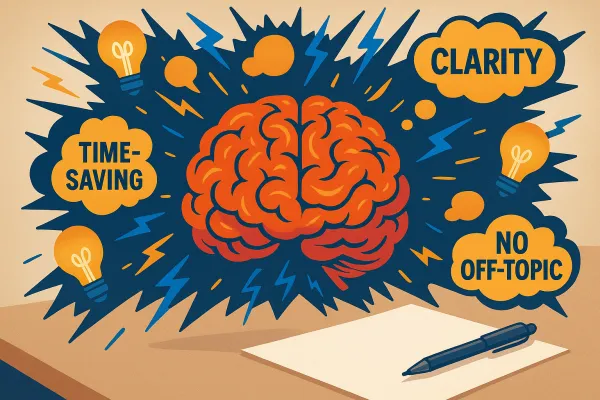
Brainstorming is a technique used to generate a large volume of ideas in a short amount of time to solve a problem. The term was coined by advertising executive Alex Faickney Osborn, using the metaphor of an “idea storm” that hits in rapid succession.
During the brainstorming process, it is crucial to encourage every thought that comes to mind, regardless of whether they seem “silly” or unfeasible at first. The primary goal at this stage is quantity over quality.
1.2. The importance of brainstorming for IELTS Writing Task 2
Spending the first 5–7 minutes brainstorming ideas for IELTS Writing Task 2 offers essential benefits, helping you optimize your score across the assessment criteria:
- Avoid going off-topic (Task Response/Achievement): This is the most common mistake. Brainstorming helps you analyze the prompt thoroughly, identify the core focus and requirements, and develop arguments that stay on track, preventing rambling or missing key points.
- Save time and reduce stress: Instead of thinking while you write, you will have a “bank” of ideas ready to go. This allows your brain to focus on expression, minimizing the risk of getting stuck and the panic that comes with time pressure. The writing process becomes much smoother and more efficient.
- Build logical and coherent arguments (Coherence and Cohesion): Brainstorming doesn’t just give you ideas; it helps you organize them logically. Once ideas are formed and selected, grouping them into paragraphs and ensuring flow between sentences becomes much easier, resulting in a well-structured and easy-to-follow essay.
- Generate creative ideas and deepen topic understanding: Brainstorming encourages limitless thinking, helping you explore various facets of a problem, including unique perspectives you might not have considered initially. This is especially helpful when dealing with unfamiliar topics.
2. A 6-step process for effective brainstorming in IELTS Writing Task 2
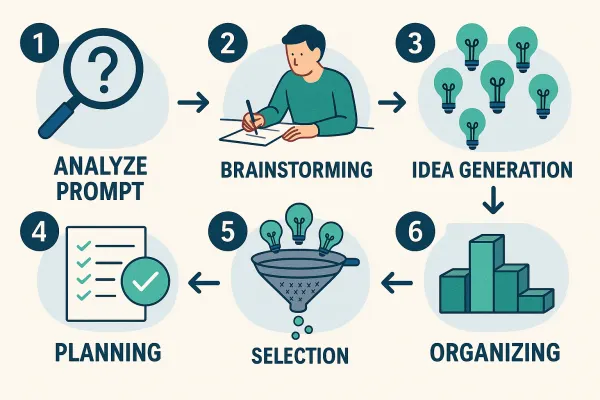
To ensure your brainstorming is scientific and effective, you can follow the 6-step process below. Remember that this is a flexible framework; feel free to adjust it to suit your own learning style and thought process.
Step 1: Understand the Prompt
This is the most critical step in ensuring your essay stays on the right track. Don’t rush!
- Identify the Topic: What is the broad subject? (e.g., Family, Education, Technology, Environment, etc.)
- Identify Keywords: Underline or highlight key terms and specific vocabulary in the prompt (e.g., “changes occurring,” “positive or negative,” “advantages,” “disadvantages”).
- Identify the Essay Type: There are 5 common types in IELTS Writing Task 2:
- Opinion/Agree or Disagree
- Problem and Solution
- Discussion (Discuss both views and give your opinion)
- Advantage and Disadvantage
- Two-part Question
- Identify Specific Questions/Instructions: What exactly is the prompt asking you to answer? How many sides do you need to discuss? Do you need to provide a personal opinion?
Example: “In recent years, the family structure has changed, as well as family roles. What are the changes occurring? Do you think these changes are positive or negative?”
- Topic: Family
- Keywords: family structure, family roles, changes occurring, positive or negative
- Essay Type: Two-part question
- Requirements: 1) Describe the changes; 2) Give your opinion on whether these changes are positive or negative.
Step 2: Develop Main Arguments
After analyzing the prompt, decide how you will answer the questions. Identify the main ideas you want to focus on.
Example (continuing from the prompt above):
- Main Idea 1 (Changes):
- Shift from extended families to nuclear families.
- Changes in gender roles: women working, men participating in housework.
- Main Idea 2 (Opinion – Positive/Negative):
- Positive: Increased privacy, reduced conflict, career opportunities for women, greater gender equality.
- Or Negative: Reduced cohesion, lack of support from grandparents, children missing out on multi-generational care.
- Or Balanced: Some positive, some negative. (Depending on your stance)
Defining your main points early provides a clear direction for the subsequent brainstorming steps.
Step 3: Idea Generation (Quantity over Quality)
This is the time to “dump” every idea related to your main points. Do not hold back or judge. Write down everything that comes to mind, even if it seems trivial, silly, or obvious.
- Method:
- Use English to note down ideas as keywords, short phrases, or bullet points.
- Don’t worry about grammar, spelling, or sentence clarity. The goal is to collect as many ideas as possible.
- Effective brainstorming techniques for this step:
-
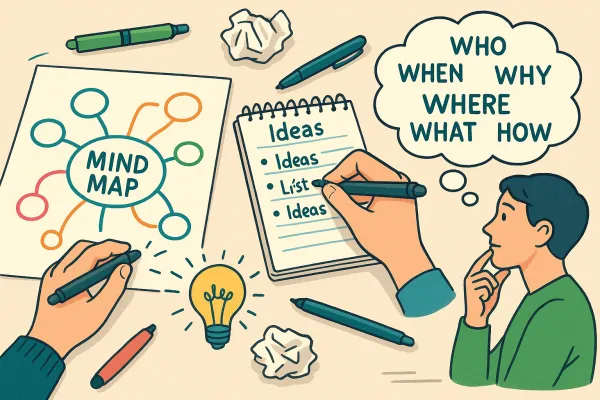
- Listing: Simply write down all ideas in bullet points.
- Example (for “Changes in family structure”):
- extended families -> nuclear families
- fewer people live together
- less contact with grandparents
- live in apartments
- divorce rates increase
- single-parent households
- Example (for “Changes in family structure”):
- Mind Mapping: Place the topic or main idea in the center, then draw branches for sub-ideas and smaller branches for examples/explanations. This is highly visual and helps connect ideas.
- 5W1H (Who, What, Where, When, Why, How): Ask these questions for each main point to dig deeper and explore different aspects of the issue.
- Example (for “Why people choose nuclear families”):
- Why? enjoy privacy, avoid conflict, less stress, modern lifestyle
- What? smaller homes, fewer responsibilities
- Example (for “Why people choose nuclear families”):
- Perspective Shifting: Imagine you are someone else (e.g., an elderly person, a child, a scientist, the government) and think about how they would view the issue. This helps expand your ideas and avoid conventional thinking.
- Example (regarding family):
- Elderly: worried about lack of care, loss of tradition.
- Government: need policies to support nuclear families/single parents.
- Example (regarding family):
- Reverse Brainstorming: Instead of looking for solutions or benefits, think about the problems, difficulties, or disadvantages. This technique sometimes helps you see opposing or complementary ideas.
- Example (If thinking about benefits of nuclear families, now think about the downsides):
- Problems: children lack traditional values, elderly feel lonely, financial burden on parents alone.
- Example (If thinking about benefits of nuclear families, now think about the downsides):
- Starbursting: Draw a star with the topic in the center, and each point of the star is a question (Who, What, When, Where, Why, How) to explore every aspect of the topic.
- Listing: Simply write down all ideas in bullet points.
Step 4: Categorize and Evaluate Ideas
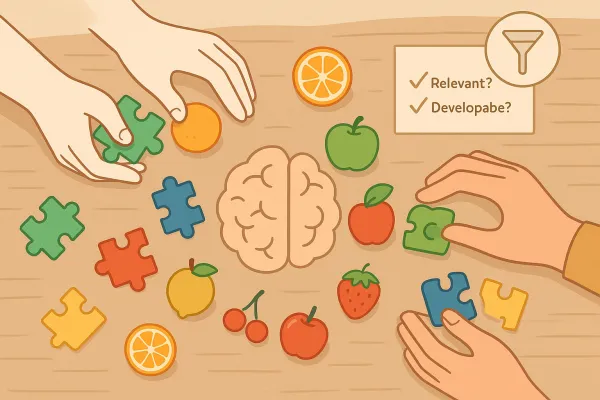
Once you have a rich list of ideas, it’s time to “filter.” Read through everything you’ve written and categorize and evaluate them based on relevance and development potential.
- Group related ideas: Combine ideas with the same argument. This helps form cohesive paragraphs.
- Eliminate weak/off-topic ideas: Cross out ideas that aren’t truly relevant to the prompt, are too vague, or are difficult to develop into solid arguments.
- Evaluation criteria:
- Relevance: Does the idea directly answer the prompt?
- Logic and Reason: Is the idea persuasive and realistic?
- Feasibility: Do you have enough knowledge and vocabulary to develop this into a clear sentence or paragraph? (Avoid choosing great ideas that are “too difficult” to express).
Example (continuing from the prompt above – after listing and grouping):
-
Changes in family structure:
- Main Idea: Shift from extended to nuclear families.
- Supporting Ideas:
- People no longer live with distant relatives/grandparents.
- Preference for private space with children.
- Avoid conflicts and decrease family stress.
-
Changes in family roles:
- Main Idea: More equal roles between men and women.
- Supporting Ideas:
- Women increasingly participate in the workforce.
- Men share household chores.
- Dual-income households are common.
-
Opinion (Positive):
- Main Idea: Nuclear families bring benefits.
- Supporting Ideas:
- Reduced financial/emotional burden on parents (only focus on children).
- More freedom and independence for couples.
- Main Idea: Equal roles promote overall societal well-being.
- Supporting Ideas:
- Women pursue careers, contribute talents to society.
- Greater gender equality.
Step 5: Elaborate and Add Details
After selecting your main and supporting ideas, review each group. Are they persuasive enough? Do you need to add evidence, explanations, or specific examples to strengthen them?
- Add Explanation: Why is this idea true?
- Add Example: Specific evidence, which could be from real life, statistics (no need for exact accuracy), or hypothetical situations.
- Add Consequence/Result: What would happen if this idea were implemented?
Example (continuing):
-
Changes in family structure:
- Preference for private space with children to avoid conflict and decrease family stress. (Explanation)
-
Changes in family roles:
- Women have an equal role to play in aiding their families and in the labor market. (Explanation of impact)
- Resulting in dual-income households, which enhance family financial stability. (Consequence)
-
Opinion (Positive):
- Reduced financial/emotional burden on parents (only focus on children) -> They can be more financially and emotionally focused on providing for their offspring. (Deeper consequence)
- Women pursue careers, contribute talents to society -> leading to greater gender equality and diverse contributions to the economy. (Deeper consequence)
Step 6: Organize and Refine Vocabulary
This is the final step of the brainstorming process, preparing you directly for writing.
- Organize the order of ideas:
- Within each paragraph: Ensure supporting ideas and details are organized logically to support the topic sentence.
- Between paragraphs: Arrange the body paragraphs logically (e.g., present all “changes” first, then move to “opinion,” or go from advantages to disadvantages, etc.).
- Refine Vocabulary (Optional): Once you have a solid structure, you can spend a moment thinking about academic vocabulary or collocations to express your ideas more effectively. However, don’t be a perfectionist here; the priority remains organizing your ideas.
Example (Summary of the outline after brainstorming):
Introduction:
- Context: Changes in family structure and roles.
- Thesis: Discussing changes + My opinion (positive).
Body Paragraph 1 (Changes in family structure):
- Topic Sentence: Shift from extended to nuclear families.
- Supporting 1: People prefer private space with children.
- Detail: Avoid conflict, reduce family stress.
- Supporting 2: Divorce/cohabitation rising, leading to single-parent homes.
Body Paragraph 2 (Changes in family roles):
- Topic Sentence: More equal roles for men and women.
- Supporting 1: Women pursue careers.
- Detail: Financial contribution to household, participate in labor market.
- Supporting 2: Men share household chores.
- Detail: Support wives, foster equality.
Body Paragraph 3 (Opinion – Positive impacts):
- Topic Sentence: These changes are largely positive.
- Supporting 1: Nuclear families reduce burden on parents.
- Detail: More focused on own children, financial/emotional stability.
- Supporting 2: Equal roles promote societal well-being.
- Detail: Women’s talents utilized, greater gender equality.
Conclusion:
- Restate thesis + summarize main points.
3. Useful tips for more effective brainstorming
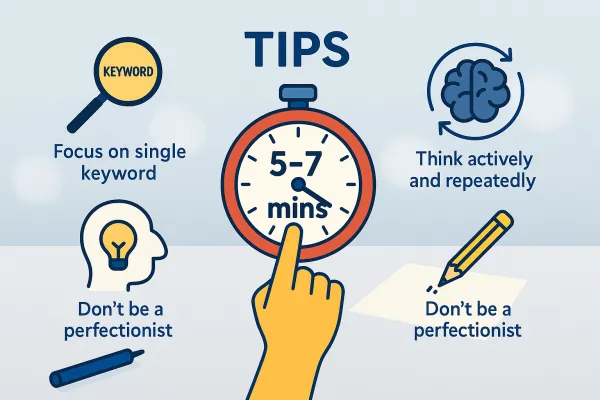
Beyond the process above, keep these small tips in mind to make your brainstorming sharper:
- Set a timer: Limit yourself to 5–7 minutes for brainstorming. This helps you stay focused and prevents spending too much time on idea generation.
- Don’t be a perfectionist early on: “Brainstorming” means letting everything flow naturally. Don’t edit grammar or worry about the perfection of your ideas immediately.
- Focus on keywords: Keep the prompt’s keywords in mind. This helps you avoid going off-topic even when ideas are flowing rapidly.
- Practice regularly: Like any skill, brainstorming requires practice. Spend 5 minutes brainstorming for every IELTS Writing Task 2 prompt you encounter, even if you don’t intend to write the full essay.
- Use scratch paper effectively: Utilize the paper provided in the exam room to quickly write down bullet points, mind maps, or related keywords.
Conclusion
Brainstorming is not just a supplementary step but a crucial stage in conquering IELTS Writing Task 2. Understanding what brainstorming is, applying effective methods like Mind Mapping, 5W1H, or perspective shifting, along with a detailed 6-step process, will help you:
- Avoid going off-topic and ensure Task Response.
- Build a cohesive, logical essay (Coherence and Cohesion).
- Optimize time and minimize pressure during the test.
Make brainstorming an indispensable habit in your study routine. With thoughtful preparation of your ideas, you will be much more confident in writing an excellent essay and achieving your dream score in IELTS Writing Task 2.</p





 Khai giảng Khóa học Hè cực HOT.
No comments yet!