


Tóm Tắt Nội Dung Bài Viết
On the journey to conquering IELTS, the Writing section is consistently one of the biggest hurdles. To hit your target band score, having high-quality study materials is essential. Among the countless options on the market, Improve your IELTS Writing Skills stands out as a “powerful ally” that many students swear by. So, what makes this book so special? Let’s dive into the details with ECE!
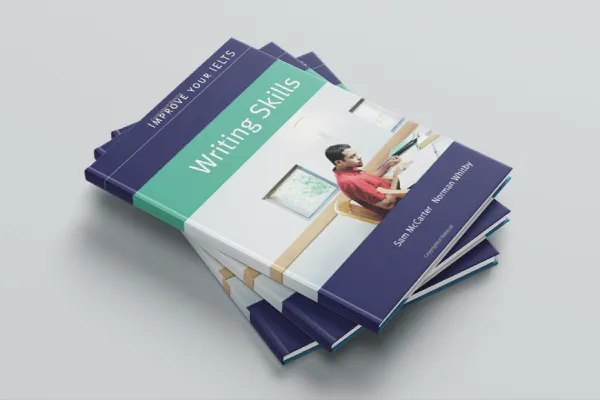
1. Overview of Improve your IELTS Writing Skills – Macmillan Education
Improve your IELTS Writing Skills is part of the “Improve your Skills for IELTS” series published by Macmillan Education, a prestigious publisher with over 180 years of experience in the education sector. The series includes dedicated books for each skill (Listening & Speaking, Reading, Writing) and offers various levels to suit different learners.
- Title: Improve your IELTS Writing Skills
- Authors: Sam McCarter and Norman Whitby (Some sources may only mention Sam McCarter, but Norman Whitby is a co-author). Sam McCarter is a renowned author with many high-quality IELTS titles, highly regarded for his expertise.
- Publisher: Macmillan Education
- Publication Year: The book was first published around December 2006. However, updated versions or reprints may have different dates.
- Page count: Approximately 112 pages (original edition).
- Language: Entirely in English.
- Price: Prices vary depending on the bookstore, edition (original print, photocopy, or ebook), and location. In Vietnam, printed copies typically range from 90,000 VND to 200,000 VND depending on the format.
This book is designed as a self-study resource or as a supplement to IELTS courses, helping learners develop the skills and language necessary for the IELTS Academic Writing test.
2. Who is this book for?
Improve your IELTS Writing Skills is tailored for the following learners:
- Intermediate-level learners and above: It is particularly suitable for those with an IELTS band score of 4.0–5.0 or higher who are aiming for a 6.0–7.5+ in the Writing section. The book is not intended for absolute beginners, as the content is entirely in English and focuses on advanced writing techniques.
- Those looking to improve academic writing: The book focuses on Writing Task 1 (Academic) and Writing Task 2, making it ideal for anyone planning to study abroad or immigrate who needs to improve their essay writing and data analysis skills.
- Self-study enthusiasts: With its clear structure, detailed guidance, and full answer keys, the book is a great choice for disciplined learners who want to practice Writing at home.
- Teachers and IELTS centers: It can be used as a reference or supplementary textbook for writing courses.
3. Detailed Content Review
Improve your IELTS Writing Skills is structured logically and scientifically, divided into topic-based units (usually 10 or 12). Each unit includes the following key sections:
- Introduction to the Topic: Introduces the unit’s theme, typically common IELTS topics like the environment, education, technology, society, etc. This section helps learners get familiar with relevant vocabulary and ideas.
- Writing Task 1:
- Provides in-depth knowledge and practice for common chart types (line graphs, bar charts, pie charts, tables, processes, maps).
- Guides you on how to read and analyze data, and how to select key information for description and comparison.
- Provides useful phrases, grammatical structures, and vocabulary for describing trends, figures, and changes.
- Includes short practice exercises to help learners apply knowledge immediately.
- Writing Task 2:
- Focuses on common essay types: Agree/Disagree, Discussion, Advantages/Disadvantages, Problem/Solution, and Two-part questions.
- Guides you on how to analyze the prompt, plan, develop ideas, write topic sentences, and craft introductions and conclusions.
- Provides techniques for cohesion and coherence using effective linking words, conjunctions, and pronouns.
- Refines your use of academic vocabulary and ensures grammatical range and accuracy.
- Includes exercises to practice writing specific parts of an essay.
- Techniques/Exam Tips: Throughout each unit, there are “Techniques” or “Exam Tips” boxes that provide helpful advice, test-taking strategies, time management tips, and common pitfalls to avoid.
- Model Answers: This is one of the book’s greatest strengths. It provides model answers for various task types, helping learners visualize what a high-scoring IELTS essay looks like. For some exercises, the book provides two model answers with different approaches and detailed annotations, helping learners better understand writing strategies.
- Practice Test: Each unit usually concludes with a full Academic Writing practice test based on that unit’s topic, helping learners synthesize and apply the skills they have learned.
- Answer Key: Provides detailed answers for all exercises, including explanations for open-ended tasks, allowing learners to self-assess their progress.
4. Pros and Cons
While it is a high-quality resource, Improve your IELTS Writing Skills has its own set of pros and cons:
Pros
- Scientific and logical content: The book is systematically designed, moving from topic introduction, vocabulary, and grammar to writing techniques and application exercises. Each unit has clear learning objectives.
- Thorough analysis of Writing tasks: The book dives deep into both Task 1 (describing charts, processes, maps) and Task 2 (essays), providing specific strategies for each type.
- High-quality model answers: These are invaluable resources for learning how to develop ideas, use language, and structure a standard essay. The annotations on the model answers help learners gain deeper insights.
- Focus on academic language: The book helps learners build academic vocabulary and grammar, which is crucial for increasing band scores. Sections like “Improve Your IELTS Word Skills” help practice paraphrasing—a vital skill.
- Exam tips and strategies: The “Techniques” and “Exam Tips” scattered throughout the book offer useful advice for approaching and handling test questions effectively.
- Great for self-study: With detailed answer keys and a clear structure, learners can study effectively without needing constant guidance.
Cons
- Entirely in English: This can be a major barrier for those with a weak English foundation or beginners. The lack of explanations in Vietnamese can sometimes make it difficult to grasp complex concepts.
- Heavy workload: Each unit contains a lot of information and exercises, which might feel overwhelming, especially without a specific study plan.
- Lack of dedicated grammar exercises: While the book focuses on grammar within the context of writing, it does not have separate, in-depth grammar drills. Learners may need to combine this with other grammar resources to solidify their foundation.
- Not frequently updated: As an older book, some content (such as very new test formats) may not be fully updated to reflect current exam trends, although the core principles and techniques remain valuable.
5. How to study effectively with this book
To make the most of this book and achieve the best results in improving your Writing skills, follow these steps:
- Determine your level and goals:
- Before you start: Take an IELTS Writing test (graded by a teacher or professional) to know your current band score. This helps you set specific goals and identify areas for improvement.
- If you are below 4.0: Focus on basic grammar and vocabulary before using this book to avoid feeling overwhelmed and discouraged.
- Study in order, unit by unit:
- Each unit is designed to build skills sequentially. Do not skip around.
- Read the topic introduction, the skills to be learned, and the unit objectives carefully.
- Combine theory with deep practice:
- Analyze the prompt: Read the question carefully, underline keywords, and identify the requirements (task type, aspects to analyze).
- Read and take notes: Study the theory, vocabulary, and grammar structures introduced. Write down good phrases and new structures in a notebook.
- Do the exercises: Complete the small exercises in the unit to reinforce your knowledge and skills.
- Outline: Before writing the full essay, spend time creating a detailed outline (brainstorming ideas, selecting main points, organizing paragraphs). This is a crucial step for a coherent essay that stays on topic.
- Write the full essay: Based on your outline, write your Task 1 and Task 2 essays under timed conditions (20 minutes for Task 1, 40 minutes for Task 2) to get used to exam pressure.
- Analyze model answers and self-correct:
- Read model answers carefully: Compare your essay with the model. Analyze how the model develops ideas, uses vocabulary and grammar, and links sentences/paragraphs.
- Self-correction: Based on the answer key and model, find and fix your own grammar, vocabulary, spelling, and logical errors.
- Get feedback from a teacher/professional: This is the most important step to identify blind spots. Ask for detailed feedback based on the 4 grading criteria (Task Achievement/Response, Coherence and Cohesion, Lexical Resource, Grammatical Range and Accuracy).
- Accumulate academic vocabulary and grammar:
- Always pay attention to the academic vocabulary and collocations introduced in the book.
- Practice using complex sentences, passive voice, and relative clauses accurately and in a varied way.
- Use a spaced repetition approach:
- Don’t just do it once and move on. Return to past units, redo exercises, or rewrite essays from a different perspective.
- Practice writing regularly, even on topics not in the book, to increase your flexibility.
A final word from ECE:
Improve your IELTS Writing Skills is truly a valuable book for anyone looking to level up their IELTS writing. However, to get the most out of it, you need to combine theory with diligent practice and, most importantly, receive quality feedback.
At ECE, we are committed to accompanying you on this journey. With our team of highly qualified teachers, personalized study programs, and student-centered teaching methods, ECE will help you not only master the knowledge from the book but also confidently apply it to the actual exam, ensuring you reach your target IELTS score.
Contact ECE today for a consultation on the best study path and start your journey to conquering IELTS Writing!




 Khai giảng Khóa học Hè cực HOT.
No comments yet!