


Tóm Tắt Nội Dung Bài Viết
Have you ever wondered how your TOEIC score compares to an IELTS band? For those interested in these two popular English proficiency tests, understanding the correlation (even if only approximate) between them can help you set clearer learning goals and save time and effort. Let’s join ECE in exploring how to convert TOEIC scores to IELTS and vice versa, along with other essential information below.
TOEIC to IELTS 4-Skills Conversion Table
Score conversion between TOEIC and IELTS is for reference only. These two tests have different objectives, structures, content, and scoring systems. However, the tables below can help you visualize the corresponding proficiency levels.
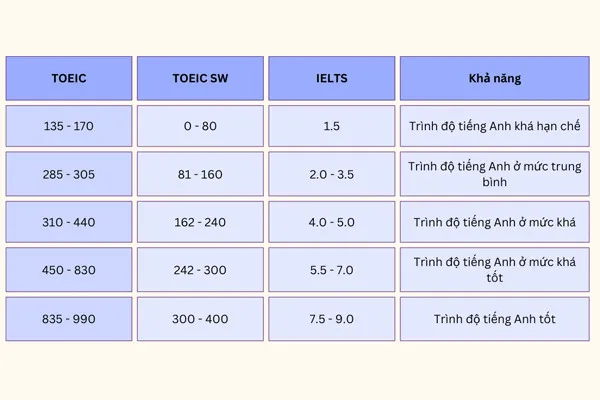
Converting TOEIC Reading & Listening to IELTS
The TOEIC Reading & Listening score (990-point scale) corresponds to IELTS as follows:
| TOEIC (R&L) | IELTS | Proficiency Description |
|---|---|---|
| 0 | 0 | Did not take the test |
| 25 – 55 | 0.5 | Lowest score; candidate cannot use English. |
| 75 – 125 | 1.0 | Candidate cannot apply English in daily life. |
| 135 – 170 | 1.5 | Candidate only knows a few simple English words. |
| 185 – 225 | 2.0 | Candidate only uses a few isolated words and memorized short phrases. |
| 235 – 260 | 2.5 | Candidate only uses a few isolated words and memorized short phrases. |
| 265 – 280 | 3.0 | Candidate can only use English in familiar situations like stating name, age, or hometown. |
| 290 – 305 | 3.5 | Candidate can use English in a few familiar situations. |
| 310 – 335 | 4.0 | Candidate can use English in specific situations like asking for directions or inquiring about health. |
| 340 – 360 | 4.5 | Candidate uses English flexibly in basic situations but struggles when communication becomes complex. |
| 365 – 440 | 5.0 | Candidate can communicate normally with only minor errors in daily life. |
| 450- 560 | 5.5 | Candidate applies vocabulary well within their professional field. |
| 570 – 680 | 6.0 | Candidate uses English relatively fluently. |
| 685 – 780 | 6.5 | Candidate can communicate in complex situations and performs well in daily interactions. |
| 785 – 830 | 7.0 | Candidate has a strong grasp of English and applies it flexibly in various situations. |
| 835 – 900 | 7.5 | Candidate understands nuances and underlying meanings in English texts. |
| 905 – 945 | 8.0 | Candidate has mastered English with only rare errors due to unfamiliarity or misunderstanding. |
| 955 – 970 | 8.5 | Candidate can debate complex topics in English. |
| 975 – 990 | 9.0 | Candidate uses English at a near-native level. |
Note: Data is sourced from IDP, one of the two authorized IELTS test providers in Vietnam.
Converting TOEIC Speaking & Writing to IELTS
For the TOEIC Speaking & Writing scale (400 points), the conversion to IELTS is as follows:
| TOEIC (S&W) | IELTS | Proficiency Description |
|---|---|---|
| 0 – 80 | 1.5 | Cannot use English. |
| 81 – 160 | 2.0 – 3.5 | Basic English usage. |
| 161 – 240 | 4.0 – 5.0 | Fair English usage. |
| 241 – 300 | 5.5 – 7.0 | Good English usage. |
| 7.5 – 9.0 | Excellent English proficiency. |
Note: This conversion table is for reference only and does not replace the official criteria of either certificate.
IELTS to TOEIC Conversion Table
Converting IELTS to TOEIC Reading & Listening
| IELTS |
Equivalent TOEIC (R&L) Score (Reference)
|
| 9.0 | 975 – 990 |
| 8.5 | 955 – 970 |
| 8.0 | 905 – 945 |
| 7.5 | 835 – 900 |
| 7.0 | 785 – 830 |
| 6.5 | 685 – 780 |
| 6.0 | 570 – 680 |
| 5.5 | 450 – 560 |
| 5.0 | 365 – 440 |
| 4.5 | 340 – 360 |
| 4.0 | 310 – 335 |
| 3.5 | 290 – 305 |
| 3.0 | 265 – 280 |
| 2.5 | 235 – 260 |
| 2.0 | 185 – 225 |
| 1.5 | 135 – 170 |
| 1.0 | 75 – 125 |
| 0.5 | 25 – 55 |
Converting IELTS to TOEIC Speaking & Writing
| IELTS |
Equivalent TOEIC (S&W) Score (Reference)
|
| 7.5 – 9.0 | 301 – 400 |
| 5.5 – 7.0 | 241 – 300 |
| 4.0 – 5.0 | 161 – 240 |
| 2.0 – 3.5 | 81 – 160 |
| ~1.5 | 0 – 80 |
Essential Information About TOEIC and IELTS Test Formats
1. TOEIC
TOEIC (Test of English for International Communication) is a test designed to assess English proficiency in professional and international communication environments, developed by the Educational Testing Service (ETS). In Vietnam, IIG is the authorized entity for organizing tests and issuing certificates. There are two main TOEIC tests:
TOEIC Listening and Reading Test:
- Test duration: 2 hours.
- Structure:
Listening: 100 questions in 45 minutes. This section tests the ability to understand conversations and information in professional and social contexts.
Reading: 100 questions in 75 minutes. This section evaluates the ability to read and understand short texts, such as emails, announcements, instructions, and other work-related documents.
- Scoring: 5 to 495 points per section (maximum total score of 990). This score reflects the ability to understand and use English in simple communication and basic work situations.
TOEIC Speaking and Writing Test:
- Test duration: Approximately 1 hour and 30 minutes.
- Structure:
Speaking: 11 questions in about 20 minutes. This section tests the ability to express ideas in English in daily and professional communication.
Writing: 8 questions in 20 minutes. This section assesses the ability to write emails, announcements, and short paragraphs related to work and communication situations.
- Scoring: Each section (Speaking and Writing) is scored from 0 to 200, with a maximum total score of 400 points.
2. IELTS
The IELTS (International English Language Testing System) is one of the most popular international English exams, used to assess candidates’ English proficiency in academic and general communication contexts. IELTS has two main formats:
1. IELTS Academic:
- Target audience: For those planning to study at universities or colleges, or those pursuing academic research.
- Structure: This test includes 4 skills: Listening, Reading, Writing, and Speaking.
- Listening: 4 listening sections with 40 questions in 30 minutes.
- Reading: 3 long passages with a total of 40 questions in 60 minutes. Reading content may relate to academic fields.
- Writing: Includes 2 tasks:
- Task 1: Describe a graph, table, chart, or process (150 words).
- Task 2: Write an essay (250 words).
- Speaking: A face-to-face interview with an examiner lasting 11-14 minutes. Candidates answer questions and engage in a conversation about familiar topics like family, work, hobbies, etc.
- Scoring: Each skill (Listening, Reading, Writing, Speaking) is scored from 0-9. The overall band score is the average of the individual skill scores.
2. IELTS General Training:
- Target audience: For those wishing to migrate to English-speaking countries (such as Australia, Canada, the UK) or those participating in vocational training or secondary education programs.
- Structure: Similar to IELTS Academic, IELTS General Training also covers 4 skills: Listening, Reading, Writing, and Speaking, but with slight differences in the Reading and Writing sections.
- Listening: Same structure as IELTS Academic (4 sections, 40 questions, 30 minutes).
- Reading: 3 passages, 40 questions total, but content focuses on practical and social situations rather than specialized academic topics.
- Writing:
- Task 1: Write a letter (150 words).
- Task 2: Write an essay (250 words) on social or daily life topics.
- Speaking: Same as IELTS Academic (face-to-face interview, 11-14 minutes).
- Scoring: Similar to IELTS Academic, each skill is scored from 0-9, and the overall band score is the average of the individual skill scores.
Comparing TOEIC and IELTS
Origin and Test Format
1. TOEIC (Test of English for International Communication):
Origin: Developed by ETS (Educational Testing Service), a leading educational testing organization based in the United States.
- Reading & Listening: Assessed on a maximum scale of 990 points.
- Speaking & Writing: Assessed on a maximum scale of 400 points.
2. IELTS (International English Language Testing System):Origin: Organized through a partnership of three leading international educational testing organizations:
- British Council.
- IDP Education.
- Cambridge Assessment English.
Test format:
- IELTS Academic: Suitable for academic purposes and research at universities or international educational institutions.
- IELTS General Training: Aimed at communication in work, daily life, or immigration requirements in English-speaking countries.
Scoring: Band scores from 1.0 – 9.0 for all 4 skills: Listening, Reading, Writing, and Speaking. Each skill has an individual score, which is then averaged to produce the Overall Band Score.
Content and Scoring Criteria
1. TOEIC:
Test content:
- Focuses on common communication situations in daily life and office environments.
- Conversations, emails, or short texts are designed to test basic English understanding and usage.
Scoring criteria:
- Evaluates based on the ability to understand listening content and reading comprehension.
- For the Speaking & Writing test, criteria focus on coherence, grammatical accuracy, and the ability to convey ideas in basic communication.
2. IELTS:
Test content:
- IELTS is designed with more diverse content than TOEIC, including:
- Social communication topics and practical daily life situations.
- Specialized content regarding academics, research, or data analysis.
- Reading, listening, and writing tasks often require critical thinking and argumentation.
Scoring criteria:
- Listening and Reading: Evaluates the ability to understand main ideas, details, and inferences.
- Writing: Focuses on idea development, coherence, grammatical accuracy, and vocabulary range.
- Speaking: Scored based on fluency, coherence, pronunciation, and the ability to use language flexibly in communication.
Differences in Purpose
TOEIC:
- Suitable for those wanting to improve English usage in basic communication or office environments.
- Widely used by businesses to assess the English proficiency of employees or candidates.
IELTS:
- Usually required for study abroad, especially in English-speaking countries.
- Supports academic goals, research, or English requirements for international visa applications.
Frequently Asked Questions (FAQ)
1. Is the TOEIC to IELTS (and vice versa) conversion table absolutely accurate?
No. These conversion tables are for reference only due to significant differences in structure, content, assessment objectives, and scoring systems. They only provide a rough overview of corresponding proficiency levels.
2. Should I take TOEIC or IELTS?
This depends entirely on your purpose:
For university graduation (in Vietnam) or applying to companies requiring professional English communication: TOEIC is often a more suitable and popular choice.
For studying abroad, immigration, or working in academic/research environments: IELTS (usually Academic) is a mandatory requirement or highly preferred. Always check the specific requirements of the school, organization, or company you are targeting.
3. What does a 700 TOEIC (Reading & Listening) score equate to in IELTS?
According to the reference table, 700 TOEIC (R&L) is roughly equivalent to 6.5 IELTS. However, keep in mind that 700 TOEIC only reflects Listening and Reading skills, while 6.5 IELTS is the average of all 4 skills (Listening, Speaking, Reading, Writing). Someone with 700 TOEIC may not necessarily reach 6.5 in the Speaking and Writing sections of IELTS.
4. Why can’t TOEIC and IELTS scores be completely interchangeable?
Because they measure different aspects of English proficiency:
Skill scope: TOEIC L&R only assesses Listening and Reading, while IELTS assesses all 4 skills.
Context: TOEIC focuses on office English and daily international communication. IELTS includes complex academic contexts.
Depth of assessment: IELTS often requires analytical thinking, argumentation, and more complex language usage.
Converting TOEIC scores to IELTS helps learners compare and evaluate their English proficiency against international standards. However, remember that while conversion tables exist, each test evaluates different skills, so improving each skill individually is crucial for achieving good results. Good luck!





 Khai giảng Khóa học Hè cực HOT.
No comments yet!