


Tóm Tắt Nội Dung Bài Viết
An IELTS 8.0 band score is a dream goal for many English learners. It doesn’t just demonstrate near-native proficiency; it serves as a “golden ticket” to countless academic and career opportunities. But is the journey to an 8.0 truly that difficult? This article from ECE Language Center provides a comprehensive and realistic look at what this band score entails.
What level of proficiency is IELTS 8.0?
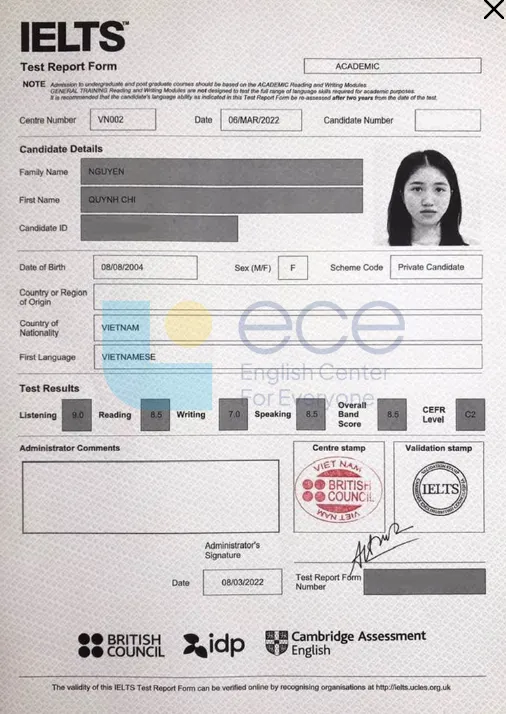
According to the Common European Framework of Reference for Languages (CEFR), an IELTS 8.0 is generally considered a very high C1 level, bordering on C2. Specifically:
- C1 (Advanced): Learners can use the language flexibly and effectively for social, academic, and professional purposes.
- C2 (Proficient): Learners can understand and express themselves naturally and fluently with virtually no obstacles.
With an 8.0 band score, you demonstrate excellent command of English, the ability to understand complex, abstract arguments, and the capacity to communicate confidently and fluently in almost any situation.
- Equivalent conversions:
- IELTS 8.0 ≈ TOEFL iBT 110 – 114
- IELTS 8.0 ≈ TOEIC 945 – 990
- IELTS 8.0 ≈ C1 – C2 (CEFR)
The Benefits of an IELTS 8.0 Certificate
Holding an IELTS 8.0 certificate provides a significant competitive edge, helping you stand out in any environment:
- Scholarships and Study Abroad: Most top-tier universities worldwide require an IELTS 6.5 – 7.5. With an 8.0, you don’t just meet the requirements—you exceed them, opening doors to full scholarships and prestigious academic programs.
- University Admissions in Vietnam: Many leading universities in Vietnam offer direct admission or priority selection for candidates with an IELTS 8.0.
- Settlement and Immigration: This is an ideal score for permanent residency or work visa applications in developed countries like Canada, Australia, and the UK.
- Career Opportunities: You will have a major advantage when applying to multinational corporations or roles requiring high-level English communication, such as diplomacy, translation/interpretation, or senior management.
- Confidence in Communication and Learning: IELTS 8.0 is proof of your critical thinking and linguistic mastery, allowing you to integrate seamlessly into international environments.
Is IELTS 8.0 Difficult? Detailed Criteria for Each Skill
IELTS 8.0 is regarded as one of the most challenging band scores to achieve. IELTS reports indicate that fewer than 3% of candidates worldwide reach this level. It requires not only a solid grasp of the language but also the ability to use English with nuance, precision, and natural flow.
Below are the specific criteria to reach band 8.0 for each skill:
- Listening:
– Candidates must correctly answer 35 – 36 out of 40 questions.
– You must be able to understand detailed information, grasping both main ideas and complex data, even when distractors are present.
– You must distinguish between various accents and tones while taking notes effectively.
- Reading:
– You need 35 – 36 correct answers out of 40 for the Academic module, or 37 – 38 out of 40 for General Training.
– You must comprehend complex texts containing significant academic vocabulary.
– You must be proficient in scanning and skimming to locate information quickly and accurately.
– You must understand vocabulary based on context and analyze the author’s argumentative structure.
- Writing:
– Task Achievement: Fully address all parts of the prompt, present a clear position, and develop ideas logically and coherently.
– Coherence and Cohesion: Organize information logically and use cohesive devices and referencing flexibly and effectively.
– Lexical Resource: Use a wide range of vocabulary accurately and naturally. Skillfully incorporate less common lexical items and idioms.
– Grammatical Range and Accuracy: Use a wide variety of complex structures with only occasional, minor errors.
- Speaking:
– Fluency and Coherence: Speak fluently and naturally with rare hesitation for language. Present ideas in a coherent and logical manner.
– Lexical Resource: Use a broad, flexible, and precise vocabulary to discuss a wide range of topics. Use idioms and rare vocabulary with sophistication.
– Grammatical Range and Accuracy: Use a wide range of complex structures with only a few minor grammatical slips.
– Pronunciation: Clear and easy to understand throughout, with natural, native-like intonation.
In reality, to achieve an Overall 8.0, you do not necessarily need an 8.0 in all four skills. Vietnamese candidates often have an advantage in Listening and Reading, while Writing and Speaking are typically harder to score high in.
Here are some common score combinations that Vietnamese candidates use to reach an Overall 8.0:
- Common scenario:
Listening 8.5, Reading 8.5, Writing 7.0, Speaking 7.0 - Receptive skills focus:
Listening 9.0, Reading 8.5, Writing 6.5, Speaking 7.0 - Balanced approach:
Listening 8.0, Reading 8.0, Writing 7.5, Speaking 7.5 - Productive skills focus:
Listening 8.0, Reading 8.0, Writing 8.0, Speaking 6.0
Understanding your strengths helps you build an effective preparation strategy, focusing on pulling up the scores of your weaker skills.
Related article: Should you start IELTS in 10th grade?
Can You Teach English with an IELTS 8.0?
The answer is yes; you can certainly become a highly qualified English teacher with an 8.0 band score. This score is seen as strong evidence of your linguistic competence.
- At Language Centers: With an IELTS 8.0, you are qualified to teach at most centers, especially for test prep classes for lower-level students.
- At International Schools or Specialized Prep Centers: Many major organizations require a band 8.0 or higher, combined with international teaching certifications like CELTA or TESOL and practical teaching experience.
Detailed Roadmap to IELTS 8.0 Based on Proficiency Levels
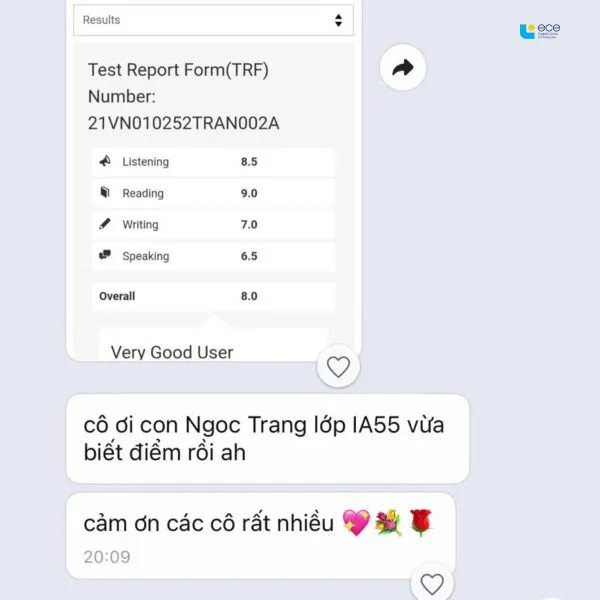
To achieve an IELTS 8.0, a structured and systematic study plan is vital. Based on the stages of IELTS skill development, we can outline the following roadmap:
Phase 1: Building the Foundation (Target 3.0 – 4.0 Overall)
- Goal: Master pronunciation principles, basic grammar structures, and become familiar with data comparison formats.
- Timeframe: Approximately 75 hours of study and 18 hours of testing.
- Skill Focus:
- Listening: Get used to short audio clips, identifying keywords and main ideas.
- Speaking: Exchange basic information regarding personal topics and hobbies.
- Reading: Understand short texts and identify sentence components.
- Writing: Write simple sentences and describe basic information.
- Reference Materials: Basic Tactics for Listening, Oxford Word Skills Basic, Grammar for IELTS, Headway Academic Skills, Expanding Tactics for Listening, Vocabulary Building, Grammar in Context, Pathway.
Phase 2: Developing Core Skills (Target 5.0 Overall)
- Goal: Expand vocabulary and knowledge of common topics, apply advanced structures in Speaking, and familiarize yourself with Reading and Writing Task 1 formats.
- Timeframe: Approximately 48 hours of study and 12 hours of testing.
- Skill Focus:
- Listening: Tackle various listening question types, aiming for 15 – 20 correct answers.
- Speaking: Provide answers at a 5.0 level for familiar topics, using time-related idioms, conditionals, and relative clauses.
- Reading: Practice scanning/skimming and solve most Reading question types.
- Writing: Write well-structured paragraphs and complete Writing Task 1 chart descriptions.
- Reference Materials: IELTS Introduction, Cambridge English IELTS Series, Advanced English Pronunciation in Use, The Best Preparation for IELTS Listening, IELTS Foundation, Improve your IELTS: Reading Skills.
Phase 3: Intermediate Advancement (Target 6.0 – 6.5+ Overall)
- Goal: Expand academic vocabulary, improve pronunciation, deepen opinion-giving skills, practice Writing Task 1 and Task 2, and achieve 20 – 30 correct answers in Listening & Reading.
- Timeframe: Approximately 96 hours of study and 24 hours of testing.
- Skill Focus:
- Listening: Get 20 – 30 correct answers and identify vocabulary traps.
- Speaking: Answer at a 5.5 – 6.5+ level across diverse topics, using advanced pronunciation techniques, cleft sentences, and idioms.
- Reading: Get 20 – 30 correct answers while practicing under time pressure.
- Writing: Master Task 1 (charts, processes, maps), write Task 2 with correct structure and themes, and learn how to upgrade sentence variety.
- Reference Materials: Cambridge English IELTS Series, Common Mistakes at IELTS Advanced, Improve your Skills: Listening & Speaking for IELTS, Mindset for IELTS, New Insight into IELTS, Vocabulary Building, Improve your Skills: Writing for IELTS, Improve your Skills: Reading for IELTS.
Phase 4: Advanced Writing and Speaking Development (Target 7.0+ Writing & Speaking)
- Goal: Enhance analytical and argumentative abilities, using academic vocabulary and complex grammatical structures in Writing and Speaking.
- Timeframe: Approximately 38 hours of study and 5 hours of testing.
- Skill Focus:
- Writing: Write analytical reports, develop ideas for difficult topics, use complex sentences, passive voice, inversions, and maintain coherent flow.
- Speaking: Respond naturally, diversify vocabulary for emotions and interests, expand answers with reasons, examples, and comparisons. Develop storytelling organization, logical presentation, use of transition words, compound-complex sentences, and advanced vocabulary. Express viewpoints (agree, disagree, compare, solutions), analyze in-depth questions, and refine natural intonation.
Phase 5: Refinement and Breaking Through to 8.0+
- Goal: Continuously practice with mock exams, expand vocabulary from model answers, perfect time management skills, and build mental resilience for the exam.
- Timeframe: At least 2 months before the official test date.
- Skill Focus:
- Comprehensive: Take full-length practice tests, focusing on remaining weak points.
- Vocabulary: Learn high-level academic and less common vocabulary.
- Strategy: Master test-taking strategies for every specific question type.
- Mindset: Maintain a relaxed and confident mental state.
- Reference Materials: The latest Cambridge IELTS Practice Tests, reputable listening sources like TED Talks, and BBC Learning English.
Note: The time required to complete each phase may vary depending on your starting level, learning capacity, and the time you dedicate to practice. Enrolling in a structured course with guidance from experienced teachers will help optimize your learning process and reach the IELTS 8.0 goal.
Summary
IELTS 8.0 is a challenging goal that requires significant perseverance and effort. However, it is by no means impossible. With a scientific study plan, high determination, and a smart preparation strategy, you can absolutely conquer this peak and open doors to a promising future.





 Khai giảng Khóa học Hè cực HOT.
No comments yet!