


Tóm Tắt Nội Dung Bài Viết
In the IELTS Writing Task 2, the “Advantages and Disadvantages” essay is one of the most common question types you might encounter. To achieve a high score, you need to master how to write this type of essay effectively and persuasively. This article provides a detailed guide on how to tackle an advantages and disadvantages essay, from identifying the question type and structuring your essay to essential tips and strategies for success.
Introduction to the Advantages and Disadvantages Essay in IELTS Writing Task 2
1.1. How to identify the Advantages and Disadvantages essay
This essay type requires you to analyze and discuss the pros and cons of a specific issue, trend, or solution. You can identify this task by looking for key phrases in the prompt, such as:
- What are the advantages and disadvantages of…?
- Discuss the advantages and disadvantages of…
- Do the advantages of… outweigh the disadvantages?
- Outline the benefits and drawbacks of…
- Analyze the pros and cons of…
1.2. Categorizing Advantages and Disadvantages prompts
These essays can generally be divided into the following sub-types:
- Discussing pros and cons: This is the most common type, requiring you to list and analyze both the benefits and drawbacks of a topic.
Example: “Discuss the advantages and disadvantages of using public transportation.”
- Comparing pros and cons: This type requires a deeper level of analysis, asking you to evaluate whether the advantages outweigh the disadvantages.
Example: “Do the advantages of online learning outweigh the disadvantages?”
- Stating a personal opinion: In this version, beyond analyzing the pros and cons, you must provide your own perspective on the issue.
Example: “Some people believe that living in a big city is more beneficial than living in the countryside. Discuss the advantages and disadvantages of both options and give your own opinion.”
2. Structure of an Advantages and Disadvantages Essay
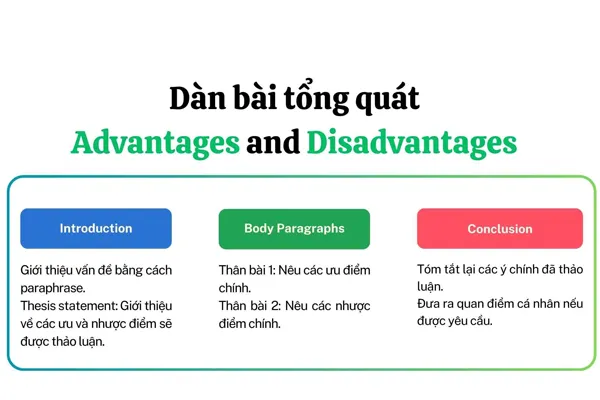
An advantages and disadvantages essay typically follows a 4-paragraph structure:
- Introduction: Introduce the topic and outline the issue to be discussed.
- Body Paragraph 1: Analyze the advantages.
- Body Paragraph 2: Analyze the disadvantages.
- Conclusion: Summarize the main points and provide your personal opinion (if requested).
The number of points in each body paragraph depends on the prompt and your ability to develop ideas. However, it is crucial to maintain a balance between the advantages and disadvantages. Even if the prompt asks whether the advantages outweigh the disadvantages, you should still explore both sides thoroughly and fairly.
- If the prompt asks for a deep dive into a few key points, focus on developing 1-2 strong arguments with clear evidence and explanations.
- If the prompt is more general, you can list more points, but ensure each one is explained clearly and logically.
2.1. Outlining your essay
Before you start writing, create a detailed outline to ensure your essay is structured and coherent. Outlining helps you organize your thoughts and arrange your arguments logically, making the final piece easier to follow. Below is an example outline for the prompt: “Discuss the advantages and disadvantages of living in a big city”:
I. Introduction
- General introduction to the trend of living in big cities.
- State the issue: The advantages and disadvantages of city living.
II. Body Paragraph 1: Advantages
- Point 1: Better job opportunities and career growth.
- Evidence: Many large companies and corporations are based in cities.
- Explanation: Easier to find high-paying jobs with more promotion prospects.
- Point 2: Modern and diverse amenities.
- Evidence: Developed transportation, education, and healthcare systems.
- Explanation: Easy access to essential services, entertainment, and shopping.
III. Body Paragraph 2: Disadvantages
- Point 1: High cost of living.
- Evidence: Expensive housing, food, and services.
- Explanation: Creates financial pressure, especially for newcomers.
- Point 2: Environmental pollution and noise.
- Evidence: High population density and heavy traffic.
- Explanation: Negatively impacts health and quality of life.
IV. Conclusion
- Summarize the main advantages and disadvantages.
- State personal opinion: The benefits of living in a big city outweigh the drawbacks.
3. Steps to writing an Advantages and Disadvantages essay
Step 1: Analyze the prompt and outline.
- Clearly identify the requirements: Is it a list, a comparison, or does it require a personal opinion?
- Create a detailed outline for each paragraph, including arguments, evidence, and explanations.
Step 2: Write the introduction.
- Introduce the topic generally.
- Paraphrase the prompt to state the issue being discussed.
Step 3: Write the body paragraphs.
- Analyze each point outlined in your plan.
- Provide specific evidence and clear explanations to support your arguments.
- Use linking words to connect ideas within and between paragraphs.
To make your essay persuasive, illustrate your points with specific examples and clearly explain the connection between the example and the argument.
- Choosing examples: You can use various types of examples, such as real-world scenarios, hypothetical situations, or statistics. The key is that the example must be relevant and convincing.
- Explaining examples: After providing an example, clearly explain how it illustrates your point.
For instance, when writing about the benefits of living in a big city, you could mention modern public transport, then explain that this allows residents to travel conveniently and save time.
Step 4: Write the conclusion.
- Summarize the main points concisely.
- State your personal opinion (if required).
- You may include a final thought or a prediction about the future.
4. Common grammatical structures for this essay type
To make your writing more diverse and impressive, use a variety of grammatical structures:
- Conditional sentences: These help you express cause-and-effect relationships.
Example: “If people use social media excessively, they may experience social isolation.”
- Passive voice: This helps you emphasize the object affected by an action.
Example: “Many job opportunities are offered in big cities.”
- Relative clauses: These allow you to provide additional information about a preceding noun.
Example: “Social media, which has become an integral part of modern life, has both advantages and disadvantages.”
- Comparative structures: These help you compare two or more subjects.
Example: “Living in a big city is more convenient than living in a small town.”
5. Important tips for your essay
1. Language and Tone:
- Use formal language: In IELTS Writing Task 2, you must use academic, polite, and objective language. Avoid slang, colloquialisms, or overly emotional phrasing.
- Consistent tone: Maintain a neutral and objective tone throughout the essay, unless the prompt specifically asks for your personal opinion.
- Avoid emotional writing: Even when stating an opinion, present it logically and based on evidence rather than emotion.
2. Avoid repetition:
- Use synonyms: Instead of repeating the same word, use synonyms or different expressions to enrich your vocabulary and keep the reader engaged.
Example: Instead of just using “advantage,” you can use “benefit,” “merit,” “strength,” or “positive aspect.”
- Paraphrase: Use paraphrasing techniques (expressing the same idea using different words and sentence structures) to avoid repetition and demonstrate your linguistic flexibility.
3. Use a variety of linking words:
- Connect ideas: Use appropriate linking words to connect ideas within sentences, between sentences, and between paragraphs. This makes your essay coherent, logical, and easy to follow.
- Show relationships: Choose linking words that clarify the relationship between ideas, such as adding information (“Furthermore,” “Moreover,” “In addition”), showing contrast (“However,” “On the other hand,” “Nevertheless”), or drawing conclusions (“Therefore,” “Thus,” “In conclusion”).
4. Develop ideas fully and persuasively:
- Clear explanation: Each point needs to be explained clearly and in detail; avoid making general statements without analysis.
- Illustrate with examples: Use specific examples, statistics, or research to support your arguments and increase persuasiveness.
- Connect examples to arguments: After providing an example, clearly explain how it relates to the point you are making.
5. Essay structure:
- Clear layout: Follow the 4-paragraph structure: Introduction, Body Paragraph 1, Body Paragraph 2, and Conclusion.
- Balanced length: Ensure a balance in length between paragraphs; avoid having one paragraph that is significantly longer than the others.
- Transitions: Use transition sentences to link paragraphs, creating a seamless flow.
6. Thorough review:
- Grammar and spelling: Before submitting, take time to carefully check for grammar and spelling errors to avoid unnecessary point deductions.
- Vocabulary and expression: Ensure you have used vocabulary accurately and in the appropriate context.
- Coherence and logic: Re-read your essay to ensure that your ideas are presented in a coherent, logical, and understandable way.
7. Time management tips:
- Allocate time wisely: In IELTS Writing Task 2, you have 40 minutes. Allocate time for reading the prompt, outlining, writing, and reviewing.
- Practice regularly: Consistent practice will improve your writing skills and time management efficiency.
6. Sample Advantages and Disadvantages essays for Writing Task 2
Below are two sample essays with different approaches:
Sample 1: Discussing the advantages and disadvantages of using social media
Step 1: Analyze the prompt and outline
-
Analysis: The prompt asks for a discussion of the pros and cons of social media; it does not require a personal opinion.
-
Outline:
- Introduction: Introduce social media and its role in modern life.
- Body Paragraph 1:
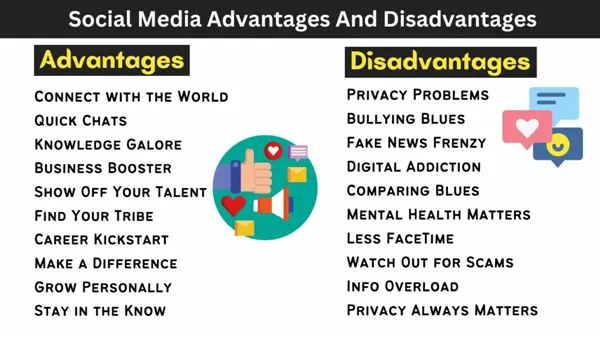
- Advantage 1: Connecting people globally (e.g., international students).
- Advantage 2: Creating online communities for shared interests.
- Advantage 3: Providing a platform for self-expression and sharing ideas.
- Body Paragraph 2:
- Disadvantage 1: Privacy issues (e.g., identity theft).
- Disadvantage 2: Cyberbullying and online harassment.
- Disadvantage 3: Addiction and social isolation.
- Conclusion: Summarize pros and cons, emphasizing responsible use.
Step 2: Write the introduction
- Social media has become an indispensable part of modern life.
- This essay will discuss the advantages and disadvantages of using social media.
Step 3: Write the body paragraphs
-
Body Paragraph 1:
- Social media allows people to connect regardless of geographical distance. For example, international students can use it to share experiences and stay in touch with family back home.
- It facilitates online communities where people can interact and discuss shared interests.
- It also serves as a platform for creative self-expression and sharing ideas with a wider audience.
-
Body Paragraph 2:
- One major disadvantage is privacy. Users often share personal information that can be accessed and misused, leading to identity theft, harassment, and other cybercrimes.
- Cyberbullying and online harassment are prevalent, negatively impacting mental health and well-being.
- Excessive use can lead to addiction and social isolation, as people spend more time online than interacting face-to-face.
Step 4: Write the conclusion
- Summary: Social media has both pros and cons. It is a powerful communication tool but raises concerns about privacy, bullying, and addiction.
- Emphasis: It is essential to use social media responsibly and be mindful of its negative impacts.
In today’s digital age, social media has become an indispensable part of our lives. Platforms like Facebook, Instagram, and Twitter have revolutionized the way we communicate, connect, and consume information. While social media offers numerous advantages, it also comes with its own set of drawbacks. This essay will discuss the benefits and disadvantages of using social media.
One of the primary advantages of social media is its ability to connect people from all over the world. Through these platforms, individuals can easily stay in touch with friends and family, regardless of geographical distance. For example, a student studying abroad can use social media to share their experiences and stay connected with loved ones back home. Social media also facilitates the formation of online communities and groups, where people with shared interests can interact and engage in discussions. These online communities can provide a sense of belonging and support, especially for individuals who may feel isolated in their offline lives. Moreover, social media provides a platform for individuals to express themselves creatively and share their thoughts and ideas with a wider audience. Artists, writers, and musicians can use social media to showcase their talents and gain recognition.
However, social media also has its downsides. One major concern is the issue of privacy. Users often share personal information online, which can be accessed and misused by others. This can lead to identity theft, online harassment, and other forms of cybercrime. Cyberbullying and online harassment are also prevalent on social media, leading to negative consequences for individuals’ mental health and well-being. The anonymity provided by the internet can embolden individuals to engage in harmful behavior that they might not otherwise exhibit in face-to-face interactions. Furthermore, excessive use of social media can be addictive and lead to social isolation, as people spend more time online than interacting with others in person. This can have detrimental effects on their social skills and overall well-being.
In conclusion, social media offers both advantages and disadvantages. While it provides a powerful tool for communication and connection, it also raises concerns about privacy, cyberbullying, and addiction. It is essential for individuals to use social media responsibly and be mindful of its potential negative impacts.
Sample 2: Comparing the benefits and drawbacks of working from home

Step 1: Analyze the prompt and outline
Analysis: The prompt requires an analysis of the pros and cons of working from home, along with a personal opinion on whether the benefits outweigh the drawbacks.
-
Outline:
- Introduction: Introduce the work-from-home trend and state the issue.
- Body Paragraph 1:
- Benefit 1: Increased flexibility (e.g., setting own hours).
- Benefit 2: Saving on commuting costs (e.g., Global Workplace Analytics study).
- Benefit 3: Improved productivity.
- Body Paragraph 2:
- Drawback 1: Social isolation and loneliness.
- Drawback 2: Blurred boundaries between work and personal life (e.g., Buffer survey).
- Conclusion: Summarize pros and cons, confirm that benefits outweigh drawbacks, and suggest solutions.
Step 2: Write the introduction
- Technological advancements and changes in work culture have led to a significant increase in remote work.
- This essay will analyze the pros and cons of working from home and argue that the benefits ultimately outweigh the drawbacks.
Step 3: Write the body paragraphs
-
Body Paragraph 1:
- One key benefit is flexibility. Employees can set their own hours, take breaks when needed, and manage their schedules according to personal preferences.
- Working from home eliminates commuting time and costs. For example, a Global Workplace Analytics study found that remote workers can save between $2,000 and $7,000 annually on commuting.
- It can increase productivity by allowing employees to work in a comfortable environment without office distractions.
-
Body Paragraph 2:
- A major concern is social isolation and loneliness. Employees may miss the social interaction and camaraderie of a traditional workplace.
- It can blur the lines between work and personal life, making it hard to switch off. For example, a Buffer survey showed that 20% of remote workers struggle with loneliness.
Chia sẻ:





 Khai giảng Khóa học Hè cực HOT.
No comments yet!