


Tóm Tắt Nội Dung Bài Viết
Crime and Punishment is a key topic within the Social Issues category for IELTS Writing Task 2. To achieve a high score in this section, candidates need to demonstrate deep insight into social issues and public order, as well as the ability to present arguments and solutions in a logical, persuasive manner.
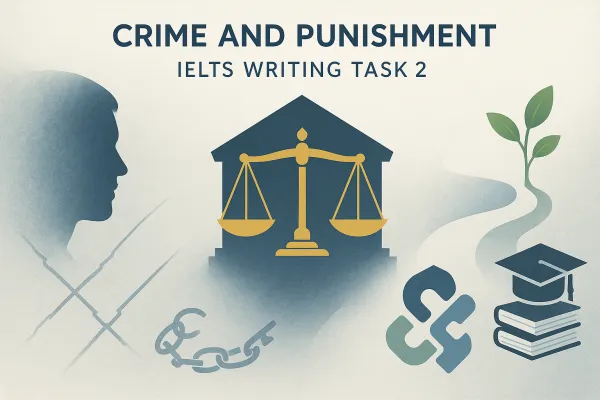
Common questions in this topic typically revolve around:
- Causes and consequences of crime: Why is crime increasing? What are its consequences for society?
- Prevention and mitigation: What roles do the government, education, families, and communities play in preventing crime?
- Effective/fair punishment: Should the focus be on rehabilitation or retribution? Should the severity of the punishment match the severity of the crime?
- Roles of stakeholders: How are the government, educational institutions, parents, and the community responsible for preventing crime and supporting the reintegration of ex-offenders?
This is considered a challenging topic, requiring not only a rich vocabulary but also critical thinking skills and the ability to provide relevant examples and evidence.
Common Question Types and Examples
In IELTS Writing Task 2, the Crime and Punishment topic can appear in various formats. Below are some common types with illustrative examples:
- Opinion Essay:
Example: Some people believe that prison is the best punishment for criminals. Others think more effective forms of punishment exist. Do you agree or disagree?
- Discussion Essay:
Example: Some people believe that criminals should be given longer prison sentences. Others argue that rehabilitation and education are more effective. Discuss both views and give your own opinion.
- Advantages/Disadvantages:
Example: Many governments are replacing prison sentences with community service for minor crimes. What are the advantages and disadvantages of this approach?
- Problem/Reason/Solution:
Example: In many countries, the crime rate among teenagers is rising. What are the causes of this trend, and what can be done to address it?
Key Ideas for Crime and Punishment
To write a strong essay on Crime and Punishment, you need to equip yourself with solid arguments. Below is a summary of key ideas and suggestions for developing each sub-topic:
IELTS Writing Task 2 Sample: Discuss both views
Sample Prompt: Some people believe that the best way to reduce crime is to give longer prison sentences. Others, however, believe there are better alternative ways to reduce crime. Discuss both views.
Introduction:
Crime reduction is a critical concern for societies worldwide, prompting intense debate over the most effective measures. While some argue that imposing longer prison sentences serves as the best deterrent, others believe that alternative approaches such as rehabilitation, education, and community programs offer more sustainable solutions. This essay will examine both perspectives before concluding with a reasoned opinion on the most effective strategies to combat criminal behaviour.
Body Paragraph 1: Supporting longer prison sentences
On the one hand, proponents of longer prison terms contend that strict punishment serves as a powerful deterrent against criminal behavior. First of all, when individuals are aware that serious crimes will lead to prolonged incarceration, they may think twice before offending. This view is supported by the theory of deterrence, which suggests that the certainty and severity of punishment can influence behavior. Moreover, extended prison sentences can incapacitate dangerous offenders, thereby protecting society by removing potential threats. In countries where harsh sentencing policies are enforced, such as the United States, proponents argue that the crime rate is kept in check due to the fear of lengthy imprisonment.
Body Paragraph 2: Supporting alternative methods
On the other hand, critics of this punitive approach argue that long-term incarceration often fails to address the underlying causes of crime, such as poverty, lack of education, and mental health issues. Instead of merely punishing offenders, society should focus on rehabilitation and reintegration. Programs aimed at vocational training, counseling, and drug treatment within prisons have shown positive outcomes in reducing recidivism rates. Furthermore, preventive strategies like investing in early childhood education, improving social services, and creating employment opportunities can tackle crime at its source. Scandinavian countries, for instance, emphasize rehabilitation over punishment and report some of the lowest crime rates globally.
Conclusion:
In conclusion, while longer prison sentences may deter crime to some extent and protect society in the short term, they are not a panacea. A more holistic approach that addresses the root causes of criminal behavior through comprehensive rehabilitation programs, combined with robust social reforms and proactive preventive strategies, is likely to yield more effective and lasting results. Therefore, it is imperative for governments and communities to prioritize these alternative methods alongside appropriate punitive measures to foster a safer and more just society.
Useful Vocabulary
To write effectively about Crime and Punishment, mastering specialized vocabulary is essential. Here is a list of key terms:
- prison sentence (n): a period of time that a person must spend in prison
- deterrent (n): something that discourages someone from doing something
- incarceration (n): the state of being confined in prison
- rehabilitation (n): the action of restoring someone to health or normal life through training
- recidivism (n): the tendency of a convicted criminal to reoffend
- reintegration (n): the process of integrating someone back into society
- vocational training (n): training for a specific job or trade
- punitive approach (n): a method of dealing with crime that focuses on punishment
- preventive strategy (n): a plan designed to stop something from happening
- underlying causes (n): the fundamental reasons behind an issue
- social reform (n): changes made to improve society
- root causes (n): the basic or primary causes of a problem
- criminal behavior (n): actions that violate the law
- offender (n): a person who commits an illegal act
- law enforcement (n): the activity of some members of government who act in an organized manner to enforce the law
- imprisonment (n): the state of being imprisoned
In summary, the Crime and Punishment topic in IELTS Writing Task 2 requires candidates to have a comprehensive and deep perspective. It is not enough to just master vocabulary; you also need the ability to construct tight, logical arguments. Understanding the causes and consequences of crime, along with preventive methods, effective punishments, and the role of social reintegration, will help you build a persuasive essay. We hope these analyses and suggestions from ECE serve as a solid foundation for you to master this topic and achieve your target IELTS band score.





 Khai giảng Khóa học Hè cực HOT.
No comments yet!