


Tóm Tắt Nội Dung Bài Viết
The Partly Agree approach is one of the most effective and popular argumentative strategies for IELTS Writing Task 2. Unlike taking a strictly “agree” or “disagree” stance, the Partly Agree method allows candidates to demonstrate multidimensional, insightful thinking, making it easier to achieve a high band score—particularly 7.0 and above.
This guide from ECE Language Center provides a comprehensive walkthrough, from identifying the prompt type and building your strategy to mastering the structure and language required to excel with the Partly Agree approach.
1. When should (and shouldn’t) you choose Partly Agree?

Choosing the right strategy from the start is crucial to your success. Based on examiner criteria and common prompt types, you should opt for a Partly Agree approach when:
- The prompt is relative, not absolute: This is the most important indicator. If the prompt uses phrases like “some people believe,” “it is argued that,” or presents a viewpoint that doesn’t apply to every situation, you can safely argue from a Partly Agree perspective.
Example: “The only way to achieve success in life is through a university education.” This statement is clearly not true in all cases, as many people succeed through practical experience.
- You have strong points for both sides: If you can easily brainstorm logical reasons to both support and challenge the prompt, this is a sign that you can build a balanced and persuasive essay.
- The prompt asks for the extent of your agreement: Questions using “To what extent do you agree or disagree?” or “How far do you agree?” are essentially invitations to choose a degree of agreement, and “Partly Agree” is a perfect response.
You should NOT choose Partly Agree when:
- The prompt is absolute or extreme: If the question contains keywords like “all,” “every,” “only,” or “must,” choosing to “partly agree” can make your argument seem inconsistent or off-topic.
Example: “All zoos should be closed because they are cruel to animals.” This is an absolute statement. You should choose one side—either strongly agree or strongly disagree—to ensure a more robust argument.
- You lack balanced arguments: If you only have compelling reasons for one side, write a “Totally Agree” or “Disagree” essay to focus on developing those points, rather than forcing a balance that results in a weak, unclear essay.
2. Advanced Argumentation Strategy: The “Context-Dependent” Approach
Instead of simply listing pros and cons, the “context-dependent” strategy is an advanced approach that helps you demonstrate deeper analytical skills. This strategy involves breaking the issue down into specific aspects or contexts.
How to apply the “context-dependent” strategy:
- Analyze the prompt: Identify the aspects to consider, such as:
- Target audience: Children, adults, the elderly.
- Field/Industry: Education, healthcare, business.
- Stage: Initial, growth, or maturity.
- Location: Urban vs. rural areas.
- Determine your stance for each context:
- Context 1: You agree with the prompt.
- Context 2: You disagree or highlight the limitations of that viewpoint.
Practical example: “If a product is good and meets customer needs, then people will buy it and advertising is unnecessary. To what extent do you agree or disagree?”
- General stance: I partly agree with this statement.
- Context for agreement (Partly Agree): Advertising is unnecessary for sectors like healthcare, education, or established brands, where product quality and word-of-mouth are the primary drivers of success.
- Context for disagreement (Partly Disagree): Advertising is essential for startups or new product launches, as they require aggressive promotional strategies to reach consumers and build initial trust, regardless of how good the product is.
This approach not only helps you generate enough ideas but also showcases sharp analytical thinking that goes far beyond a simple list of pros and cons.
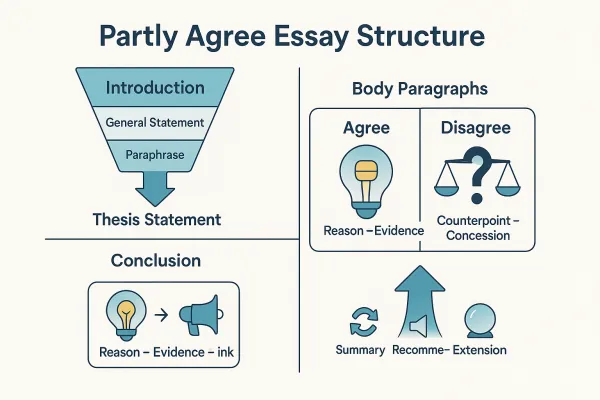
3. Structuring a Partly Agree Essay
A Partly Agree essay requires a clear structure to ensure coherence and persuasiveness.
Introduction
Use the G.S.T formula (General – Specific – Thesis):
- General Statement: Introduce the broad topic. (e.g., The debate about the role of advertising in business has long been a heated topic.)
- Specific Focus: Paraphrase the prompt in your own words.
- Thesis Statement: Clearly state your Partly Agree position. Use concessive structures to show balance. (e.g., While I acknowledge that high-quality products can thrive without extensive marketing, I believe that advertising remains indispensable for new businesses and rapid growth.)
Body Paragraphs
There are two main structural options:
- Block Structure (Suitable for band 6.0-7.0):
- Paragraph 1 (Body 1): State reasons for agreeing with one part of the prompt.
- Topic sentence: State the main idea.
- Explanation & Example: Develop the point with arguments and specific examples.
- Paragraph 2 (Body 2): State reasons for disagreeing or highlighting limitations.
- Topic sentence: Use contrastive connectors (However, On the other hand, etc.).
- Explanation & Example: Develop the point similarly to paragraph 1.
- Paragraph 1 (Body 1): State reasons for agreeing with one part of the prompt.
- Point-by-Point / “Context-Dependent” Structure (Suitable for band 7.0+):
- Paragraph 1 (Body 1): Analyze aspect A of the issue.
- Agree with the prompt in context X, but disagree in context Y.
- Paragraph 2 (Body 2): Analyze aspect B of the issue.
- Agree with the prompt in context Z, but highlight limitations in context W.
- Paragraph 1 (Body 1): Analyze aspect A of the issue.
Conclusion
Use the P.R.E formula (Paraphrase – Recommendation – Extension):
- Paraphrase: Summarize your main position and the key arguments mentioned.
- Recommendation/Prediction: Offer a solution or future prediction to expand on the issue. (e.g., Therefore, it is crucial for businesses to adopt a balanced approach…)
- Extension: Add a final thought (optional, but adds depth).
4. How to express your position clearly?
The core of “Partly Agree” is balance, but you must still lean toward one side. To avoid losing points for an unclear stance, keep these tips in mind:
- Clear Thesis Statement: Use concessive structures, but clearly state which side you lean toward or what you consider most important.
- Do: “While I accept that public funding for roads is important, I believe that investing in public transport is the most effective long-term solution for cities.”
- Avoid: “While I agree with both views, I think governments should consider both roads and public transport.” (This is too neutral and lacks a clear stance.)
- Use logical connectors: Words like However, On the contrary, and Nevertheless help transition between ideas smoothly and logically.
- Body paragraph length: If you lean more toward “agree,” make your first body paragraph (agreeing) longer and more detailed. The second paragraph (disagreeing) should still be well-developed but can be more concise.
5. Sample “Partly Agree” Essay for IELTS Writing Task 2
Based on the principles above, here is a sample essay illustrating the “context-dependent” strategy.
Prompt: “Some people believe that the best way to improve public health is to increase the number of sports facilities. To what extent do you agree or disagree?”
Sample Essay:
Introduction: The issue of how to effectively enhance public well-being has long been a subject of debate. While it is widely argued that building more sports facilities is a vital step, I partly agree with this perspective by contending that its effectiveness is conditional, as other crucial factors, such as education and accessibility, must also be addressed.
Body Paragraph 1: On the one hand, I acknowledge that the construction of new sports facilities can play a significant role in improving public health, especially for urban populations. One primary reason is that these facilities provide easily accessible and well-maintained venues, encouraging citizens to engage in regular physical activities. For example, local parks with jogging tracks, basketball courts, and gyms can motivate city dwellers, who often lead sedentary lifestyles, to exercise after work. This, in turn, can help mitigate health issues such as obesity and heart disease. Additionally, these spaces serve as hubs for community interaction, fostering a sense of belonging and improving mental well-being, which is an equally crucial aspect of public health.
Body Paragraph 2: However, the idea that sports facilities alone are the best way to improve public health is flawed, as their impact is often limited without accompanying social policies and educational campaigns. In many rural and underprivileged areas, a lack of awareness regarding healthy habits or the financial means to use private sports facilities remains a major barrier. Simply building a new facility in such a community may not lead to higher usage if people are not educated on the benefits of exercise or if the costs are prohibitive. Furthermore, for the elderly or individuals with disabilities, sports facilities might not be the most suitable solution. Instead, investing in public health education programs that promote basic nutrition and simple exercises, or providing subsidies for medical check-ups, could yield more comprehensive and equitable results.
Conclusion: In conclusion, while the development of sports facilities can certainly contribute to better public health by promoting physical activity, its effectiveness is not guaranteed. A truly comprehensive strategy requires a balanced approach, integrating public health education, targeted campaigns, and policies that ensure accessibility for all segments of the population. Ultimately, relying solely on infrastructure without addressing the underlying social and economic factors would be an incomplete solution.
Summary
Choosing the “Partly Agree” strategy is an effective way to demonstrate high-level critical thinking in IELTS Writing. However, it requires careful preparation regarding structure, strategy, and language. By applying the “context-dependent” method, you will not only overcome this challenge but also create an essay with depth, persuasion, and the potential for a consistently high score. Good luck!





 Khai giảng Khóa học Hè cực HOT.
No comments yet!