


Tóm Tắt Nội Dung Bài Viết
The IELTS Writing section is consistently one of the biggest hurdles for many test-takers, requiring the ability to use language flexibly, logically, and appropriately to convey ideas. To help learners overcome this challenge, the book IELTS Writing Step By Step was created as a detailed, systematic guide. This article from the ECE language center will help you explore the content and target audience for this book in detail.
Overview of IELTS Writing Step By Step
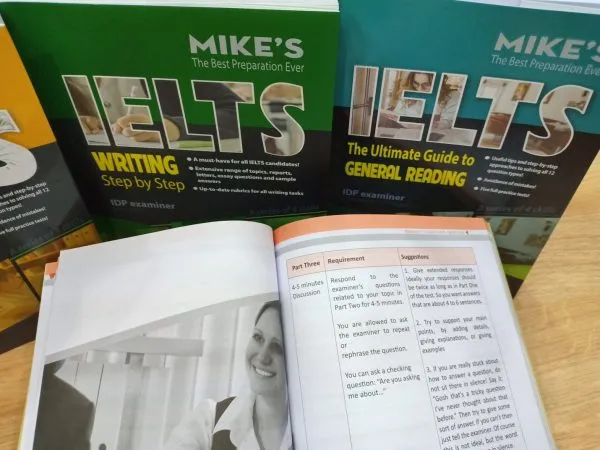
IELTS Writing Step By Step is part of the well-known IELTS Mike series, focusing exclusively on the Writing skill. This book is designed to help candidates prepare effectively for both Writing Task 1 and Task 2, covering both the Academic and General Training modules.
- Book Title: IELTS Writing Step by Step – Task 1 and 2: Academic and General Test
- Author: Mike Wattie. As a former IELTS examiner, his advice and experience shared in the book are highly practical, helping learners better understand grading criteria and common pitfalls to avoid.
- Publisher: Hong Duc Publishing House. Distributed by MCBooks.
- Language: The book is written entirely in English. This is an important point for learners to note.
- Dimensions: 17 x 24 cm.
- Page count: 172 pages.
Target Audience
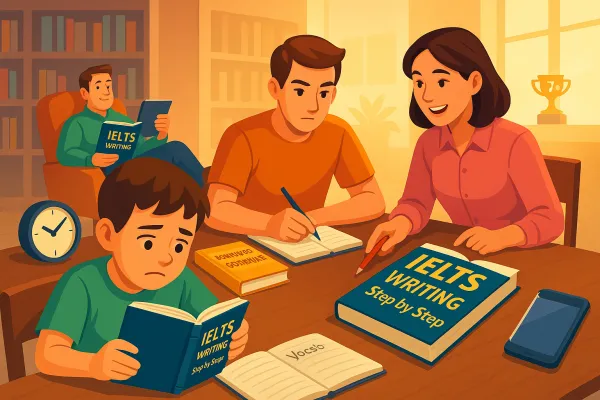
IELTS Writing Step By Step is designed for a specific range of learners:
- Learners with a basic to intermediate English foundation (IELTS 4.0 and above): The book is suitable for those who already have a solid grasp of grammar and vocabulary. Since it is written entirely in English, learners need a reasonable level of reading comprehension to absorb the material.
- Self-study candidates: With its scientific and detailed “step-by-step” approach, the book provides a clear roadmap that helps learners navigate and practice on their own without needing a language center.
- Candidates looking to improve their Writing score and avoid common mistakes: Because the author is a former IELTS examiner, the book focuses on analyzing common errors and providing advice to boost your band score, rather than just offering “hacks.”
- Candidates preparing for both IELTS Academic and General Training: The book includes detailed guidance for both Task 1 (Academic Reports and General Letters) and Task 2 (Essay Writing) for both test formats.
Who this book is NOT for:
- Absolute beginners or those with an English level below IELTS 4.0: If you lack a solid foundation in grammar and vocabulary, this book may be too challenging. You should prioritize more basic materials, ideally those written in Vietnamese or focused on building your foundation first.
- Those looking for “quick fixes” or “shortcuts”: The book focuses on building genuine writing skills and guiding you toward accurate, natural language use, rather than teaching mechanical “tricks” to achieve a high score.
Detailed Content Review
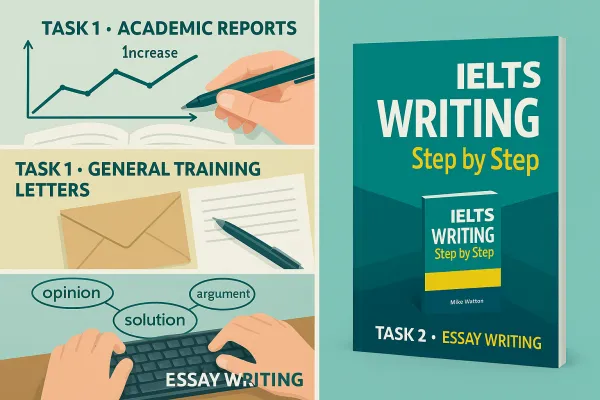
IELTS Writing Step By Step is structured scientifically and systematically, divided into 4 main chapters that cover all the knowledge and question types in the IELTS Writing test:
Chapter 1: Introduction to the IELTS Writing Test
- Differences: An analysis of the differences between the Writing sections in IELTS Academic and IELTS General Training.
- Common Mistakes: Highlights the 3 biggest mistakes candidates often make in IELTS Writing.
- General Methodology: Introduces general methods to increase your Writing band score.
- Grading Criteria: Clearly explains the IELTS Writing assessment criteria (Task Achievement/Response, Coherence and Cohesion, Lexical Resource, Grammatical Range and Accuracy) so learners fully understand the requirements.
Chapter 2: Task 1 – Academic Reports (For IELTS Academic)
This section dives deep into how to handle the common chart types in Task 1 Academic:
- Overview: Basic knowledge on how to read the prompt, identify question types, and understand Task 1 assessment criteria.
- Detailed Task Types:
- Single time (static) task: Describing data at a fixed point in time.
- Change over time task: Describing trends and data changes over time (Line Graph, Bar Chart, Pie Chart, Table).
- Process diagram or flowchart: Guidance on describing steps in a manufacturing or natural process.
- Map or floor plan: Guidance on describing changes to a location over time.
- Language and Structure: Provides useful vocabulary, sentence structures, and how to determine the appropriate tense for each task type.
- Common Mistakes: A summary of frequent errors made in Task 1 Academic.
Chapter 3: Task 1 – General – Letters (For IELTS General Training)
This chapter is dedicated to General Training candidates, providing detailed guidance on letter writing:
- Overview: General knowledge on how to improve letter writing, assessment criteria, writing sequence, and the basic structure of a letter.
- Types of letters: Categorization and guidance on how to develop each common type of letter, such as:
- Requesting information
- Giving information
- Making a complaint
- Making an apology
- Thanking someone
- Structure and Language: Provides opening phrases, useful structures, and common expressions for each type of letter.
- Common Mistakes: Errors that candidates often make when writing letters.
Chapter 4: Task 2 – Essay Writing (For both IELTS Academic and General Training)
This chapter focuses on the essay types in Task 2:
- Overview: Provides knowledge on the types of topics and questions in Task 2, the writing sequence, assessment criteria, how to distinguish between them, and a brief structure for the three different question types.
- Detailed Task Types:
- Opinion essay (Agree/Disagree): Guidance on how to present personal opinions and arguments.
- Both sides and opinion essay (Discuss both views and give your opinion): Analyzing and discussing both sides of an issue, then providing a personal opinion.
- Two-question essay (Two-part question): Guidance on answering two separate questions in the same essay.
- (Problem/Solution and Advantage/Disadvantage types are often grouped under “types of questions” and are guided similarly to the above in terms of structure and idea development).
- Developing Ideas and Language: Provides useful structures, ways to state opinions, and academic vocabulary for common topics.
- Improving Scores: Offers methods to improve your band score and grammar.
- Sample Essays: The book provides several sample essays, especially for the Opinion essay type (e.g., in Model essay version 3: Outweigh), helping learners visualize the structure and writing style.
Pros and Cons of the Book
- Reputable Author: Written by Mike Wattie, a former IELTS examiner, the book offers practical advice and experience, helping learners gain a deep understanding of grading criteria and how to avoid mistakes.
- Comprehensive and Systematic Structure: The book covers all task types for both Task 1 and Task 2 for both IELTS Academic and General Training. The content is logically organized, step-by-step, making it easy for learners to follow and apply.
- Focus on Genuine Skills: The book emphasizes building a solid foundation and guiding you on how to use language accurately and naturally rather than just providing “hacks.” This helps learners truly improve their writing ability.
- Easy-to-understand Language (for those with a foundation): Although written in English, the author uses clear language and highlights key points, making it accessible.
- Many Examples and Practice Exercises: Each theoretical section comes with illustrative examples and specific exercises, helping learners reinforce knowledge and practice immediately.
- Analysis of Common Mistakes: The book points out “classic” errors that Vietnamese candidates often make, helping learners proactively avoid them.
- Clear Layout and Presentation: The book has an easy-to-read layout with clearly divided headings, using color, bolding, and underlining to highlight important information.
Some limitations of the book:
- Entirely in English: This is a significant barrier for beginners or those with a weak English foundation (below IELTS 4.0), requiring learners to use a dictionary frequently.
- Lack of diverse high-band sample essays: While there are some samples, the book does not provide many complete high-band (e.g., 7.0+) essays for learners to study in detail regarding how to develop complex ideas and use advanced language.
How to Study Effectively with IELTS Writing Step By Step
To optimize your learning process with IELTS Writing Step By Step and achieve the best results in the IELTS Writing test, you should apply the following strategies:
- Define your goals and study roadmap:
– The book includes knowledge for both IELTS Academic and General Training. Based on your goals, focus on the relevant chapters (Chapters 1, 2, 4 for Academic; Chapters 1, 3, 4 for General Training).
– Read the “Overview” of each chapter carefully to get a general idea of the content and the requirements for each Task.
-
Prepare support tools:
– Since the book is written entirely in English, always have a dictionary (hard copy or app) to look up new vocabulary and phrases.
– Prepare a notebook or note-taking app to summarize vocabulary, grammar, sentence structures, and important tips. Systematic note-taking (e.g., using mind maps) will help you remember longer.
-
Study theory and practice in parallel:
– Read each theory section carefully, ensuring you understand the essay structure, how to develop ideas, and the language requirements for each task type.
– Most importantly: Practice immediately. Whenever you finish a section, complete all the accompanying examples and exercises. Don’t just read; actual writing practice will help you master the knowledge better.
-
Create a detailed outline before writing:
For every prompt, whether Task 1 or Task 2, spend 5-10 minutes creating a detailed outline. This helps you organize ideas logically and coherently, ensuring your essay has a tight structure and stays on topic.
-
Write and self-edit meticulously:
– Practice writing under timed conditions (20 minutes for Task 1, 40 minutes for Task 2) to get used to exam pressure.
– After writing, take time to self-check. Review each grading criterion: Task Achievement/Response (did you answer all parts of the prompt?), Coherence and Cohesion (is the essay logical and well-linked?), Lexical Resource (is the vocabulary varied and accurate?), and Grammatical Range and Accuracy (is the grammar diverse and correct?).
-
Seek support (feedback/correction):
– This is the key factor for rapid progress. If possible, ask a teacher, tutor, or experienced person to grade your essays and provide specific feedback on your strengths and weaknesses.
– If self-studying, you can join online IELTS communities to exchange ideas, ask friends for feedback, or consider professional essay correction services.
-
Learn from high-quality sample essays:
– Although the book has some samples, you should proactively seek out high-band (7.0+) sample essays from reputable sources like IELTS Liz, Simon, or the British Council/IDP.
– Carefully analyze how these samples develop ideas, use academic vocabulary, complex grammar structures, and link paragraphs. Note down good phrases and effective sentence structures to apply to your own writing.
-
Maintain a writing habit and reinforce vocabulary:
– Writing skills require persistence. Try to practice writing regularly, at least 2-3 essays per week.
– Alongside writing practice, continuously supplement your vocabulary by topic. Read English newspapers and news articles to expand your vocabulary and learn how to use words in natural contexts.
With persistence, effort, and the right study methods, Mike Wattie’s IELTS Writing Step By Step will surely be a powerful tool to help you significantly improve your writing skills and confidently conquer your IELTS band score goal.




 Khai giảng Khóa học Hè cực HOT.
No comments yet!