


Tóm Tắt Nội Dung Bài Viết
For anyone on the path to mastering English, choosing to pursue a prestigious international certification is a major decision. With three popular options—IELTS, TOEFL, and TOEIC—many learners find themselves confused: Which test should I choose? Which one aligns with my goals? And most importantly, between IELTS, TOEFL, and TOEIC, which one is the hardest?
Many people are quick to answer that “TOEFL is the hardest.” However, this answer is too simplistic and fails to capture the true nature of the issue. The “difficulty” of a test is not a constant; it depends heavily on your own strengths, weaknesses, and even your personal study habits.
This article from ECE won’t provide a definitive “one-size-fits-all” answer. Instead, we will “dissect” each test in detail, compare them skill by skill, and analyze the factors that make them “difficult” from multiple angles. Our goal is to provide you with a comprehensive map so you can find the most accurate answer for yourself: What is the biggest challenge for you, and what is the smartest choice for your journey?
Part 1: A Quick Overview of IELTS, TOEFL, and TOEIC
Before diving into a deep analysis, let’s take a look at the most basic information about these three exams in the comparison table below.
| Criteria | IELTS (International English Language Testing System) | TOEFL (Test of English as a Foreign Language) |
TOEIC (Test of English for International Communication)
|
| Organizers | IDP, British Council, Cambridge Assessment English | Educational Testing Service (ETS) |
Educational Testing Service (ETS)
|
| Primary Purpose | Academic & General: Study abroad, work, and immigration. | Academic: Primarily for study abroad, especially in North America. |
Workplace Communication: Primarily for job applications and assessing English proficiency in professional environments.
|
| Test Format | Paper-based or Computer-based. | Primarily computer-based (iBT – Internet-based Test). |
Paper-based (Listening & Reading) and computer-based (Speaking & Writing).
|
| Main Structure | 4 skills: Listening, Speaking, Reading, Writing. Two versions: Academic and General Training. | 4 skills: Listening, Speaking, Reading, Writing. |
2 skills (Listening & Reading) or 4 skills (Listening, Speaking, Reading, Writing).
|
| Validity | 2 years | 2 years | 2 years |
| Fee (2024-2025 ref) | ~ 4,664,000 VND | ~ 4,170,000 VND |
~ 1,500,000 VND (2 skills) / ~ 3,625,000 VND (4 skills)
|
From the table above, we can see a major difference in purpose: TOEIC is clearly geared toward the workplace, while IELTS and TOEFL focus more on academic contexts. The cost difference is also a factor to consider. However, to truly understand the “difficulty,” we need to delve into the structure of each test section.
Part 2: Analyzing the Experience of IELTS, TOEFL, and TOEIC
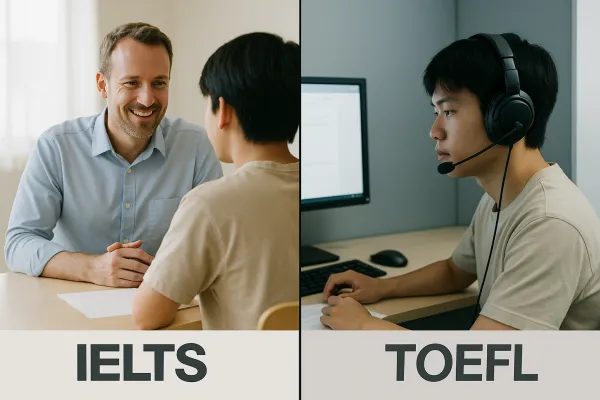
This is the most important section to help you get a real feel for the differences in the testing experience.
2.1. Listening Skills
- IELTS: You will experience a “symphony” of different English accents (British, American, Australian, Canadian, etc.). The test requires high multitasking ability because you must listen and answer questions simultaneously. The question types are diverse, ranging from gap-fills, multiple-choice, and matching information to the “tricky” map labeling, which requires you to navigate spatial information while listening to directions.
- TOEFL: This test checks your endurance and focus. You will listen to long conversations or academic lectures (3–5 minutes), primarily in North American accents. Only after the audio ends do you see and answer a series of related questions. This means note-taking skills are paramount. If you aren’t good at taking notes, you will find it nearly impossible to recall the details needed to answer.
- TOEIC: The TOEIC Listening section is the most closely aligned with real-world workplace scenarios. You will hear short announcements, brief office conversations, airport or restaurant interactions, etc. The questions are usually straightforward, asking for specific details without requiring complex inference.
Key takeaway: TOEFL Listening tests endurance, memory, and note-taking. IELTS Listening tests multitasking and adaptability to various accents. TOEIC Listening tests reflex speed in practical situations.
2.2. Reading Skills
- IELTS: Consists of 3 long passages taken from academic journals, books, and newspapers. The “difficulty” of IELTS Reading lies in the variety and complexity of the question types. You will face Matching Headings, Summary Completion, and especially the True/False/Not Given questions, which require a clear ability to distinguish between “false” information and information that is simply “not mentioned.”
- TOEFL: TOEFL passages are generally longer and more in-depth than IELTS, focusing on specific scientific topics (astronomy, biology, history, etc.). However, one advantage is that most questions are multiple-choice. The test also includes summary questions that require you to identify the main ideas of the passage.
- TOEIC: The TOEIC Reading section includes texts you encounter in daily work: emails, letters, internal announcements, advertisements, schedules, etc. Vocabulary is focused on business and commerce. The main challenge is the sheer volume of questions (100 questions) in a short time (75 minutes), requiring extreme reading speed and information processing.
Key takeaway: IELTS Reading tests your ability to handle various logical question types. TOEFL Reading tests deep comprehension and academic vocabulary. TOEIC Reading tests speed and the ability to skim workplace documents.
2.3. Writing Skills
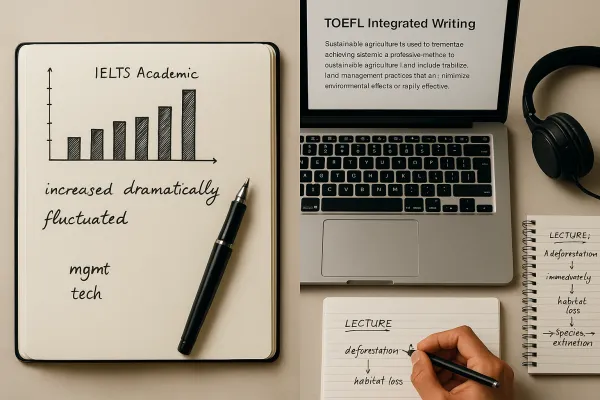
- IELTS: Consists of 2 parts. Task 1 of the Academic version is a unique challenge: you must analyze and describe a chart, table, map, or process. Task 2 is an academic essay. Visual data analysis is a signature element of IELTS.
- TOEFL: Also consists of 2 parts but requires a different mindset. Task 1 is an Integrated Task: you read a passage and listen to a lecture on the same topic (usually countering the passage), then write a summary comparing information from both sources. Task 2 is an independent essay, similar to IELTS. Information synthesis is the key to TOEFL Writing.
- TOEIC: The writing section is much simpler, often requiring you to write an email responding to a request or a short essay presenting your opinion on a workplace issue.
Key takeaway: IELTS Writing requires visual data analysis skills. TOEFL Writing requires listening-reading synthesis skills. TOEIC Writing focuses on practical workplace writing skills.
2.4. Speaking Skills
This is the biggest difference and is often the deciding factor for many candidates.
- IELTS: You will take the test face-to-face with a real human examiner. The test feels like a natural conversation, ranging from personal questions to presenting a topic and discussing it in depth. It assesses communication, interaction, and fluency in a real-world context.
- TOEFL: You will speak into a microphone and your answers will be recorded. You will answer personal questions and integrated tasks (e.g., reading a short passage, listening to a conversation, then summarizing and stating your opinion). It assesses your ability to organize ideas and present a structured short talk independently.
- TOEIC: Similar to TOEFL, you speak into a microphone to answer questions simulating workplace situations, such as reading an announcement, describing a picture, or responding to a voicemail.
Key takeaway: IELTS Speaking is an interview, testing communication skills. TOEFL Speaking is a short presentation, testing independent delivery. The choice between these two formats depends entirely on your personality and style.
Part 3: So, Which Certification is “Harder”?
After dissecting the experience of each skill for all three exams, you can now evaluate which test will be the biggest challenge for you.
TOEFL will be “harder” if you:
- Lack note-taking skills and struggle to focus for long periods: TOEFL’s long listening passages will be a nightmare.
- Are afraid of speaking alone to a computer: If you need the interaction, eye contact, and gestures of another person to keep a conversation natural, speaking into a mic will make you feel awkward.
- Are not good at synthesizing information: TOEFL’s integrated writing and speaking tasks require you to quickly link what you read and hear, which is a complex skill.
IELTS will be “harder” if you:
- Lose your composure when facing strangers: Sitting face-to-face with an examiner can cause more psychological pressure than speaking to a computer.
- Have difficulty listening to various accents: If you are only used to American English, the variety of accents in IELTS will be a major obstacle.
- Are weak in logical thinking and data analysis: Academic Writing Task 1 requires you to describe charts objectively, which is a very different skill from standard essay writing.
- Are easily “trapped” by complex questions: The True/False/Not Given question type in IELTS Reading is notoriously “tricky” and prone to causing confusion.
TOEIC is considered “easier” in terms of academic complexity, but it has its own “hard” aspects:
- Specialized vocabulary: If you don’t have a foundation in business, finance, or marketing vocabulary, you will struggle.
- Time pressure: Answering 200 questions in 2 hours requires extreme speed and endurance, leaving no time for deep reflection.
Part 4: Choosing Between IELTS, TOEFL, and TOEIC Based on Your Goals
Ultimately, choose the test that best serves your goals.
Goal: Study Abroad & Scholarships
- USA and Canada: TOEFL is still “king.” Most universities here prioritize or require TOEFL iBT. While more schools are accepting IELTS, they often require a very high score.
- UK, Australia, New Zealand, and Europe: IELTS Academic is the number one choice and is the most widely accepted.
Goal: University Graduation & Job Hunting in Vietnam
- TOEIC is the most economical and effective choice. Many domestic companies use TOEIC as an entry requirement or for salary and promotion reviews.
- IELTS is a major advantage if you are applying to multinational corporations or companies with a professional international work environment.
Goal: Immigration & Working Abroad
This is the “playing field” for IELTS. Immigration programs in countries like Canada, Australia, and New Zealand often require an IELTS certificate, which could be either Academic or General Training depending on your profession and government requirements.
Conclusion
There is no absolute answer to the question “Which is the hardest: IELTS, TOEFL, or TOEIC?”. A test might be a “mountain” for one person but just a “hill” for another. The smartest choice isn’t picking the “easiest” test, but the one that best fits your strengths, weaknesses, study style, and ultimate goals. ECE wishes you success on the path you have chosen!




 Khai giảng Khóa học Hè cực HOT.
No comments yet!