


Tóm Tắt Nội Dung Bài Viết
Hello everyone! Today, we’re going to “decode” an IELTS Speaking topic that, while familiar, can be quite tricky for many candidates: Pens and Pencils.
These simple everyday items can actually be a great source of inspiration for some interesting questions. Don’t worry—with guidance from Ms. Huong Thao, an 8.5 IELTS instructor at ECE Language Center, you’ll have all the ideas and “top-tier” vocabulary you need to answer any question with confidence. Let’s get started!
IELTS Speaking Part 1: Pens & Pencils
In Part 1, the examiner will ask short questions about your habits and personal opinions. Keep your answers natural and direct.
1. Which do you use more often? Pens or pencils?
Answer: Pens, definitely. As a student, I have to take notes on a daily basis, so pens have become my close companions every time I go to class.
2. When was the last time you bought a pen or pencil?
Answer: Last Monday, if I remember correctly. I was on my way to university for an exam when I suddenly realized I’d run out of ink. I just popped into a nearby bookstore to grab a new one.
3. What do you think if someone gives you a pen or pencil as a present?
Answer: I find it quite a meaningful gift, to be honest, as it conveys a sense of thoughtfulness. It’s something you need almost every day. For example, if you’re gifted a high-quality fountain pen, it becomes a memorable keepsake, doesn’t it?
IELTS Speaking Part 2: Describe a special pen or pencil
In Part 2, you’ll have one minute to prepare and two minutes to talk about a special pen or pencil. This is your chance to showcase your storytelling skills and descriptive vocabulary.
Describe a pen or pencil that is special to you. You should say:
- What it looks like
- Who gave it to you (or where you got it)
- How often you use it
- And explain why it is special to you
Sample Answer:
I’d like to talk about a fountain pen I received from my aunt when I graduated from high school and was about to start university.
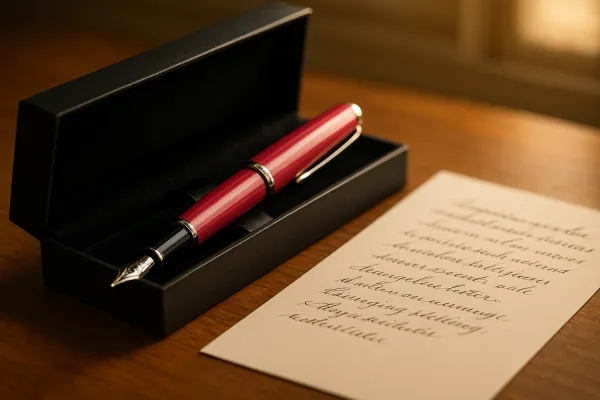
The moment I unboxed the present, I was blown away by how gorgeous it was. What captured my attention immediately was the sleek, glossy pink body—which was perfect because pink is my all-time favorite color. The pen came in a tiny, delicately wrapped box lined with black velvet. The nib itself is also a highlight; it’s shiny and slightly pointed, making this fountain pen a real treasure for me.
The more I value this pen, the less I dare to use it—even now, I must admit. Most of the time, I tend to use standard ballpoint pens to jot things down or sign documents. However, if a truly special occasion arises in the future, I’ll definitely consider taking it out.
No matter how simple this pen might seem to others, I have a strong sentimental attachment to it. First, it’s a gift from my beloved aunt, who has lived abroad for most of her life. Although she’s much older than me, we’re undoubtedly on the same wavelength. I’ve always considered her a trusted friend whom I can confide in. Also, the pen is evocative of how important family is to me. With the unwavering support of my family, nothing seems impossible.
💡 Key Vocabulary & Phrases:
- Be blown away: To be extremely impressed.
- Sleek, glossy: Elegant and shiny in appearance.
- Sentimental attachment: A deep emotional connection to an object.
- On the same wavelength: (Idiom) To think in the same way or get along very well.
- Confide in (someone): To share private matters or secrets with someone.
- Evocative of (something): Bringing strong images or memories to mind.
- Unwavering support: Steady, constant, and firm support.
IELTS Speaking Part 3: Pens, Pencils & Technology
Part 3 expands on the topic with more abstract, discussion-based questions that require logical analysis.
1. How has technology changed the way people write today?
Answer: Technology has tremendously transformed the way people write. It’s becoming increasingly common for people, especially the younger generation, to take notes, write, or even sign documents on screens using digital gadgets like smartphones or tablets. Although this is more convenient, it has slowly eroded our handwriting skills because we don’t practice as much as we used to.
💡 Useful Vocabulary:
- Tremendously: (Adv) To a great extent; significantly.
- To erode handwriting skills: To gradually weaken or diminish the ability to write by hand.
2. Why do some people prefer writing with a pen rather than typing on a computer?
Answer: One plausible explanation is individual preference. To be specific, the old-school crowd often feels more comfortable with pens because that’s what they grew up with. Another reason is the sense of authenticity that a handwritten note provides, whereas typing can feel a bit impersonal. Consequently, it may fail to convey the true personality of the writer.
💡 Useful Vocabulary:
- Plausible explanation: A reasonable or believable explanation.
- The old-school crowd: People who prefer traditional ways of doing things.
- A sense of authenticity: A feeling of being genuine or real.
- Impersonal: (Adj) Lacking human warmth or individual character.
Vocabulary Summary: “Pen and Pencil” Topic
To help you study, ECE has compiled all the useful vocabulary from this article:
- Stationery: Writing materials like paper and pens.
- Ballpoint pen: A pen with a small ball bearing at the tip.
- Fountain pen: A pen with a reservoir of liquid ink.
- Mechanical pencil: A pencil with a replaceable lead.
- Refill: A replacement ink cartridge or lead.
- Nib: The pointed metal part of a pen that touches the paper.
- Eraser: A rubber used to remove pencil marks.
- Ink smudge: A blurred mark caused by touching wet ink.
- Handwriting: The style of a person’s writing.
- Sketch / doodle: To draw quickly or absent-mindedly.
We hope this detailed guide gives you the tools you need to conquer the “Pens and Pencils” topic. Now it’s your turn—pick up a pen, practice with these questions, and good luck with your IELTS exam!





 Khai giảng Khóa học Hè cực HOT.
No comments yet!