


Tóm Tắt Nội Dung Bài Viết
You’ve surely used public transportation at least once, right? In IELTS Speaking Part 1, this is a very common topic. Don’t worry if you aren’t sure how to give an impressive answer. This article will share tips, high-scoring vocabulary, and sample answers to help you confidently “score big” with the examiner!
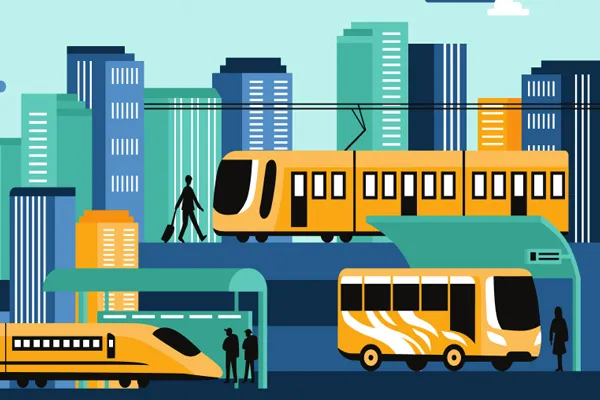
1. Introduction to the Public Transportation topic in IELTS Speaking Part 1
“Public Transportation” is a popular topic in IELTS Speaking Part 1. When you encounter this topic, you might be asked about:
– The types of public transport you use regularly.
– Your opinions on public transport.
– Your commuting experiences or habits.
*Common questions include:
- How often do you use public transportation?
- What kinds of public transport are available in your city?
- Do you think public transport is reliable in your country?
- Have you ever had a bad experience with public transport?
💡 Tips for a high band score:
- Answer naturally, expanding your response with reasons, examples, or comparisons.
- Use advanced vocabulary and a variety of sentence structures.
- Speak clearly with natural intonation.
2. Useful Vocabulary & Structures for Public Transportation
Advanced Vocabulary
- Modes of transport: subway, tram, commuter train, ferry, electric scooter…
- Advantages: cost-effective, environmentally friendly, alleviate traffic congestion, enhance connectivity…
- Disadvantages: overcrowded, unreliable, subject to delays, poorly maintained…
Advanced Structures
– “One of the biggest advantages of public transport is that…”
– “Had there been a more efficient transport system, fewer people would have relied on private vehicles.”
– “Not only does public transport reduce pollution, but it also helps to ease traffic congestion.”
3. IELTS Speaking Part 1 Sample Answers
Q1: How often do you use public transportation?
A: Well, I take public transport almost daily because it’s the most efficient way to get around the city. The metro is my go-to option since it’s both fast and cost-effective. Although it can be quite packed during rush hours, I still prefer it over driving as it saves me from the stress of traffic jams.
efficient (adj): productive and time-saving.
Example: “The metro is the most efficient way to get around the city.”
get around (v): to travel from place to place.
→ Example: “Public transport makes it easy to get around the city.”
go-to option (n): a preferred or primary choice.
→ Example: “Coffee is my go-to option when I need to stay awake.”
cost-effective (adj): economical; good value for money.
→ Example: “Taking the bus is more cost-effective than driving.”
packed (adj): very crowded.
→ Example: “The train was so packed that I couldn’t even find a seat.”
rush hours (n): peak travel times when traffic is heaviest.
→ Example: “Avoid traveling during rush hours if you don’t want to be stuck in traffic.”
Q2: What kinds of public transport are available in your city?
A: My city has a fairly well-developed public transport network, including buses, a metro system, and even electric scooters for short-distance travel. While the metro is the most convenient choice for long commutes, buses are more accessible for areas that are not covered by the subway.
well-developed (adj): advanced and comprehensive.
→ Example: “Japan has a well-developed railway system.”
short-distance travel (n): traveling over a small distance.
→ Example: “Bicycles are great for short-distance travel.”
long commutes (n): long journeys to work or school.
→ Example: “Many people dislike long commutes because they are time-consuming.”
accessible (adj): easy to reach or use.
→ Example: “The city center is accessible by bus and metro.”
Q3: Do you think public transport is reliable in your country?
A: It really depends on the city. In major metropolitan areas, the metro is quite reliable, operating on schedule most of the time. However, buses tend to be unpredictable due to heavy traffic and occasional delays. I think there’s still room for improvement in terms of efficiency and coverage.
major metropolitan areas (n): large cities.
→ Example: “Public transport is essential in major metropolitan areas.”
operate on schedule (v): to run according to a timetable.
→ Example: “The metro system is efficient, always operating on schedule.”
tend to (v): to be likely to do something.
→ Example: “Buses tend to be late during rush hours.”
unpredictable (adj): not able to be foreseen or known beforehand.
→ Example: “The weather in spring is quite unpredictable.”
room for improvement (n): potential for something to be made better.
→ Example: “The public transport system is good, but there’s still room for improvement.”
Related articles:
IELTS Speaking topic Entertainment
4. IELTS Speaking Part 2 Sample Answer
Describe a time when you used public transportation.
You should say:
- Where you went
- What type of transport you used
- How you felt about it
- And explain why you chose this form of transport
Sample:
One memorable experience I had with public transportation was during a trip to Ho Chi Minh City last year. Given the city’s notorious traffic congestion, I decided to take the newly launched metro instead of a taxi.
The moment I stepped onto the train, I was pleasantly surprised by how modern and well-maintained the system was. The train was spacious, air-conditioned, and ran incredibly smoothly. Unlike buses, which are often caught in traffic, the metro was extremely punctual, allowing me to reach my destination without any hassle.
What impressed me the most was how affordable the fare was compared to other means of transport. If I ever visit Ho Chi Minh City again, I wouldn’t hesitate to use the metro as my primary mode of travel.
notorious (adj): famous for something bad.
→ Example: “This street is notorious for its traffic jams.”
traffic congestion (n): heavy traffic.
→ Example: “Big cities often suffer from traffic congestion.”
pleasantly surprised (adj) : surprised in a positive way.
→ Example: “I was pleasantly surprised by the excellent service at the hotel.”
well-maintained (adj) : kept in good condition.
→ Example: “The hotel is clean and well-maintained.”
spacious (adj): having plenty of room.
→ Example: “The restaurant is spacious and comfortable.”
punctual (adj): on time.
→ Example: “The train system in Japan is famous for being punctual.”
affordable (adj): reasonably priced.
→ Example: “The bus offers an affordable fare for daily commuters.”
5. IELTS Speaking Part 3 Sample Answers
Q1: How could public transportation be improved in your country?
A: I believe the government should prioritize expanding metro networks in major cities, as they are the most efficient way to combat traffic congestion. Additionally, public buses should be upgraded with better seating and air-conditioning to enhance passenger comfort. Investing in technology, such as real-time tracking systems, would also make public transport more reliable.
passenger comfort (n): the level of comfort for travelers.
→ Example: “Reclining seats improve passenger comfort on long-distance buses.”
real-time tracking systems (n): systems that show the current location of vehicles.
→ Example: “Real-time tracking systems help passengers know the exact arrival time of buses.”
Q2: Do you think public transportation will become more popular in the future?
A: Absolutely! With rising fuel costs and increasing concerns about environmental sustainability, more people will likely shift towards public transport. Governments worldwide are also investing heavily in green transportation, such as electric buses and high-speed rail, making it a more attractive option for daily commuting.
environmental sustainability (n): the ability to maintain ecological balance.
→ Example: “Using renewable energy sources promotes environmental sustainability.”
green transportation (n): eco-friendly transport.
→ Example: “Green transportation options, like bicycles and electric buses, are gaining popularity.”
Q3: Should governments invest more in public transport or road infrastructure?
A: While both are essential, I strongly believe public transport should be the priority. Expanding roads might provide temporary relief from congestion, but in the long run, it encourages more private vehicle use, which worsens pollution and traffic. A well-developed public transport system, on the other hand, promotes sustainable urban mobility and significantly reduces carbon emissions.
temporary relief (n): short-term help.
→ Example: “Painkillers provide temporary relief from headaches.”
in the long run: over a long period of time.
→ Example: “In the long run, investing in education will benefit the economy.”
sustainable urban mobility (n): eco-friendly city travel.
→ Example: “Sustainable urban mobility reduces traffic congestion and pollution.”
carbon emissions (n): greenhouse gases released into the atmosphere.
→ Example: “Factories and cars are major sources of carbon emissions.”
With the knowledge and strategies in this article, you can definitely score high in the IELTS Speaking Part 1 section on Public Transportation. Don’t forget to prepare thoroughly, stay relaxed, and show off your best skills. Good luck!





 Khai giảng Khóa học Hè cực HOT.
No comments yet!