


Tóm Tắt Nội Dung Bài Viết
In the IELTS Speaking test, topics related to “Places” and “Changes” are perennial favorites. In particular, the prompt: “Describe a recent development in the area where you live” is appearing with increasing frequency.
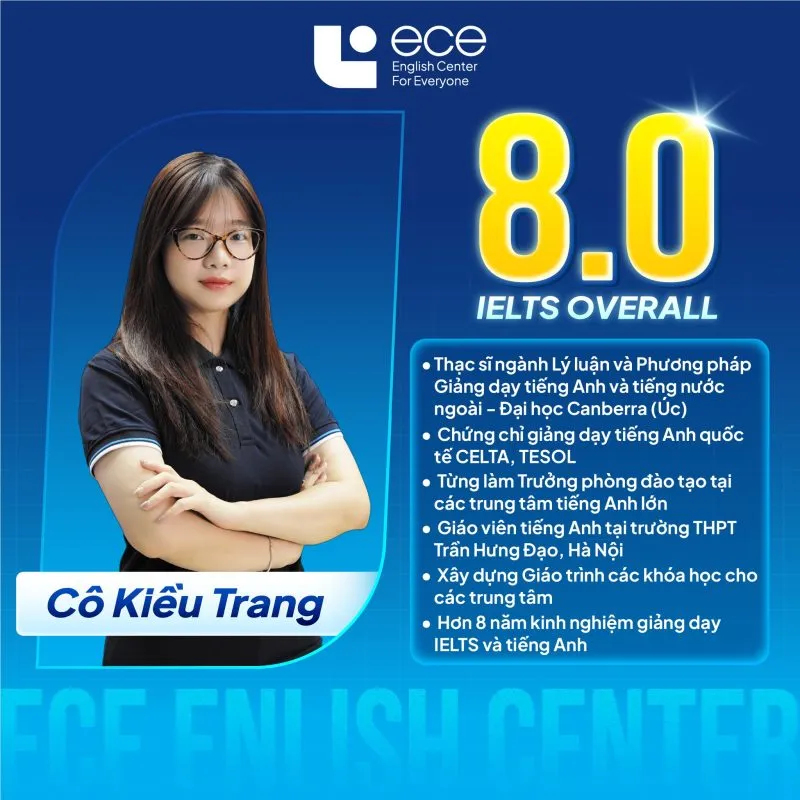
This topic requires more than just describing a construction project; it demands the ability to compare the past with the present and evaluate the impact of the change on the community. Today, Ms. Kieu Trang will share a set of high-level vocabulary and a Band 8.0 sample answer to help you conquer this topic!
High-scoring Vocabulary & Structures for “Urban Development”
To discuss urban development effectively, you need specialized vocabulary rather than simple descriptive terms.
- Topic Vocabulary
Nouns for changes & construction:
- Recent development: A recent change or project.
- Urban transformation / Urban renewal: The process of improving or modernizing an urban area.
- Infrastructure upgrade: Improvements to public systems (roads, bridges, etc.).
- Residential complex / Housing project: A group of residential buildings.
- Recreational facilities: Places for leisure and sports.
- Commercial hub / Shopping complex: A center for business and retail.
- Green spaces / Public parks: Areas with vegetation for public use.
- Construction boom: A period of rapid building activity.
Impact-related terms:
- Revitalize the neighborhood: To bring new life to an area.
- Improve quality of life: To enhance living standards.
- Reduce traffic congestion: To ease traffic jams.
- Environmentally friendly / Sustainable development: Growth that respects the environment.
- Noise & air pollution: Environmental degradation.
- Cost of living skyrockets: A sharp increase in living expenses.
- Useful Structures
Using these structures will make your speech more coherent and natural:
- Comparing time:
- In the past… but now…
- Compared to a few years ago…
- Describing impacts:
- This development has brought a lot of benefits such as…
- However, it also causes several drawbacks including…
- Personal opinion:
- Personally, I think this is a step forward because…
- To some extent, I agree that…
- Natural starters:
- Well, one major change in my neighborhood recently is…
- Speaking of recent developments, the first thing that comes to my mind is…
IELTS Speaking Part 2 Sample Answer: Describe a recent development
Prompt: Describe a recent development in the area where you live. You should say:
- what the development is
- where it is
- when it happened
- and explain how it has affected the area.
Sample Answer:
I’d like to talk about a recent development in my neighbourhood, which is the construction of a new public park combined with a small community sports complex. This project is located right in the centre of the residential area where I live, on a piece of land that used to be an abandoned construction site.
The development started about a year ago and was completed just a few months back. At first, many local residents were quite sceptical because the construction caused a lot of noise and traffic disruption. However, once the project was finished, it completely transformed the area. The park now features green walking paths, children’s playgrounds, outdoor gym equipment, and even a small football pitch that is open to the public.
In terms of its impact, I would say the development has brought about mostly positive changes. Firstly, it has significantly improved the quality of life for local residents. People now have a safe and convenient place to exercise, relax, or spend time with their families, instead of having to travel far to find recreational facilities. Secondly, the park has helped strengthen the sense of community, as neighbours often meet and interact during evening walks or weekend activities.
Overall, although the construction phase was somewhat inconvenient, this recent development has made the neighbourhood more liveable and visually appealing, and I believe it will continue to benefit the area in the long run.
IELTS Speaking Part 3: Urban Development & Community
In Part 3, the examiner will probe deeper into urban planning and social impacts. Here are Ms. Kieu Trang’s sample responses:
1. How does urban development affect people’s lives?
Urban development can have a profound impact on people’s daily lives, both positively and negatively. On the positive side, well-planned development can improve living standards by providing better infrastructure, public services, and job opportunities. For example, new roads, parks, or public transport systems can make commuting more convenient and reduce stress. However, rapid or poorly managed urban development may lead to problems such as overcrowding, traffic congestion, and rising living costs, which can place pressure on local residents, especially those with lower incomes.
2. Why do governments invest heavily in urban development projects?
Governments invest heavily in urban development mainly to support economic growth and improve citizens’ quality of life. Modern infrastructure attracts businesses, tourists, and investors, which can create employment and increase tax revenue. In addition, urban development projects are often designed to address long-term social issues, such as housing shortages or environmental sustainability. By upgrading cities, governments aim to make urban areas more competitive, liveable, and resilient in the future.
3. What are the disadvantages of rapid urban development?
One major disadvantage of rapid urban development is the strain it places on existing infrastructure and public services. When cities expand too quickly, facilities such as hospitals, schools, and transport systems may not keep pace with population growth. Another drawback is the loss of green spaces, which can negatively affect both the environment and residents’ mental health. Furthermore, rapid development can widen social inequality, as property prices often rise, making housing unaffordable for many people.
4. How can urban development influence community relationships?
Urban development can significantly influence how people interact within a community. On the one hand, developments like public parks, community centres, or pedestrian-friendly streets can encourage social interaction and strengthen neighbourhood bonds. On the other hand, large-scale projects may disrupt established communities, forcing residents to relocate and weakening social ties. Therefore, whether urban development benefits community relationships largely depends on how carefully it is planned and implemented.
5. Do you think preserving old buildings is important when cities develop?
Yes, I believe preserving old buildings is extremely important during urban development. Historic buildings reflect a city’s cultural identity and help maintain a sense of continuity between the past and the present. While modern architecture is necessary, replacing all old structures with new ones can make cities feel impersonal. A balanced approach, where historical buildings are preserved and integrated into modern urban planning, can create cities that are both functional and culturally meaningful.
6. How can cities develop in a more sustainable way in the future?
Cities can develop more sustainably by prioritising long-term environmental and social impacts over short-term economic gains. This includes investing in public transport, renewable energy, and green spaces to reduce pollution and improve living conditions. In addition, governments should involve local communities in planning decisions to ensure developments meet residents’ real needs. By adopting sustainable urban planning strategies, cities can grow while remaining healthy and liveable for future generations.
Advice from Ms. Kieu Trang
The “Urban Development” topic requires critical thinking. When answering Part 3, don’t just focus on the benefits (high-rises, modern roads); mention the downsides as well (pollution, rising housing costs). Using vocabulary like “sustainable development” or “infrastructure upgrade” flexibly will help you score highly in Lexical Resource. Wishing you effective study sessions with ECE!





 Khai giảng Khóa học Hè cực HOT.
No comments yet!