


Tóm Tắt Nội Dung Bài Viết
The Sentence Completion task is one of the most common question types in the IELTS Reading section, often considered a “breather” by many test-takers. However, don’t let your guard down! To truly secure a high score and avoid unnecessary pitfalls, you need to equip yourself with an effective strategy and sharp analytical skills.
In this article, the ECE language center will dive deep into every aspect of the Sentence Completion task—from how to identify it and step-by-step execution to common mistakes and advanced tips to help you conquer it with confidence.
1. Overview of the Sentence Completion Task in IELTS Reading
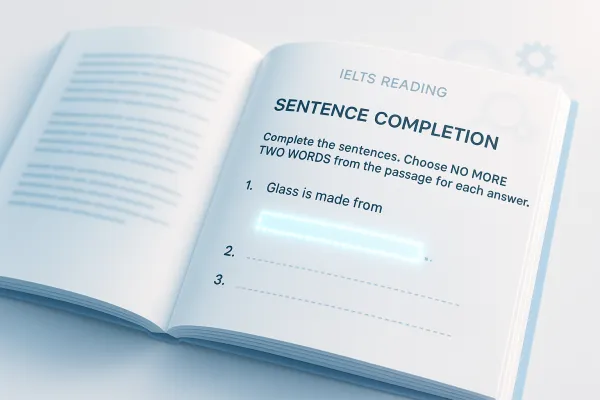
Sentence Completion requires you to fill in the blanks with appropriate words or phrases to complete a sentence or a summary, based on information provided in the reading passage. The primary goal of this task is to test your ability to locate information, understand specific details, and recognize paraphrasing within the text.
Key Features:
- Number of questions: Usually 3 to 6 questions per passage.
- Order of information: A golden rule of IELTS Reading is that the answers to the questions will always appear in the same order as the information in the passage. This is incredibly helpful for locating your answers.
- Word limits: The instructions will always specify the number of words you are allowed to use. This is the most important rule to follow; failing to do so will cost you points, even if your answer is factually correct. Common requirements include:
- ONE WORD ONLY: Use only one word.
- NO MORE THAN TWO WORDS: Use a maximum of two words (one or two words).
- NO MORE THAN THREE WORDS: Use a maximum of three words (one, two, or three words).
- ONE WORD AND/OR A NUMBER: Use one word and/or a number.
- Note: Hyphenated words (e.g., time-saving, well-known) count as a single word.
2. A 5-Step Strategy to Ace Sentence Completion
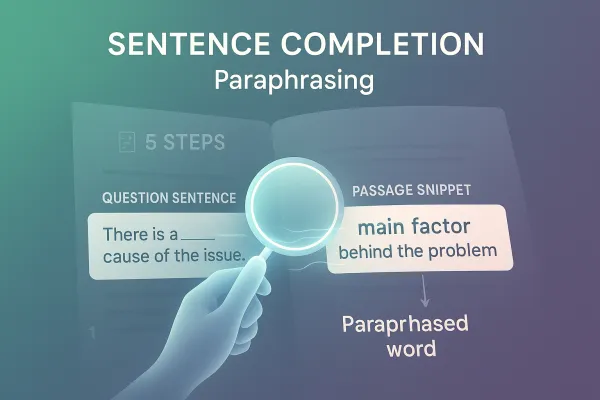
To excel at this task, apply the following 5-step strategy:
Step 1: Read instructions carefully & note the word limit
Before looking at the questions, always read the instructions thoroughly, especially the bolded text regarding word counts.
Example: If the instructions say “NO MORE THAN TWO WORDS,” understand that your answer must be either 1 or 2 words. If you write 3 or more, the answer will not be marked.
Knowing the word limit helps you immediately filter out unnecessary words or overly long phrases when searching for the answer.
Step 2: Analyze the question and predict the information
This is a crucial step to guide your search.
- Underline Keywords:
Fixed keywords: These are words that are difficult to paraphrase, such as proper nouns (e.g., Hiram Bingham), locations (Urubamba valley, Machu Picchu), figures (1911, 200,000), or technical terms (trichloroanisole). Use these for quick scanning in the passage.
Flexible keywords: These are words that the author might replace with synonyms or different structures, including verbs, nouns, adjectives, adverbs, and common phrases.
Example: Instead of “advantages,” the passage might use “benefits” or “positive aspects.” Instead of “created,” it might use “developed” or “established.”
- Predict the word type: Based on the grammatical structure of the question, predict the type of word needed (noun, verb, adjective, adverb).
Example: “The track that took Bingham down the Urubamba valley had been created for the transportation of __________.”
“of” is a preposition, and nouns typically follow prepositions.
The question asks for the “transportation of (something),” so the blank requires a noun referring to the object or material being transported.
Predicting the word type helps narrow your search and allows you to double-check the grammar after filling in the blank.
- Predict Meaning/Context: Read the question and try to visualize the content or topic the blank refers to. This helps you better understand the context when you locate the information in the passage.
Step 3: Locate information in the passage
Using your underlined keywords and predictions, start searching the passage.
- Skimming: Quickly read the title, and the first and last sentences of each paragraph to grasp the main idea and structure. This helps identify which paragraph likely contains the answer.
- Scanning: Use fixed keywords (proper nouns, numbers, etc.) to scan the entire passage and pinpoint the paragraph containing the relevant information.
- Utilize the “Sequential Order” rule: Remember that the answer to question 1 will appear before the answer to question 2, and so on. This saves you from re-reading the entire passage for every question. Once you find the answer to one question, simply continue reading from that point to find the next.
Step 4: Recognize Paraphrasing & analyze sentence structure
This is the step that determines your success. Information in the passage is rarely copied verbatim into the question.
- Recognize Paraphrasing:
-
- Synonyms/Antonyms: “spoil” might be paraphrased as “affect negatively”; “created” as “blasted down.”
- Word form changes: A noun in the question might be a verb in the passage and vice versa (e.g., “transportation” (N) in the question might be “to be brought up” (V) in the passage).
- Sentence structure changes: Active voice to passive voice, simple sentences to complex ones.
- Explanations/Definitions: Instead of using a direct word, the passage might explain the meaning of that word.
- Generalization/Specification: A general concept in the question might be specified in the passage, or vice versa.
- Analyze sentence structure: Compare the structure of the question with the structure of the passage where you located the information.
- Illustrative example:
- Question: The track that took Bingham down the Urubamba valley had been created for the transportation of __________.
- Passage: “…a track had recently been blasted down the valley canyon to enable rubber to be brought up by mules from the jungle.”
- Analysis:
- “had been created for the transportation of” (question)
- “had been blasted down to enable … to be brought up by mules” (passage)
- Notice that “transportation of” is paraphrased as “to be brought up by mules.”
- Therefore, the word to fill in is the noun representing the material being transported: rubber.
- Watch for linking words/discourse markers: Words like but, however, although, despite, therefore, as a result, in contrast, on the other hand signal shifts in meaning or relationships between ideas. These can be key to identifying the correct information or avoiding traps.
- Illustrative example:
Step 5: Review your answers and finalize
After filling in your answers, perform a final check to ensure absolute accuracy.
- Check Word Limit: Ensure the number of words you used matches the instructions perfectly.
- Check Grammar: Read the complete sentence. Does your answer make the sentence grammatically correct? (e.g., singular/plural nouns, verb tenses, adjective/adverb forms).
- Check Spelling: Correct spelling is mandatory. A minor typo can cost you the point.
- Check Overall Meaning: Ensure the completed sentence is logical and matches the content of the passage. Sometimes, you might find a word that fits grammatically and meets the word count, but doesn’t fit the context.
3. Common Mistakes in Sentence Completion
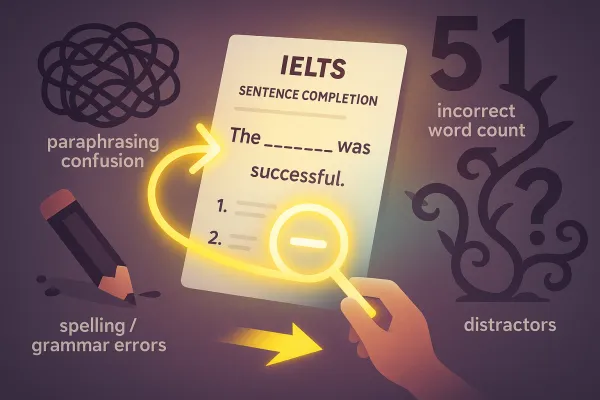
Test-takers often make the following mistakes:
- Ignoring word limits: This is the most common and easily avoidable mistake. Always double-check the word count.
- Spelling or grammar errors: Even if you find the right word, incorrect spelling or word form (e.g., motivation instead of motivate, children instead of child) will cost you points.
- Failing to recognize paraphrasing: This is the primary reason students fail to find the answer or choose the wrong one. Practice this skill regularly.
- Falling for “distractors”: Passages often contain words or phrases that seem relevant but are not the correct answer. These are traps set by the examiners. Always compare the question and passage carefully, relying on context and sentence structure to choose the best fit.
Example: The question might ask about “causes,” but the passage lists both “causes” and “effects.” You must select the correct piece of information being asked for.
- Using too many words when only one is allowed: Try to find the most “precise” word; don’t try to include a long phrase if the instructions limit you to one word.
- Fixating on one question: If you spend too much time on one question without finding the answer, skip it and move on. Come back later if you have time.
4. Tips for Success
- Practice Skimming & Scanning consistently: Reading speed and the ability to locate information quickly are key.
- Build your vocabulary, especially synonyms/antonyms: This is the foundation for recognizing paraphrasing. Read English newspapers and magazines, and keep a record of synonyms by topic.
- Practice sentence structure analysis: Try to clearly understand “who does what” and “what happens” in every complex sentence. This helps you grasp the core meaning.
- Manage your time: Spend about 1–1.5 minutes per question. If you haven’t found the answer after 2 minutes, move on.
- Practice with various types of exercises: The more Sentence Completion exercises you do, the more familiar you will become with different types of paraphrasing and common test traps.
In conclusion, the Sentence Completion task in IELTS Reading is a great opportunity to score points if you approach it strategically. By applying the 5-step process suggested by ECE, continuously improving your vocabulary, and honing your paraphrasing recognition skills, you will feel much more confident and achieve your target score in the Reading section.





 Khai giảng Khóa học Hè cực HOT.
No comments yet!