


Tóm Tắt Nội Dung Bài Viết
“Urban farming” is an increasingly popular social topic and a frequent subject in IELTS Reading. The “Urban Farming” passage from Cambridge 18, Test 1, Passage 1 is a prime example, offering an intriguing look at a rooftop farm in Paris.
This article from the ECE language center provides the reading passage, vocabulary analysis, and, most importantly, detailed explanations for every question, helping you gain a deep understanding and conquer this reading passage with confidence.
Reading Passage
Urban farming
In Paris, urban farmers are trying a soil-free approach to agriculture that uses less space and fewer resources. Could it help cities face the threats to our food supplies?
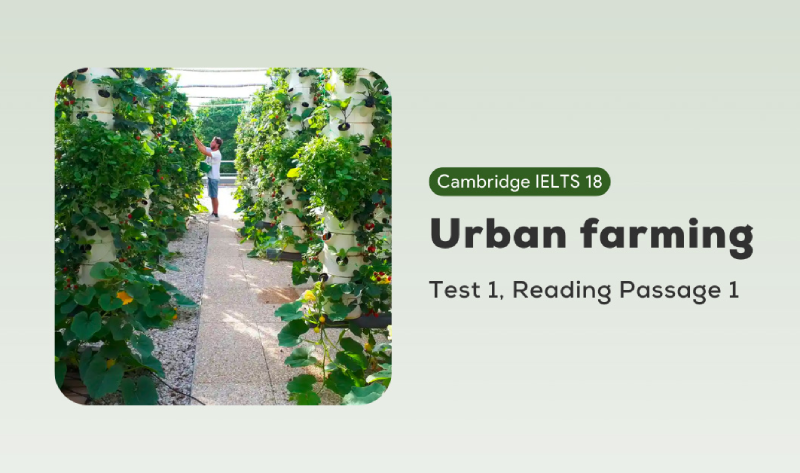
On top of a striking new exhibition hall in southern Paris, the world’s largest urban rooftop farm has started to bear fruit. Strawberries that are small, intensely flavoured and resplendently red sprout abundantly from large plastic tubes. Peer inside and you see the tubes are completely hollow, the roots of dozens of strawberry plants dangling down inside them. From identical vertical tubes nearby burst row upon row of lettuces; near those are aromatic herbs, such as basil, sage and peppermint. Opposite, in narrow, horizontal trays packed not with soil but with coconut fibre, grow cherry tomatoes, shiny aubergines and brightly coloured chards.
Pascal Hardy, an engineer and sustainable development consultant, began experimenting with vertical farming and aeroponic growing towers – as the soil-free plastic tubes are known – on his Paris apartment block roof five years ago. The urban rooftop space above the exhibition hall is somewhat bigger: 14,000 square metres and almost exactly the size of a couple of football pitches. Already, the team of young urban farmers who tend it have picked, in one day, 3,000 lettuces and 150 punnets of strawberries. When the remaining two thirds of the vast open area are in production, 20 staff will harvest up to 1,000 kg of perhaps 35 different varieties of fruit and vegetables, every day. ‘We’re not ever, obviously, going to feed the whole city this way,’ cautions Hardy. ‘In the urban environment you’re working with very significant practical constraints, clearly, on what you can do and where. But if enough unused space can be developed like this, there’s no reason why you shouldn’t eventually target maybe between 5% and 10% of consumption.’
Perhaps most significantly, however, this is a real-life showcase for the work of Hardy’s flourishing urban agriculture consultancy, Agripolis, which is currently fielding enquiries from around the world to design, build and equip a new breed of soil-free inner-city farm. ‘The method’s advantages are many,’ he says. ‘First, I don’t much like the fact that most of the fruit and vegetables we eat have been treated with something like 17 different pesticides, or that the intensive farming techniques that produced them are such huge generators of greenhouse gases. I don’t much like the fact, either, that they’ve travelled an average of 2,000 refrigerated kilometres to my plate, that their quality is so poor, because the varieties are selected for their capacity to withstand such substantial journeys, or that 80% of the price I pay goes to wholesalers and transport companies, not the producers.’
Produce grown using this soil-free method, on the other hand – which relies solely on a small quantity of water, enriched with organic nutrients, pumped around a closed circuit of pipes, towers and trays – is ‘produced up here, and sold locally, just down there. It barely travels at all,’ Hardy says. ‘You can select crop varieties for their flavour, not their resistance to the transport and storage chain, and you can pick them when they’re really at their best, and not before.’ No soil is exhausted, and the water that gently showers the plants’ roots every 12 minutes is recycled, so the method uses 90% less water than a classic intensive farm for the same yield.
Urban farming is not, of course, a new phenomenon. Inner-city agriculture is booming from Shanghai to Detroit and Tokyo to Bangkok. Strawberries are being grown in disused shipping containers, mushrooms in underground carparks. Aeroponic farming, he says, is ‘virtuous’. The equipment weighs little, can be installed on almost any flat surface and is cheap to buy: roughly €100 to €150 per square metre. It is cheap to run, too, consuming a tiny fraction of the electricity used by some techniques.
Produce grown this way typically sells at prices that, while generally higher than those of classic intensive agriculture, are lower than soil-based organic growers. There are limits to what farmers can grow this way, of course, and much of the produce is suited to the summer months. ‘Root vegetables we cannot do, at least not yet,’ he says. ‘Radishes are OK, but carrots, potatoes, that kind of thing – the roots are simply too long. Fruit trees are obviously not an option. And beans tend to take up a lot of space for not much return.’ Nevertheless, urban farming of the kind being practised in Paris is one part of a bigger and fast-changing picture that is bringing food production closer to our lives.
Questions 1-3:
Complete the sentences below.
Choose NO MORE THAN TWO WORDS ANDIOR A NUMBER from the passage for each answer.
Write your answers in boxes 1-3 on your answer sheet.
Urban farming in Paris
- Vertical tubes are used to grow strawberries, ………………… and herbs.
- There will eventually be a daily harvest of as much as …………………… in weight of fruit and vegetables.
- It may be possible that the farm’s produce will account for as much as 10% of the city’s …………………… overall.
Questions 4 – 7:
Complete the table below.
Choose ONE WORD ONLY from the passage for each answer.
Write your answers in boxes 4-7 on your answer sheet.
Intensive farming versus aeroponic urban farming
| Intensive farming | Aeroponic urban farming | |
| Growth | – wide range of 4…………… used
– techniques pollute air |
– no soil used
– nutrients added to water, which is recycled |
| Selection | – quality not good
– varieties of fruit and vegetables chosen that can survive long 5…………… |
produce chosen because of its 7…………… |
| Sale | 6…………… receive very little of overall income |
Questions 8 – 13:
Do the following statements agree with the information given in Reading Passage 1? Write:
- TRUE if the statement agrees with the information
- FALSE if the statement contradicts the information
- NOT GIVEN if there is no information on this
8. Urban farming can take place above or below ground.
9. Some of the equipment used in aeroponic farming can be made by hand.
10. Urban farming relies more on electricity than some other types of farming.
11. Fruit and vegetables grown on an aeroponic urban farm are cheaper than traditionally grown organic produce.
12. Most produce can be grown on an aeroponic urban farm at any time of the year.
13. Beans take longer to grow on an urban farm than other vegetables.
Summary of the Reading Passage: Urban farming
The passage describes the world’s largest urban farming project on a rooftop in Paris, utilizing a soil-free cultivation method (aeroponics).
- Project Introduction: The farm grows strawberries, lettuces, and herbs in vertical plastic tubes, and other produce in trays containing coconut fibre.
- Founder & Scale: Pascal Hardy, the founder, estimates that upon completion, the farm could harvest up to 1,000 kg of produce daily and has the potential to supply 5–10% of the city’s consumption.
- Drawbacks of Traditional Agriculture: Hardy criticizes intensive farming for its heavy use of pesticides, generation of greenhouse gases, and the high cost of transporting produce over thousands of kilometers, which lowers quality and prevents profits from reaching the farmers.
- Advantages of Aeroponics: This method saves 90% of water, produce is sold locally, and it allows for crop selection based on flavor rather than durability.
- General Context: Urban farming is booming in many cities, with diverse forms (growing in containers, underground parking lots). Aeroponic equipment is cheap, lightweight, and consumes very little electricity.
- Pricing & Limitations: Products are priced higher than those from intensive agriculture but cheaper than soil-based organic produce. Limitations include the inability to grow root vegetables (like carrots, potatoes) and fruit trees.
Key Vocabulary from the Passage
- resplendently (adv): in a way that is attractive and impressive.
- Example: “Strawberries that are… resplendently red…”
- sustainable development (n.p): economic development that is conducted without depletion of natural resources.
- aeroponic (adj): relating to the process of growing plants in an air or mist environment without the use of soil.
- practical constraints (n.p): real-world limitations or restrictions.
- Example: “…you’re working with very significant practical constraints…”
- flourishing (adj): growing or developing in a healthy or vigorous way.
- Example: “…Hardy’s flourishing urban agriculture consultancy…”
- intensive farming (n.p): a type of agriculture, both of crop plants and of animals, with higher levels of input and output per unit of agricultural land area.
- greenhouse gases (n.p): gases that contribute to the greenhouse effect by absorbing infrared radiation.
- withstand (v): remain undamaged or unaffected by; resist.
- Example: “…capacity to withstand such substantial journeys…”
- yield (n): the amount of an agricultural product produced.
- Example: “…for the same yield.”
- disused (adj): no longer being used.
- Example: “…grown in disused shipping containers…”
- a tiny fraction of (phrase): a very small part or proportion of something.
- Example: “…consuming a tiny fraction of the electricity…”
Answer Key and Detailed Explanations
1. Answer: lettuces
- Location: Paragraph 1
- Evidence: “From identical vertical tubes nearby burst row upon row of lettuces; near those are aromatic herbs…”
- Explanation: The question lists the types of plants grown in vertical tubes: “strawberries, … and herbs.” The text lists three: strawberries (in the previous sentence), “lettuces,” and “herbs.” The missing word is “lettuces.”
2. Answer: 1,000 kg
- Location: Paragraph 2
- Evidence: “…20 staff will harvest up to 1,000 kg of perhaps 35 different varieties of fruit and vegetables, every day.”
- Explanation: The question asks for the daily harvest weight. “As much as” is a synonym for “up to.”
3. Answer: (food) consumption
- Location: Paragraph 2
- Evidence: “…there’s no reason why you shouldn’t eventually target maybe between 5% and 10% of consumption.’”
- Explanation: The farm could account for “as much as 10%” of the city’s “consumption.” Although the text doesn’t explicitly say “food consumption,” in this context, “consumption” refers to food consumption.
4. Answer: pesticides
- Location: Paragraph 3
- Evidence: “…most of the fruit and vegetables we eat have been treated with something like 17 different pesticides, or that the intensive farming techniques…”
- Explanation: The table compares “Intensive farming.” The question asks for a “wide range of … used.” The text mentions “17 different pesticides” are used.
5. Answer: journeys
- Location: Paragraph 3
- Evidence: “…the varieties are selected for their capacity to withstand such substantial journeys…”
- Explanation: The table discusses selection. The question asks for “survive long…” The text states varieties are chosen to “withstand” (survive) “substantial journeys” (long journeys).
6. Answer: producers
- Location: Paragraph 3
- Evidence: “…or that 80% of the price I pay goes to wholesalers and transport companies, not the producers.”
- Explanation: The table discusses sales. The question asks who “…receive very little … income.” The text says 80% of the price does not go to the “producers.”
7. Answer: flavour / flavor
- Location: Paragraph 4
- Evidence: “You can select crop varieties for their flavour, not their resistance to the transport…”
- Explanation: The table asks about the selection criteria for “Aeroponic urban farming.” The text states crops are selected for their “flavour.”
8. TRUE
- Question: Urban farming can take place above or below ground.
- Evidence (Paragraph 5): “Strawberries are being grown in disused shipping containers, mushrooms in underground carparks.”
- Explanation: The text describes the Paris farm on a “rooftop” (above ground) and mentions mushrooms in “underground carparks” (below ground). Thus, the statement is TRUE.
9. NOT GIVEN
- Question: Some of the equipment used in aeroponic farming can be made by hand.
- Evidence (Paragraph 5): “The equipment weighs little… and is cheap to buy…”
- Explanation: The text only says the equipment is “cheap to buy,” but provides no information about whether it can be “made by hand.”
10. FALSE
- Question: Urban farming relies more on electricity than some other types of farming.
- Evidence (Paragraph 5): “It is cheap to run, too, consuming a tiny fraction of the electricity used by some techniques.”
- Explanation: “A tiny fraction” means it consumes much less electricity. This contradicts the idea that it “relies more on electricity.”
11. TRUE
- Question: Fruit and vegetables grown on an aeroponic urban farm are cheaper than traditionally grown organic produce.
- Evidence (Paragraph 6): “Produce grown this way typically sells at prices that… are lower than soil-based organic growers.”
- Explanation: The text explicitly states the prices are “lower than” soil-based organic growers. This matches.
12. FALSE
- Question: Most produce can be grown on an aeroponic urban farm at any time of the year.
- Evidence (Paragraph 6): “…and much of the produce is suited to the summer months.”
- Explanation: The fact that produce is “suited to the summer months” contradicts the idea that it can be grown “at any time of the year.”
13. NOT GIVEN
- Question: Beans take longer to grow on an urban farm than other vegetables.
- Evidence (Paragraph 6): “And beans tend to take up a lot of space for not much return.”
- Explanation: The text compares beans in terms of “space” and “return” (yield), but provides no information regarding “time” (longer to grow).
Conclusion
The “Urban Farming” passage is an excellent example for Passage 1, combining Completion and TRUE/FALSE/NOT GIVEN question types. The passage provides deep insight into a modern technological solution for food security while testing the candidate’s ability to read for detail and compare information. We hope this detailed analysis from ECE has helped you master the techniques and gain useful knowledge. Good luck with your studies!





 Khai giảng Khóa học Hè cực HOT.
No comments yet!