


Tóm Tắt Nội Dung Bài Viết
Roman Britain is shrouded in countless mysteries, and Fishbourne Roman Palace stands as one of its most magnificent and enigmatic legacies. This IELTS Reading passage takes us on an archaeological journey, exploring the history, construction, and theories surrounding the owner of the largest Roman palace ever discovered north of the Alps.
This article from ECE will help you “decode” each paragraph, providing vocabulary, content summaries, and detailed explanations for every answer to help you conquer this historical topic.
Reading Passage
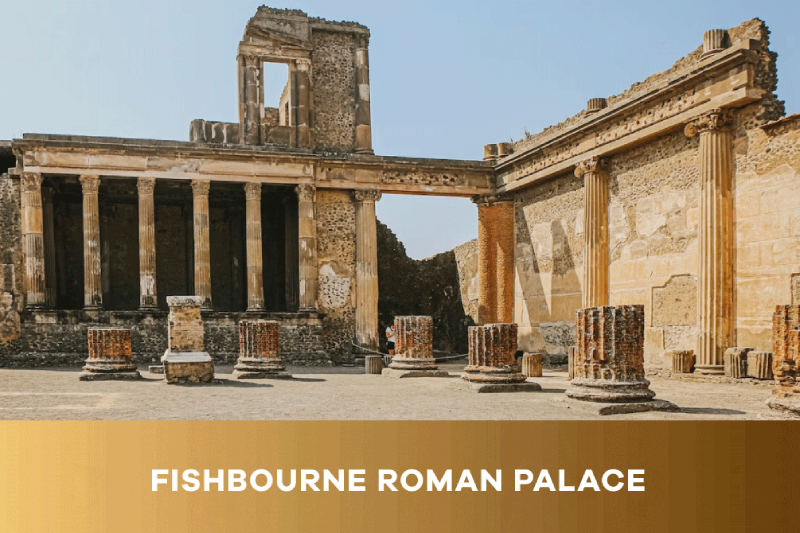
A Fishbourne Roman Palace is in the village of Fishbourne in West Sussex, England. This large palace was built in the 1st century AD, around thirty years after the Roman conquest of Britain, on the site of Roman army grain stores which had been established after the invasion, during the reign of the Roman Emperor Claudius in 43 AD. The rectangular palace was built around formal gardens, the northern half of which has been reconstructed. There were extensive alterations in the 2nd and 3rd centuries AD, with many of the original black and white mosaic floors being overlaid with more sophisticated colored ones, including a perfectly preserved mosaic of a dolphin in the north wing. More alterations were in progress when the palace burned down around 270 AD, after which it was abandoned.
B Local people had long believed that a Roman palace once existed in the area. However, it was not until 1960 that the archaeologist Barry Cunliffe, of Oxford University, first systematically excavated the site, after workmen accidentally uncovered a wall while laying a water main. The Roman villa excavated by Cunliffe’s team was so grand that it became known as Fishbourne Roman Palace, and a museum was erected to preserve some of the remains. This is administered by the Sussex Archaeological Society.
C In its day, the completed palace would have comprised four large wings with colonnaded fronts. The north and east wings consisted of suites of private rooms built around courtyards, with a monumental entrance in the middle of the east wing. In the north-east corner, there was an assembly hall. The west wing contained state rooms, a large ceremonial reception room, and a gallery. The south wing contained the owner’s private apartments. The palace included as many as 50 mosaic floors, under-floor central heating, and a bathhouse. In size, Fishbourne Palace would have been approximately equivalent to some of the great Roman palaces of Italy and was by far the largest known Roman residence north of the European Alps, measuring about 500 feet (150 m) square. A team of volunteers and professional archaeologists are involved in ongoing archaeological excavation on the site of nearby, possibly military, buildings.
D The first buildings to be erected on the site were constructed in the early part of the conquest in 43 AD. Later, two timber buildings were constructed, one with clay and mortar floors and plaster walls, which appears to have been a house of some comfort. These buildings were demolished in the 60s AD and replaced by a substantial stone house, which included colonnades and a bath suite. It has been suggested that the palace itself, incorporating the previous house in its south-east corner, was constructed around 73–75 AD. However, Dr. Miles Russell, of Bournemouth University, reinterpreted the ground plan and the collection of objects found and suggested that, given the extremely close parallels with the imperial palace of Domitian in Rome, its construction may more plausibly date to after 92 AD.
E With regard to who lived in Fishbourne Palace, there are a number of theories. For example, one proposed by Professor Cunliffe is that, in its early phase, the palace was the residence of Tiberius Claudius Cogidubnus, a local chieftain who supported the Romans and may have been installed as king of a number of territories following the first stage of the conquest. Cogidubnus is known from a reference to his loyalty in Agricola, a work by the Roman writer Tacitus, and from an inscription commemorating a temple dedicated to the gods Neptune and Minerva found in the nearby city of Chichester.
F Another theory is that it was built for Sallustius Lucullus, a Roman governor of Britain in the late 1st century, who may have been the son of the British prince Adminius. Two inscriptions recording the presence of Lucullus have been found in Chichester, and the redating by Miles Russell suggests that if the palace was designed for Lucullus, it may have only been in use for a few years, as the Roman historian Suetonius records that Lucullus was executed by the Emperor Domitian in or shortly after 93 AD. Additional theories suggest that either Verica, a British king of the Roman Empire in the years preceding the Claudian invasion, was the owner of the palace, or Tiberius Claudius Catuarus, following the recent discovery of a gold ring belonging to him. The palace outlasted the original owner, whoever he was, and was extensively re-planned early in the 2nd century AD and subdivided into a series of lesser apartments. Further redevelopment was begun in the late 3rd century AD, but these alterations were incomplete when the north wing was destroyed in a fire around 270 AD. The damage was too great to repair, and the palace was abandoned and later dismantled.
G A modern museum has been built by the Sussex Archaeological Society, incorporating most of the visible remains, including one wing of the palace. The gardens have been re-planted using authentic plants from the Roman period.
Questions 1 – 6 (TRUE/ FALSE/ NOT GIVEN)
Do the following statements agree with the information given in the Reading Passage? Write:
- TRUE if the statement agrees with the information
- FALSE if the statement contradicts the information
- NOT GIVEN if there is no information on this
1. Fishbourne Palace was the first structure to be built on its site.
2. Fishbourne Palace was renovated more than once.
3. Fishbourne Palace was large in comparison with Roman palaces in Italy.
4. Research is continuing in the area close to Fishbourne Palace.
5. Researchers agree on the identity of the person for whom Fishbourne Palace was constructed.
6. Fishbourne Palace was burnt down by local people.
Questions 7 – 13
Complete the notes below. Choose NO MORE THAN TWO WORDS AND/OR A NUMBER from the passage for each answer.
Fishbourne Palace
Construction
- The first buildings on the site contained food for the 7…
- The palace building surrounded 8…
- In the 2nd and 3rd centuries, color was added to the 9… of the palace.
Discovery
- The first part of the palace to be found was part of a 10…
- Possible Inhabitants
- Congidubnus – he is named in several writings
- Sallustius Lucullus – he may have lived there until approximately 11… AD
- Verica – a British king
- Catuarus – his 12… was found there
Present Day
- A 13… has been built on the site to help protect it.
Summary of the Reading Passage
This passage describes the history, architecture, and theories surrounding Fishbourne Roman Palace.
- Overview & History (A): Introduces the palace, built in the 1st century AD on the site of former Roman army grain stores. It underwent numerous alterations before being destroyed by fire and abandoned around 270 AD.
- Discovery (B): Accidentally discovered in 1960 by workmen, then excavated by archaeologist Barry Cunliffe.
- Architecture (C): Describes the grandeur of the palace: four wings, 50 mosaic floors, and under-floor heating. Its size was “equivalent” to great palaces in Italy.
- Theories on Ownership (D, E, F): Several theories exist regarding the owner:
- Cogidubnus: A local chieftain who supported the Romans (per Cunliffe).
- Sallustius Lucullus: A Roman governor (likely only lived there for a few years as he was executed in 93 AD).
- Verica or Catuarus: Other figures (based on evidence like a gold ring).
- Present Day (G): A modern museum has been built to preserve and display the remains.
Key Vocabulary from the Passage
- conquest (n) (Paragraph A): the act of conquering a country or territory.
- alterations (n) (Paragraph A): changes or modifications.
- Example: “There were extensive alterations in the 2nd and 3rd centuries…”
- overlaid with (v.p) (Paragraph A): covered with a layer of something.
- Example: “…mosaic floors being overlaid with more sophisticated colored ones.”
- excavated (v) (Paragraph B): dug up to reveal historical remains.
- comprised (v) (Paragraph C): consisted of or made up of.
- colonnaded (adj) (Paragraph C): having a series of columns.
- approximately equivalent to (phrase) (Paragraph C): roughly equal to.
- ongoing (adj) (Paragraph C): continuing; still in progress.
- Example: “…involved in ongoing archaeological excavation…”
- demolished (v) (Paragraph D): destroyed or pulled down.
- reinterpreted (v) (Paragraph D): analyzed or explained in a new way.
- chieftain (n) (Paragraph E): the leader of a tribe or clan.
- inscription (n) (Paragraph E): words carved into stone or metal.
- subdivided (v) (Paragraph F): divided into smaller parts.
- dismantled (v) (Paragraph F): taken apart or disassembled.
- authentic (adj) (Paragraph G): genuine or original.
Answer Key and Detailed Explanations
Questions 1 – 6 (TRUE/FALSE/NOT GIVEN)
1. FALSE
- Question: Fishbourne Palace was the first structure to be built on its site.
- Location (Paragraph A): “…This large palace was built… on the site of Roman army grain stores which had been established after the invasion…”
- Explanation: The palace was built “on the site of” Roman army grain stores. This means the grain stores were the first structures, not the palace.
2. TRUE
- Question: Fishbourne Palace was renovated more than once.
- Location (Paragraph A): “There were extensive alterations in the 2nd and 3rd centuries AD… More alterations were in progress when the palace burned down…”
- Explanation: “Alterations” implies renovation. The text mentions “extensive alterations” and then “more alterations,” confirming it happened more than once.
3. FALSE
- Question: Fishbourne Palace was large in comparison with Roman palaces in Italy.
- Location (Paragraph C): “In size, Fishbourne Palace would have been approximately equivalent to some of the great Roman palaces of Italy…”
- Explanation: “Approximately equivalent to” contradicts the idea that it was larger than those in Italy.
4. TRUE
- Question: Research is continuing in the area close to Fishbourne Palace.
- Location (Paragraph C): “A team of volunteers and professional archaeologists are involved in ongoing archaeological excavation on the site of nearby… buildings.”
- Explanation: “Ongoing” means continuing, and “nearby” means in the area close to the palace.
5. FALSE
- Question: Researchers agree on the identity of the person for whom Fishbourne Palace was constructed.
- Location (Paragraph E): “With regard to who lived in Fishbourne Palace, there are a number of theories.”
- Explanation: The existence of “a number of theories” indicates that researchers do not agree.
6. NOT GIVEN
- Question: Fishbourne Palace was burnt down by local people.
- Location (Paragraph F): “…the north wing was destroyed in a fire around 270 AD.”
- Explanation: The text states it was destroyed in a fire, but it does not specify the cause or who was responsible.
Questions 7 – 13 (Note Completion)
7. Roman army
- Location: Paragraph A
- Evidence: “…built… on the site of Roman army grain stores [contained food]…”
- Explanation: The grain stores belonged to the Roman army.
8. (formal) gardens
- Location: Paragraph A
- Evidence: “The rectangular palace was built around formal gardens…”
- Explanation: The palace was built around these gardens.
9. floors / mosaic floors
- Location: Paragraph A
- Evidence: “…many of the original black and white mosaic floors being overlaid with more sophisticated colored ones…”
- Explanation: Color was added to the floors.
10. wall
- Location: Paragraph B
- Evidence: “…workmen accidentally uncovered a wall while laying a water main.”
- Explanation: The wall was the first part found.
11. 93
- Location: Paragraph F
- Evidence: “…Lucullus was executed… in or shortly after 93 AD.”
- Explanation: Lucullus lived there until his execution in 93 AD.
12. (gold) ring
- Location: Paragraph F
- Evidence: “…Tiberius Claudius Catuarus, following the recent discovery of a gold ring belonging to him.”
- Explanation: The theory about Catuarus is linked to the discovery of his gold ring.
13. (modern) museum
- Location: Paragraph G
- Evidence: “A modern museum has been built by the Sussex Archaeological Society, incorporating most of the visible remains…”
- Explanation: A museum was built to protect/preserve the site.
Conclusion
The “Fishbourne Roman Palace” reading passage summarizes the history of a major Roman palace, from its construction on grain stores to its various renovations, abandonment, and eventual rediscovery. It also presents conflicting theories regarding its owner and purpose.
This analytical article provides an effective study method for IELTS Reading. By directly matching questions to specific keywords in the text, you can sharpen your critical thinking skills—an essential ability for avoiding common traps and boosting your score.




 Khai giảng Khóa học Hè cực HOT.
No comments yet!