


Tóm Tắt Nội Dung Bài Viết
Are you looking to conquer the IELTS but aren’t sure of your current English proficiency? Taking an IELTS placement test is the essential first step. This assessment accurately evaluates your skills against the IELTS standard, providing a vital foundation for building an effective study roadmap and selecting the right learning approach. This article provides everything you need to know about the IELTS placement test: its benefits, common structure, formats, and how to make the most of your results.
What is an IELTS placement test?

An IELTS placement test is a specialized assessment designed to evaluate an individual’s current English proficiency within the framework of the international IELTS exam. The core objective is not to issue a certificate or determine a pass/fail status, but to accurately pinpoint your current English level relative to the IELTS band score scale. These results serve as a crucial basis for developing an effective study plan.
In other words, it’s like getting a general health check-up before starting an intensive training program. You need to know your current condition so that a doctor (or coach) can prescribe the most suitable regimen.
Why should you take an IELTS placement test?
- Determine your starting point: This is the most important purpose. Knowing your current level (e.g., equivalent to band 3.0, 4.5, or 5.0) helps you and your teacher/center know exactly where to begin.
- Build a personalized study roadmap: Based on your results, you can choose the most suitable courses, materials, and study methods, avoiding wasted time on concepts you have already mastered or material that is too advanced.
- Set realistic goals: Once you know your current ability, you can set a feasible target band score to achieve within a specific timeframe.
- Identify strengths and weaknesses: While not as detailed as a full mock test, a placement test helps you visualize which skills (Listening, Speaking, Reading, Writing) or areas of knowledge (grammar, vocabulary) you are strong or weak in.
- Save time and money: By choosing the right path from the start, you avoid enrolling in the wrong class or level, saving both time and money.
- Basis for professional guidance: For English centers, placement test results are the foundation for advising students and placing them in appropriate classes to ensure training quality.
Distinguishing between a placement test and a mock test
| Criteria | Placement Test |
Mock Test
|
| Main Purpose | Determine current level and starting point |
Simulate the actual exam and assess progress
|
| Timing | Before starting an intensive study program |
During the study process, usually periodically
|
| Length & Structure | Usually shorter, structure may be flexible |
Identical to the actual exam in timing and structure
|
| Time Pressure | Usually less pressure |
High pressure, simulating actual exam conditions
|
| Results & Feedback | Provides an estimated band score and general level |
Provides detailed band scores for each skill and specific errors
|
| Secondary Goal | Helps select courses and build an initial roadmap |
Helps get used to pressure, practice test-taking skills, and identify areas for improvement
|
What does an IELTS placement test include?
When asking “What is in an IELTS placement test?”, it is important to understand that its primary goal is to measure your foundational English proficiency and estimate your corresponding IELTS band score to create a suitable study path. While there is no single “standard” structure applied everywhere, most reputable placement tests include the following components with varying levels of detail:
1. Grammar Assessment
- Core Objective: To evaluate your grasp of basic and intermediate English grammar structures, which are the backbone of all four IELTS skills. Accurate grammar usage directly impacts your Writing and Speaking scores, as well as your comprehension in Reading and Listening.
- Common Format: Primarily Multiple Choice Questions (MCQs) for easy grading and quick assessment.
- Common question types (Detailed examples):
- Verb forms: Testing tenses (present simple/continuous/perfect, past simple/continuous/perfect, future…), Passive Voice, Conditionals (types 1, 2, 3), and Modal Verbs.
Example: “By the time she arrives, we _______ (finish) our dinner.” (A. will finish B. will have finished C. finish D. are finishing)
-
- Prepositions / Conjunctions: Testing your ability to use prepositions of time, place, direction, or conjunctions to connect sentences/clauses.
Example: “He is interested ___ learning about different cultures.” (A. in B. on C. at D. for)
-
- Error identification and correction: Providing a sentence with a grammatical error and asking you to identify or correct it.
-
- Sentence completion with given structures: Testing structures like Relative Clauses, Comparisons, and basic Inversions.
Example: “The book _____ I borrowed from the library was very interesting.” (A. who B. which C. where D. when)
2. Vocabulary Assessment
- Core Objective: To evaluate the range of your vocabulary (including single words and phrases) and your ability to recognize and use words in the correct context. Vocabulary is a key factor in all four skills, especially Reading and Writing.
- Common Format: Usually multiple choice or gap-fill.
- Common question types (Detailed examples):
- Synonyms / Antonyms:
Example: “Choose the word closest in meaning to ‘essential’.” (A. optional B. crucial C. additional D. minor)
-
- Gap-fill: Choosing the most appropriate word in terms of meaning and grammar to complete a sentence or short paragraph.
Example: “The government has implemented new _______ to reduce pollution.” (A. measures B. aspects C. levels D. quantities)
-
- Word Forms: Choosing the correct part of speech (noun, verb, adjective, adverb) to fit the sentence structure.
Example: “Regular exercise contributes to physical _______.” (A. strong B. strength C. strongly D. strengthen)
-
- Collocations: Sometimes testing phrases that naturally go together (e.g., “make a decision”, “take advantage of”).
3. Listening Comprehension Assessment
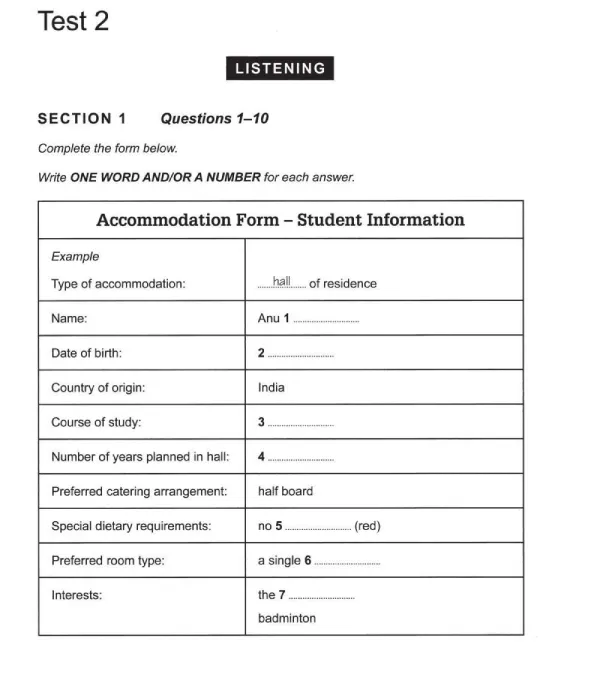
- Core Objective: To evaluate your ability to listen for main ideas, specific details, and the speaker’s attitude/opinion in various communication situations.
- Content & Difficulty: Usually uses shorter audio clips with a slightly slower speaking speed than the actual IELTS exam. Topics typically revolve around daily situations (booking tickets, asking for directions, registering…) or short announcements, which are less academic.
- Common question types (Detailed examples):
- Form Completion: Listening to a conversation (usually a transaction) and filling in missing information such as names, phone numbers, addresses, dates, codes, etc., into a provided form.
- Multiple Choice: Listening to a conversation or monologue and choosing the correct answer (A, B, C) for questions about main content, specific details, or the speaker’s purpose/attitude.
- Sentence/Note Completion: Listening and filling in (usually 1-3 words) the blanks in summary sentences or notes about the audio content.
- Matching: Listening and matching items in column A (e.g., names) with corresponding items in column B (e.g., opinions, activities). This type is less common in short placement tests.
4. Reading Comprehension Assessment
- Core Objective: To evaluate your ability to read and understand various types of texts, from grasping main ideas and finding specific details to understanding the author’s attitude and purpose.
- Content & Difficulty: Uses one or more shorter passages with simpler language than the long, complex academic texts in the actual IELTS exam. Topics can be general or semi-academic.
- Common question types (Detailed examples):
- Matching Headings: Reading short paragraphs (A, B, C…) and choosing the most suitable heading from a provided list for each paragraph based on its main idea.
- True/False/Not Given (T/F/NG): Reading statements and determining based on the text whether they are True (matches information), False (contradicts information), or Not Given (no basis to determine).
- Sentence/Summary Completion: Reading the text and using words from the passage (or a provided list) to fill in blanks in sentences or a summary paragraph.
- Multiple Choice: Reading and answering questions about main ideas, specific details, vocabulary in context, or inferences by choosing the correct answer (A, B, C, D).
- Short Answer Questions: Reading and answering questions using a few words or numbers taken directly from the text.
5. Writing & Speaking Assessment
- High Variability: These two skills are harder to assess automatically and are more time-consuming, so their presence and format in placement tests vary significantly between providers.
- Writing (If included):
- Format: Usually requires writing a short paragraph (about 100-150 words) instead of a full essay.
- Content: Could be presenting an opinion on a very familiar and simple topic (e.g., hobbies, benefits of reading) or describing a very basic chart/table (much less complex than actual Task 1).
- Assessment Goal: Primarily to check the ability to express basic ideas, use simple sentence structures, common vocabulary, and foundational grammar.
- Speaking (If included):
- Format: Usually a short interview (5-10 minutes) with a teacher (if testing at a center) or sometimes recording your answers (if testing online).
- Content: Focuses on questions similar to Part 1 of the actual exam: introducing yourself, family, hometown, studies/work, hobbies. May include a short request to speak on a familiar topic (like a shortened Part 2).
- Assessment Goal: Primarily to check basic fluency (ability to speak smoothly with few hesitations), clear pronunciation, and sufficient vocabulary/grammar to express simple ideas.
- Grading Issues:
- Free Online: Writing/Speaking sections are often not graded in detail or only assessed superficially by AI (accuracy may be limited).
- At a Center: Teachers will directly evaluate based on core criteria (as mentioned above) to provide feedback and estimate your band score.
Distinguishing between “Quick” and “Comprehensive” tests
- “Quick” Test
- Duration: Usually 30 – 45 minutes.
- Content: Focuses primarily on Grammar and Vocabulary via multiple choice, possibly with a few short Listening/Reading questions.
- Purpose: Quick screening, suitable for basic class placement or preliminary assessment.
- “Comprehensive” Test
- Duration: Can be 60, 90, or even 120 minutes.
- Content: Includes Listening and Reading sections with more questions, more diverse formats, and closer to the actual exam structure (though still shorter and easier). May include a short Writing and/or Speaking section.
- Purpose: More detailed assessment of skills, providing more reliable band score estimates for in-depth roadmap consulting.
Online vs. Offline: Which format should you choose?
Choosing between an online IELTS placement test or an in-person test at a center depends on many factors, such as your assessment goals, personal circumstances, and the level of detail you expect. Carefully consider each format:
1. Online IELTS Placement Test
Advantages:
- Convenience and Flexibility: This is the biggest advantage. You can take the test anywhere with a stable Internet connection (at home, a quiet cafe, a library…) at any time that fits your schedule, without needing to travel or adhere to a center’s business hours. This is especially useful for busy individuals or those living far from English centers.
- Speed and Instant Results (For multiple-choice sections): Sections like Grammar, Vocabulary, Listening, and Reading are usually graded automatically by a computer. You can know your scores for these sections immediately after finishing, helping you quickly grasp your level.
- Many Options (Including Free): There are countless websites, apps, and English learning platforms that offer online placement tests. Many are free, making it easy to access and try without initial costs. Paid options may provide higher-quality tests or additional assessment features.
Disadvantages:
- Very Limited Writing and Speaking Assessment: This is a critical weakness.
For free tests: They often skip Writing and Speaking assessment entirely, or ask you to self-assess (which is not objective).
For some paid tests: They may use AI to provide a preliminary grade. However, current AI struggles to accurately assess complex factors like Coherence & Cohesion, Lexical Resource, and Grammatical Range and Accuracy in Writing, or Fluency and Pronunciation in Speaking, compared to a human examiner. You will miss out on detailed, professional feedback from a teacher.
- Requires High Self-Discipline and a Controlled Environment: You need to create a quiet space, free from distractions, ensure a stable Internet connection, and most importantly, be honest and self-disciplined so the results accurately reflect your ability. External factors (noise, weak connection, lack of focus) can negatively impact your results.
- Inconsistent Quality (Especially with free tests): Not every online test is well-designed, updated, or calibrated accurately to the IELTS scale. Some free tests may be too easy, too hard, or focus on grammar/vocabulary points that aren’t central to IELTS, leading to unreliable results and potentially misleading you about your level.
2. Offline IELTS Placement Test (In-Person at a Center)
Advantages:
More Objective and Detailed Speaking and Writing Assessment: This is a major advantage. The Speaking test is usually conducted 1-on-1 with an experienced teacher, and the Writing test is also graded directly by a teacher based on standard IELTS criteria. You will receive specific, authentic feedback on your strengths and weaknesses in expression, word choice, grammar, pronunciation, etc., which online tests struggle to provide.
Opportunity for Direct Consultation and Personalized Roadmap: Immediately after receiving your results (often including estimated scores for Speaking/Writing), you can discuss them directly with a consultant or teacher at the center. They will explain your results, strengths, and weaknesses, and most importantly, propose the most suitable study roadmap and course for your level and goals. This creates a clear and reliable next step.
Serious and Standardized Testing Environment: Taking the test at a center helps you focus better and simulates the atmosphere of an actual exam. Conditions regarding the testing room and equipment (headphones for Listening) are usually guaranteed, minimizing external distractions.
Disadvantages:
Requires Travel and More Time: You must arrange time to travel to the center, take the test according to their schedule (usually 60-120 minutes), and potentially spend extra time waiting or consulting. The total time spent is definitely more than an online test.
Requires Booking in Advance: Most centers require you to register and book an appointment for the placement test, which may not be flexible if you have a sudden schedule change.
Potential Costs: Although many centers offer free placement tests to attract students, some places may charge a fee, especially for comprehensive tests that include detailed assessment of all 4 skills by a teacher.
So, Which Format Should You Choose? The final decision depends on your needs and priorities:
-
Choose an Online Test if:
- You only need a quick and preliminary estimate of your level, mainly for Listening, Reading, Grammar, and Vocabulary.
- You live far from English centers or have a very busy schedule and need maximum flexibility.
- You have high self-discipline and can ensure a good testing environment.
- You want to save on initial costs (by using free tests).
Advice: Choose tests from reputable sources (large centers, well-known educational platforms) to increase reliability.
-
Choose an Offline Test (at a center) if:
- You want a comprehensive and most accurate assessment for all 4 skills, especially Writing and Speaking.
- You want to receive detailed, objective feedback from an experienced teacher.
- You want direct consultation and a clear study roadmap immediately after knowing your results.
- You need a serious testing environment to maximize your focus.
Advice: This is usually the better choice if you are truly serious about studying for the IELTS and want a structured investment from the start.
At ECE English Center, we offer in-person IELTS placement tests with results returned within 2-3 days. If you need a free IELTS placement test before joining a course, contact ECE today to book your appointment!
Contact Information:
- Branch 1: No. 43, Alley 91 Tran Duy Hung, Cau Giay District, Hanoi – Hotline: 0982.166.634
- Branch 2: No. 16N8B, Alley 7 Hoang Minh Giam, Thanh Xuan, Hanoi – Hotline: 0971.217.556
- Branch 3: House CL11-A2, Alley 118 Nguyen Khanh Toan Street, Quan Hoa, Cau Giay (Behind Honda 120 Nguyen Khanh Toan) – Hotline: 0981.733.342
Suggested free online IELTS placement test sources
1. IELTS Online Tests
IELTS Online Tests is an online platform providing free IELTS mock tests, helping you get familiar with the exam format and assess your English proficiency. This site stands out with a diverse, frequently updated collection of tests covering Listening, Speaking, Reading, and Writing. Additionally, IELTS Online Tests provides supplementary study materials such as vocabulary, grammar, and writing samples. You can visit IELTS Online Tests to get started.
2. IELTS Exam
IELTS Exam offers a wealth of test preparation resources. The site features a series of free mock tests along with many online study materials for all 4 skills. Using resources like IELTS Exam can help you familiarize yourself with the exam format and self-assess your skills. You can access the IELTS Exam website to take a mock test here.
3. IELTS For Free
IELTS For Free is considered one of the most reputable free online IELTS testing websites, with a diverse collection of IELTS study materials ranging from vocabulary and grammar to 4-skill practice. Materials are updated regularly. The website interface is intuitive and easy to use. You can visit IELTS For Free to select tests and materials.
4. IELTS Buddy
IELTS Buddy provides tests for both IELTS Academic and General Training. The difference is that skills are often separated for individual practice (Reading, Listening, Writing, Speaking) rather than a full integrated test. The website also has many online study materials for vocabulary, grammar, sample essays, and useful tips. You can visit the IELTS Buddy website to explore.
5. IELTS Liz
This website is very famous for detailed lessons, effective tips, and practice exercises for all 4 skills shared by Liz, an experienced teacher and former IELTS examiner. Although it doesn’t focus on providing a large number of full mock tests like some other sites, it is a high-quality source for learning and practicing, especially regarding methods and test-taking strategies. You can visit IELTS Liz to find lessons and skill-based exercises.
6. Mini-IELTS
This site focuses heavily on providing many Reading and Listening practice tests in the exact format of the actual exam (often taken from Cambridge books). You can take timed tests and check your answers immediately, which is very useful for practicing speed and test-taking skills for Listening and Reading. You can visit Mini-IELTS for in-depth Listening and Reading practice.
In summary, an IELTS placement test is an important first diagnostic step, helping you accurately determine your starting point. Whether you choose the convenience of an online test or an in-person test at a center for more detailed assessment, the key is to use the results intelligently. A well-directed start will make your journey to conquering the IELTS clearer and more effective. Good luck!





 Khai giảng Khóa học Hè cực HOT.
No comments yet!