


Tóm Tắt Nội Dung Bài Viết
The audio plays only once, information flies by at breakneck speed, and you have to listen, read the questions, and find the answers all at the same time. This is the pressure every candidate faces in the IELTS Listening test. In this battle against time and information, note-taking is not just a secondary skill—it is a strategic “weapon” that helps you secure a high score.
Consider the difference:
- Poor note-taking:
The students decided to go to the university library to do research for their project.(Too long, impossible to keep up). - Effective note-taking:
stds → uni lib 📖 for research proj.(Concise, uses symbols, captures all the key points).
This guide from ECE Language Center is your most comprehensive resource, covering everything from strategic mindset to practical techniques for each question type, helping you turn note-taking into a decisive advantage in the exam room.
Part 1: The Right Mindset for IELTS Note-Taking

Before learning the tips, you need to establish the right mindset to make your note-taking truly effective.
-
Goal: “Catch the Answer,” Don’t “Write Everything.” Your ultimate goal in the exam room is to select the correct answer. Therefore, do not try to transcribe everything you hear. Instead, train your ability to listen selectively, keeping an ear out for “trigger words” that often signal the answer is coming, such as “The main reason is…”, “What we found surprising was…”, or “It’s essential to…”. Your notes should serve one purpose only: to capture concise “evidence” that helps you circle the correct answer or fill in the blank accurately.
-
Manage your focus: No one can maintain 100% concentration for 30 minutes. Learn how to “sprint” and “pace” your attention.
- Pacing: When the audio is introducing the topic or providing general information, maintain a moderate level of focus while keeping your eyes on the questions.
- Sprinting: When you hear the question number (“Now look at question 21…”) or the keywords you’ve underlined, this is the time to pour 100% of your focus into listening and note-taking.
-
Is note-taking always necessary? No. A smart IELTS strategist knows when to use a “scalpel” (detailed notes) and when to use a “needle” (minimal notes).
| Section | Common Question Types |
Recommended Note-Taking Level
|
| 1 | Form/Table Completion |
Minimal: Mostly listening and writing directly onto the question paper.
|
| 2 | Multiple Choice, Map/Diagram |
Moderate: Quick notes (symbols, keywords) right next to the options or on the map.
|
| 3 | Matching, Multiple Speakers |
High: Need to take notes on scratch paper, using techniques like column division.
|
| 4 | Lecture (Note Completion) |
Very High: Structured notes are required to keep up with long lectures.
|
Part 2: Quick Note-Taking Techniques
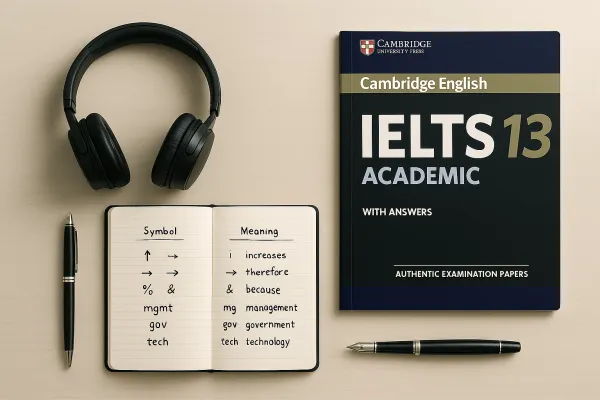
To keep up with the speed of the audio, you need to equip yourself with a shorthand toolkit.
- Use Abbreviations and Symbols: This is the most important technique. Build and practice your own set of symbols.
| Category | Symbol | Meaning |
| Common words | info, tech, env, gov, dev |
information, technology, environment, government, development
|
| Logic | →, b/c, ∴ |
leads to/causes, because, therefore
|
| Comparison | >, <, = |
greater than/more, less than/fewer, equals/is
|
| Trends | ↑, ↓, ~ |
increase/growth, decrease/decline, approximately
|
| Relationships | & or +, w/, w/o |
and, with, without
|
| Evaluation | ✓ or +, X or -, ? |
good/positive, bad/negative, unsure/needs review
|
-
Vowel/Consonant Deletion: This is a classic shorthand technique. You can shorten words by keeping only the main consonants.
management→mgmtproblem→prblmschedule→sked
-
Focus on “Content Words”: See the following example to understand the power of this.
- Original sentence: “Although the new museum is architecturally impressive, it has been criticized for being impractical for large exhibitions.”
- Thought process:
new museum…architecturally impressive…BUT…criticized…impractical…large exhibitions. - Final notes:
new museum: impress architec ✓, BUT impractical for large exhib X
Part 3: Note-Taking Strategies for Each IELTS Listening Task
Each task type requires a different note-taking approach.
1. Form/Note/Table Completion
- Strategy: “Predict and Track”.
- How to do it: This task requires the least amount of scratch paper notes. The key skill is to read ahead and predict the type of information needed (name, address, phone number, plural noun, etc.). When listening, focus intensely on the keywords around the blank and be ready to write the answer directly.
- Common trap: The speaker may correct themselves. For example: “My phone number is 0912… oh, sorry, that’s my old number. The correct one is 0987…”. Always listen until the end to ensure the information hasn’t changed.
2. Multiple Choice
- Strategy: “Elimination and Evidence-based Notes”.
- How to do it:
- Underline keywords in the question AND all options A, B, and C.
- When listening, don’t try to pick the right answer immediately. Instead, take quick notes next to the options to keep track.
- Example question: What is the main advantage of the new library? A) Its modern design. B) Its large collection of books. C) Its convenient location.
- Audio might say: “…While the design is certainly modern (A), its main advantage isn’t its appearance. It doesn’t have more books than the old one (B), but its central location (C) is what makes it so popular…”
- Your notes: A)
design modern, BUT not mainB)X (not more books)C)✓ central location = popular - This method helps you confidently eliminate wrong options and select the correct one.
3. Matching
- Strategy: “Note next to the subject”.
- How to do it:
- This task usually provides a list of subjects (e.g., 3 researchers) and a list of findings (A-G).
- Focus on the list of subjects. When the audio starts talking about the first person (e.g., “Firstly, Johnson’s study found…”), listen to the description and write 1-3 summary keywords right next to the name “Johnson”. For example:
Johnson: children + sugar → hyperactive. - Do the same for the subsequent researchers.
- After the audio finishes, use these concise notes to match with the findings (A-G) easily and accurately.
4. Map/Diagram Labelling
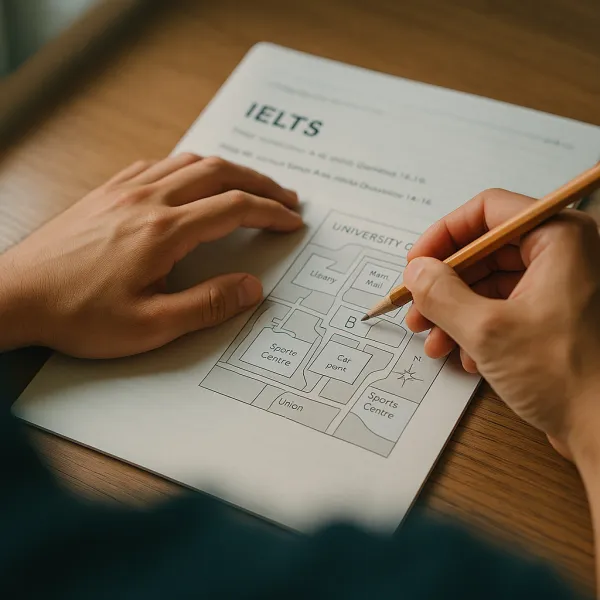
- Strategy: “Follow with your pen tip” and listen for directional language.
- Important directional language:
go straight ahead,turn left/right,at the corner,go past the...,it's opposite the...,next to / adjacent to,behind,in front of,at the top/bottom. - How to do it: Use your pencil tip to move along the directions mentioned in the audio. When a location is identified, quickly write the answer (e.g., A, B, C) in the correct position on the map.
5. Multiple Speakers (Dialogue/Discussion)
- Strategy: “Column division”.
- How to do it: Draw 2 or 3 columns on your scratch paper, each corresponding to a speaker. As each person gives their opinion, take notes in the corresponding column. Pay special attention to language indicating agreement (
I agree,You're right,That's a good point) or disagreement (I'm not so sure,But what about...,On the other hand...), as this is often where the answers for opinion-based questions are found.
Part 4: Practice to Master
Knowing the techniques isn’t enough; you need to practice to make them a natural reflex.
- Build and memorize your personal symbol set: Create flashcards for your symbols and test yourself daily until you can write them without thinking.
- Deliberate practice with suitable audio: Start by practicing shorthand techniques with short, moderate-speed audio (e.g., BBC 6 Minute English). Then, move on to the practice tests in the official Cambridge IELTS books.
- Review and Reflect: This is the most important step. After finishing a test, review your notes and answer these questions: “Did these notes help me find the answer?”, “Could I have taken shorter notes?”, “Why did I miss the information in question X?”.
- Create a “Note-Taking Error Log”: Keep a notebook or Excel file. Every time you make a mistake, record: 1) What was the error? (e.g., notes too long, couldn’t understand my own symbols). 2) Why did it happen? (e.g., tried to write the whole sentence). 3) How will I fix it next time? (e.g., only write nouns + verbs).
Conclusion
IELTS note-taking is an art of speed, accuracy, and strategic thinking. It is not about aimless scribbling, but a series of tactics honed to meet the requirements of each specific question type. By applying the right mindset, building a shorthand toolkit, and practicing these strategies deliberately, you will turn the pressure of the Listening section into an opportunity to break through your score ceiling. ECE wishes you success!




 Khai giảng Khóa học Hè cực HOT.
No comments yet!