


Tóm Tắt Nội Dung Bài Viết
In education management and recruitment, the IELTS certificate is now widely used as a criterion for university admissions, graduation exam exemptions, public sector hiring, and immigration document reviews. To ensure transparency and prevent credential fraud, the verification of score reports is strictly enforced.
The concept of “IELTS post-verification” is essentially a mandatory administrative review procedure conducted by receiving authorities. Understanding how this mechanism operates, along with processing times and potential scenarios, helps test-takers proactively monitor and protect their legitimate rights.
1. What is IELTS Post-Verification?
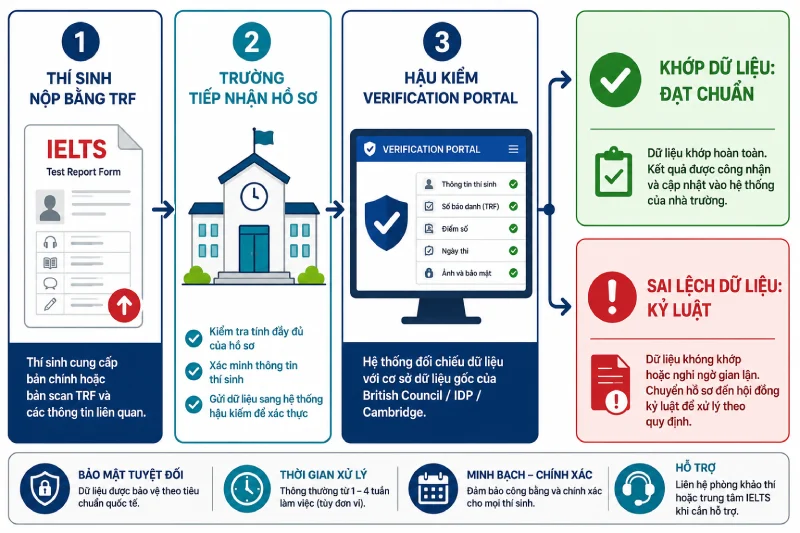
IELTS Results Verification is the process of confirming the validity and accuracy of an IELTS Test Report Form (either the physical TRF or digital e-TRF) after a candidate submits their application to a specific organization. This process cross-references the candidate’s submitted information with the master databases of the test administrators.
Organizations that routinely perform this verification procedure include:
-
Universities and Colleges: They cross-check applications for admitted students through combined admission methods, as well as student files submitted to meet graduation proficiency standards.
-
State Management Agencies: They review applications during civil service recruitment drives, public employee hiring, or periodic inspections and professional title promotions.
-
Diplomatic and Immigration Authorities (Embassies, Ministries of Home Affairs): They verify the authenticity of score reports included in student, work, and residency visa applications.
2. How the IELTS Verification System Works
IELTS score verification is not handled through standard public score-lookup channels. Instead, the procedure relies on a highly secure, specialized management system.
Verification via the IELTS Results Verification Service
The IELTS Results Verification Service (commonly referred to as the Verification Portal) is a dedicated verification platform reserved for officially authorized organizations (such as universities, government bodies, and immigration agencies). This system is not open to the general public for independent searches to protect candidate data privacy.
During a review, the organization’s designated staff member logs into the portal and enters the TRF Number (the unique identification code printed at the bottom right corner of the score report or e-TRF). The system then displays verification results pulled directly from the global databases of the IELTS co-owners (Cambridge English, British Council, and IDP). If the information on the screen matches the hard copy or digital file submitted by the candidate, the application is marked as valid.
Verification via Official Administrative Correspondence
During large-scale inspections or specialized recruitment processes by government agencies, the receiving organization may compile a list of candidates and send an official dispatch requesting direct verification to the IDP or British Council representative office in Vietnam. The test organization will then cross-check the master data and issue an official, legally stamped written confirmation.
3. Procedures and Processing Times Across Organizations
Comparison of Two Common Verification Methods
| Criteria | Electronic Verification via Portal | Administrative Verification via Official Dispatch |
| Method of Execution | Entering the TRF number directly into an authorized internal electronic system. |
Compiling a list and sending a physical official dispatch to the IDP/BC office. |
| Processing Time | Can be completed anywhere from a few minutes to a few working days. |
Typically takes 1 to 4 working days or longer during peak periods. |
| Administrative Fees |
Generally free for organizations with registered portal accounts. |
Some institutions may charge administrative fees according to their own regulations to process the files. |
Note: Depending on each institution’s operational cycle (for instance, some universities only batch verification requests on a fixed day of the month), the score update timeline may take longer. Test-takers should proactively initiate verification 2 to 3 months before their application deadline to avoid missing important milestones.
4. Technical Reviews and Actual Score Adjustments
Post-verification is not only intended to check candidate honesty but also serves to synchronize data when testing systems undergo updates.
Score Adjustments Due to Technical Reviews
Management records show that IELTS organizers occasionally conduct large-scale internal technical reviews (such as data synchronization glitches affecting Reading and Listening components for certain test cohorts between 2023 and 2025). When algorithmic errors that skew component scores or the Overall band score are discovered, the test organizer updates the accurate scores on the electronic system (Test Taker Portal) and issues a new TRF.
When such incidents occur, some receiving universities will conduct internal audits and require students to update and submit their latest score reports to ensure data accuracy and fairness for admissions.
Withholding Results for Investigation
According to the general terms and conditions of the IELTS test, if irregular signs are detected (such as abnormal score discrepancies between skills, or test rooms flagged for potential regulation breaches), the test organizer (IDP/BC) reserves the right to delay releasing scores or withhold results for in-depth investigation. While this investigation process ensures the transparency and integrity of the exam, it may impact a candidate’s application timeline.
5. Penalties for Credential Fraud
Any attempts to tamper with scores, purchase fake certificates, or forge TRF numbers will be uncovered when receiving authorities cross-check data against the master database.
If information discrepancies or certificate falsifications are detected during post-verification, violators will face severe penalties depending on each institution’s regulations:
-
By the Test Organizer: Candidates may have their current test results canceled and face penalties or long-term bans from taking the exam, as stipulated by IELTS regulations.
-
By Educational Institutions (Universities): Based on academic regulations, schools can revoke admission offers or expel students caught engaging in fraud, even if they have already been studying for some time.
-
By Employers: Revocation of job offers, termination of employment, or disciplinary action in accordance with labor laws and civil service regulations.
6. Frequently Asked Questions About IELTS Verification (FAQ)
Can candidates log into the Verification Portal to check their own scores?
No. The IELTS Results Verification Service grants access exclusively to authorized government bodies, schools, and organizations. To check their personal results, candidates can only log into the Test Taker Portal to view their online data against the physical TRF they hold.
Are IELTS certificates issued during periods of partnership suspensions in Vietnam affected during verification?
The review process for certificates issued during regulatory transition periods for joint testing partnerships depends entirely on specific guidelines from the Ministry of Education and Training and the admission decisions of each university’s academic board. Candidates should actively monitor official announcements from the receiving institution to determine whether their credentials require supplemental verification.
If a student’s score is revised downward after university verification, will their enrollment be canceled?
This depends on the admissions and academic regulations of each university. If your adjusted score falls below the cutoff for that academic year, the school will apply current regulations to determine an appropriate solution (such as transferring you to a major matching your new score or applying other administrative measures as required).
IELTS post-verification is a necessary administrative procedure designed to uphold fairness and objectivity in education and hiring. Genuine preparation, language skill improvement, and sitting for the exam legally at licensed test centers remain the best ways for learners to protect their legal rights on their academic and career journeys.




 Khai giảng Khóa học Hè cực HOT.
No comments yet!