


Tóm Tắt Nội Dung Bài Viết
The topic of Artificial Intelligence (AI) is becoming increasingly prevalent in IELTS Writing Task 2, reflecting the rapid evolution of the modern world. To help you confidently tackle this “tough” subject, we have compiled a detailed guide prepared by Mr. Trinh Nam Viet (an 8.0 IELTS instructor at ECE), featuring key arguments, essential vocabulary, and a sample essay.
Overview of the Artificial Intelligence (AI) Topic in IELTS Writing Task 2
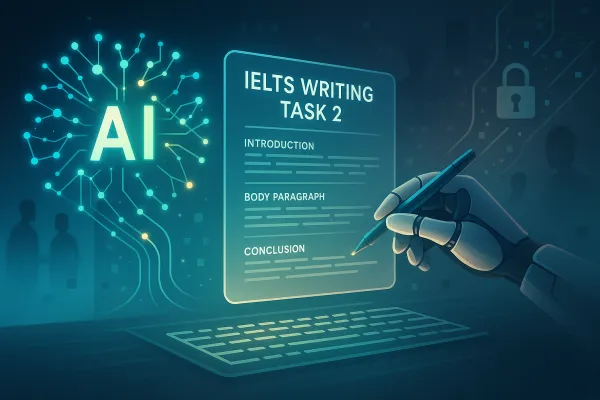
This is a contemporary topic that often intersects with fields such as technology, science, employment, education, and society. The most common aspects of the prompt include:
- The impact of AI on employment and the labor market.
- The role of AI in education and healthcare.
- The benefits and risks of AI development.
- The influence of AI on human life and privacy concerns.
To achieve a high score, you need to equip yourself with relevant academic vocabulary (e.g., automation, machine learning, robotics, efficiency, privacy concerns, unemployment, innovation) and express a clear stance (supporting, opposing, or a balanced view).
Common Question Types for the AI Topic
This topic can appear in various formats. Below are the most common types:
Brainstorming Ideas and Arguments for the AI Topic
Below are some lines of reasoning you can use for your essay, categorized into advantages, disadvantages, and solutions.
Advantages:
- Efficiency and productivity: AI can automate repetitive tasks, freeing humans to focus on work that requires creativity and critical thinking.
- Medical applications: AI assists in more accurate disease diagnosis, accelerates drug development, and personalizes patient care.
- Personalized education: AI can design learning programs tailored to the individual ability and learning pace of each student.
- Safety & convenience: Applications such as self-driving cars, financial fraud detection systems, and 24/7 customer support chatbots.
Disadvantages:
- Mass unemployment: Many jobs in sectors like manufacturing and office administration are at high risk of being replaced by machines.
- Technological dependency: Humans may lose fundamental thinking and problem-solving skills.
- Ethical & security risks: AI can be misused for surveillance, autonomous warfare, or creating sophisticated deepfakes for fraudulent purposes.
- Widening social gaps: Developed nations may leverage AI to surge ahead, increasing global inequality.
Solutions / Balanced Perspectives:
- Reskilling and upskilling: Governments should invest in training programs for new skills that machines cannot easily replicate.
- Establishing legal frameworks: Strict laws and ethical guidelines are necessary to control the development and application of AI.
- Harmonious integration: View AI as a powerful supporting tool rather than a complete replacement for human labor.
Sample IELTS Writing Task 2 Essay on Artificial Intelligence
Prompt: Some people believe that artificial intelligence will bring more benefits than drawbacks to society. To what extent do you agree or disagree?
Sample Essay:
In today’s world, the rise of artificial intelligence (AI) has become one of the most transformative developments of the 21st century. While critics argue that it threatens employment and raises ethical dilemmas, I am convinced that its benefits, if properly harnessed, far outweigh the drawbacks.
One compelling advantage of AI lies in its capacity to enhance efficiency and productivity across numerous sectors. In medicine, for instance, AI-powered diagnostic tools can detect diseases at an earlier stage than human doctors, leading to life-saving interventions. Similarly, in education, AI can deliver personalized learning pathways, adapting lessons to the unique pace and strengths of each student. These breakthroughs not only improve outcomes but also help narrow gaps in access to quality services.
Nevertheless, the potential downsides of AI cannot be ignored. Widespread automation could trigger technological unemployment, disproportionately affecting low-skilled workers. Moreover, the misuse of AI in areas such as mass surveillance or autonomous weapon systems poses serious ethical risks. Without robust regulation, society may face a loss of privacy and even threats to global security.
However, these challenges can be mitigated with appropriate governance. Governments and institutions should invest in reskilling and upskilling programs, equipping workers with abilities that machines cannot easily replicate, such as creativity and critical thinking. Furthermore, establishing an international framework to ensure the ethical deployment of AI would prevent its abuse while promoting innovation.
In conclusion, although AI presents undeniable risks, its potential to revolutionize healthcare, education, and industry makes it a powerful force for progress. With prudent regulation and forward-looking policies, societies can capitalize on its transformative potential while safeguarding against misuse.
Key Vocabulary from the Sample Essay
- artificial intelligence (n): artificial intelligence
- properly harnessed (phr): utilized or exploited effectively
- efficiency (n): the state or quality of being efficient
- productivity (n): the state or quality of being productive
- life-saving interventions (n): actions taken to save lives
- personalized learning pathways (n): customized educational routes
- technological unemployment (n): unemployment caused by technological change
- autonomous weapon systems (n): weapons that can operate without human intervention
- reskilling and upskilling programs (n): training initiatives to learn new skills or improve existing ones
- ethical deployment (n): the implementation of technology in a morally responsible way
- capitalize (v): to take the chance to gain an advantage from something
- transformative potential (n): the capacity to cause a major, positive change
We hope this detailed analysis from ECE helps you feel more confident when encountering the Artificial Intelligence topic in your IELTS Writing Task 2. Good luck with your studies and may you achieve your target score!




 Khai giảng Khóa học Hè cực HOT.
No comments yet!