


Tóm Tắt Nội Dung Bài Viết
“Leisure time” is a familiar topic we encounter in our daily lives. It is especially common for students who frequently engage with English-language materials, as this is a fundamental subject that appears often in classroom lessons. However, it is also a very popular topic in IELTS Writing Task 2. While it may seem “easy” or even a bit mundane, this topic actually hides many interesting angles to explore, and it is quite easy to drift off-topic if you aren’t careful.
Join Ms. Le Tran Thanh Thuy, an 8.0 IELTS instructor at ECE, as we dive deeper into the “Leisure time” topic, explore how to develop ideas, create outlines, and analyze a sample essay. We hope that after reading this article, you will be able to expand your ideas, sharpen your approach, and enrich your vocabulary for this topic.

Overview of the ‘Leisure time’ topic & Common angles
As you know, IELTS Writing Task 2 prompts typically focus on social issues that are often controversial and can be approached from various perspectives. The same applies to “leisure time” questions. Common exam questions in this category often focus on aspects such as: the link between leisure and academic/work productivity; the role of technology in entertainment; differences in how children, teenagers, and adults spend their free time; work-life balance; and active versus passive leisure activities.
Here are some common types of “Leisure time” questions that appear in the exam:
Opinion:
- Some people believe that young people should spend most of their free time on activities that improve their future career prospects. To what extent do you agree or disagree?
- Many parents feel that children should use their leisure time to do homework or revise for school. Do you agree or disagree?
- Some people think that adults should spend more of their leisure time doing physical activities rather than relaxing. Do you agree or disagree?
Discussion:
- Some people think children should have structured leisure activities, while others believe they should be free to choose how they spend their free time. Discuss both views and give your opinion.
- Some people argue that leisure activities for young people should be organised by schools or community groups, while others think young people should decide for themselves. Discuss both sides and give your opinion.
- Some people believe leisure time should always be productive, while others feel that relaxing without purpose is equally important. Discuss both views and give your opinion.
Advantages/Disadvantages:
- Many people today spend their leisure time on technological devices such as smartphones and computers. What are the advantages and disadvantages of this trend?
- More people are choosing indoor activities, such as watching movies or playing video games, instead of outdoor activities in their free time. Is this a positive or negative development?
- Some parents arrange numerous extracurricular activities for their children during their free time. What are the advantages and disadvantages of this approach?
Problem/Solution:
- Many young people do not have enough leisure time nowadays. What are the reasons for this? What can be done to improve the situation?
- Nowadays, stress and burnout prevent many adults from enjoying their free time. What problems does this cause, and what solutions can be implemented?
- Some children spend too much of their free time using electronic devices. What problems does this create, and how can these issues be solved?
Direct question (2-part question):
- Many people struggle to find enough leisure time despite modern conveniences that are supposed to save time. Why is this happening? What can people do to better manage their free time?
- Children today engage in fewer outdoor activities during their leisure time compared to previous generations. Why is this happening? What can be done to encourage more outdoor play?
While “leisure time” is a relatable topic, it is easy to ramble if you lack a coherent structure and a clear outline. During your practice, take time to brainstorm ideas for the common angles mentioned above. Using a mind map can help you memorize these points and make your future revision much more efficient.
How to develop ideas for the ‘Leisure Time’ topic in IELTS Writing Task 2
Let’s brainstorm ideas and arguments for the following prompt:
“Some people believe that young people should spend most of their free time on activities that improve their future career prospects. To what extent do you agree or disagree?”
This is an opinion essay, and you have three main approaches:
1) Fully agree
2) Fully disagree
3) Partly agree
For this essay, I will choose the “Partly agree” approach. Here is how we should structure our thinking:
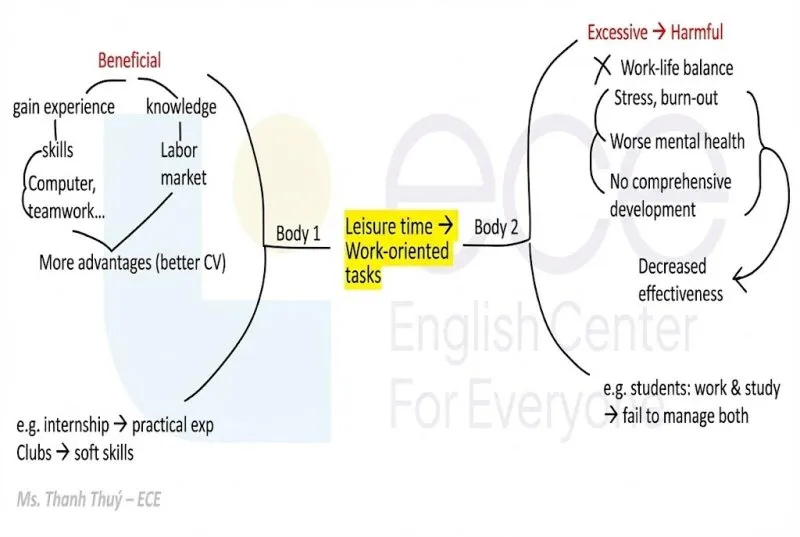
Body Paragraph 1: I agree that career-oriented activities are beneficial, as they help build experience, knowledge, and provide a competitive edge.
Specifically:
- Developing work-related skills (communication, teamwork, time management).
- Gaining insight into the labor market through courses, volunteering, or part-time work.
→ Increased competitiveness when applying for jobs (a stronger CV).
Examples:
- Students doing internships → gaining practical experience.
- Students joining a debate club → developing soft skills.
Body Paragraph 2: However, I believe that spending too much free time on career-oriented tasks is harmful, as we need to maintain a healthy work-life balance.
Explanation:
Over-committing to career-oriented tasks leads to:
- Stress and imbalance (Free time is essential for rest and holistic development, including personal hobbies).
- Poor mental health → potentially affecting academic performance. Argument: Leisure activities (sports, arts, reading for pleasure) can improve mental well-being, making learning more effective.
Example: Some students become overwhelmed by juggling schoolwork and part-time jobs, leading to burnout and an inability to perform well in either area.
Outlining the ‘Leisure time’ topic for IELTS Writing Task 2 using a mind map
Before writing, you should quickly sketch out your main points and key vocabulary to create a rough outline. This prevents rambling and helps you stay in control of your essay. You can refer to the mind map I’ve created below:
Prompt & Sample Essay for the ‘Leisure time’ topic
“Some people believe that young people should spend most of their free time on activities that improve their future career prospects. To what extent do you agree or disagree?”
Some people argue that young people should spend most of their free time on activities that improve their future career prospects. While I agree that career-oriented activities can be beneficial, I only agree to a certain extent because spending too much time on them may negatively affect young people’s well-being.
On the one hand, activities that support future employment can indeed bring work-related experience and knowledge. To be specific, they allow young people to develop important skills such as teamwork, communication, and time management, all of which are highly valued in the modern workplace. Additionally, participating in part-time jobs, volunteering, or taking short professional courses also helps them understand the labour market better. As a result, they become more competitive when applying for jobs. For example, students who complete internships often gain practical experience that sets them apart from other applicants, and those who join debate clubs can acquire strong soft skills that are useful in many fields.
On the other hand, encouraging young people to spend most of their leisure time on career-related tasks may be harmful; It can cause excessive pressure and disrupt their work-life balance. This, in turn, can lead to decreased performance in many aspects of their lives since leisure time plays a crucial role in helping young people relax, recharge, and develop their personal interests. Engaging in enjoyable activities such as sports or arts can improve their mental health and ultimately make them more effective learners, whereas being under pressure can lead to the opposite result. For instance, some students who try to juggle schoolwork and part-time jobs often become overwhelmed, which may even result in burnout.
In conclusion, although participating in career-focused activities can be valuable for young people as it better prepares them to enter the job market, I believe these tasks should not take up the majority of their free time due to their potential negative impacts on people’s emotional stability.
Conclusion
We have now taken a deep dive into the “Leisure time” topic for IELTS Writing Task 2, exploring how to brainstorm, outline, and write a Band 7.0+ sample essay. ECE hopes this article provides you with a clear perspective and fresh ideas for this topic, as well as a better understanding of how to tackle Task 2. Good luck with your studies, and may you reach your target score!





 Khai giảng Khóa học Hè cực HOT.
No comments yet!