


Tóm Tắt Nội Dung Bài Viết
When setting your sights on an IELTS Band 7.0, one of the most common questions learners ask is: “How much vocabulary do I actually need?” This score is a significant milestone, representing a high level of English proficiency, and Lexical Resource plays a pivotal role in achieving it across all four skills. In this article, ECE will dive deep into not just the quantity, but the quality of the vocabulary required for Band 7.0, while providing effective study strategies to help you get there.
So, how much vocabulary do you need for IELTS Band 7.0?

It is difficult to provide an exact number for how much vocabulary is needed for an IELTS Band 7.0. This is because assessing vocabulary isn’t just about how many words you “know” (passive vocabulary); more importantly, it is about your ability to use them flexibly, accurately, and appropriately in context (active vocabulary).
However, based on the Common European Framework of Reference for Languages (CEFR) and linguistic research, learners at a level equivalent to Band 7.0 (usually categorized as B2+ to C1-) typically need a vocabulary of around 6,000 to 8,000+ word families.
Important note: This figure is for reference only. It is not simply about knowing the meaning of 7,000 individual words. A “word family” includes the root word and its various forms (e.g., nation, national, nationality, international, nationalize). Furthermore, knowing a word is one thing; using it naturally and accurately is another.
Vocabulary quality is the key

Instead of obsessing over the question “how much vocabulary do I need for IELTS 7.0,” you should focus on meeting the Lexical Resource criteria in the IELTS Band Descriptors for Band 7:
- Use a sufficient range of vocabulary: You need to demonstrate the ability to use a variety of words to express ideas flexibly and precisely, avoiding excessive repetition.
- Use less common lexical items: Band 7 requires you to start using less common vocabulary and idiomatic language naturally, even if there are occasional inaccuracies. For example, instead of using “good,” you might use “beneficial,” “advantageous,” “constructive,” or “effective” depending on the context.
- Awareness of style and collocation: You need to understand that some words are more suitable for academic writing, while others are better for informal speech. More importantly, you must use correct collocations, such as “commit a crime” (not “do a crime”), “make progress” (not “do progress”), or “heavy traffic” (not “strong traffic”).
- Effective paraphrasing: The ability to rephrase ideas using different words or structures is crucial to avoid repeating words from the prompt or your own previous sentences. This is a core skill for IELTS Band 7 vocabulary.
- Minor errors are acceptable: At Band 7, you may still make some errors in word choice, spelling, or word form, but these must not impede communication (they should not affect the clarity of your meaning).
Effective strategies for building IELTS Band 7 vocabulary
So, how do you build the necessary IELTS Band 7 vocabulary?
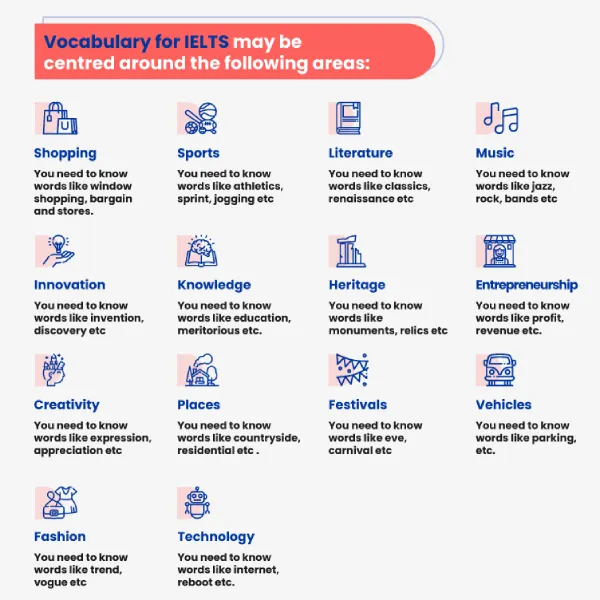
- Learn topic-based vocabulary: IELTS often revolves around familiar themes like Education, Environment, Technology, Health, Work, Society, and Culture. Systematize and learn core vocabulary for these topics, including related nouns, verbs, adjectives, and adverbs.
- Read academic and reputable news sources: This is the best way to encounter IELTS Band 7 vocabulary in real-world contexts. Recommended sources include academic texts, BBC News, The Economist, National Geographic, and scientific journals. Pay attention to how native speakers use words, collocations, and sentence structures.
- Learn words in context, not in isolation: When you encounter a new word, don’t just write down the definition. Note down example sentences, common collocations, synonyms/antonyms (if applicable), and other forms of the word (word family).
- Use a vocabulary notebook or apps: Keeping records systematically helps you review more effectively. Apps like Quizlet or Anki use spaced repetition, which is excellent for long-term retention.

- Focus on collocations: As mentioned, using correct collocations is a hallmark of a natural English speaker and a key requirement for Band 7. There are many books and resources dedicated to this (e.g., Oxford Collocations Dictionary, English Collocations in Use).
- Practice paraphrasing regularly: When learning new words, try to rephrase the sentence or idea using synonyms or different structures.
- Actively use new words: Learning is one thing, but using them is what counts. Try to incorporate new words and collocations into your practice Writing and Speaking. Don’t be afraid of making mistakes—try, and seek feedback.
- Distinguish between active and passive vocabulary: Focus on turning passive vocabulary (words you recognize) into active vocabulary (words you can confidently use in Speaking/Writing).
Mistakes to avoid when studying for IELTS 7.0
-
Memorizing long lists of words without understanding the context:
Why it’s a mistake: This is “surface” learning. You might recognize the word or remember its most basic meaning when reading, but you will be completely lost when you need to use it. Vocabulary learned this way usually remains passive; you cannot actively recall and use it during speaking or writing. Context determines usage, nuance, and accompanying prepositions. A single word can have multiple meanings, and rote memorization won’t help you distinguish between them.
Consequences for IELTS 7.0: You will struggle to use vocabulary flexibly and accurately—a key Band 7 criterion. When speaking or writing, you will revert to familiar, safe words, failing to demonstrate a wide range. Your ability to paraphrase—a vital skill—will be severely limited because you haven’t mastered different ways of expressing the same idea. Examiners will easily notice that you “know” words but cannot “use” them.
-
Overusing “fancy” or complex words incorrectly or inappropriately:
Why it’s a mistake: Many learners mistakenly believe that using “sophisticated” words guarantees a high score. However, using a complex word with the wrong meaning, in the wrong context (e.g., using formal language in an informal conversation), or with the wrong collocation will backfire. It not only makes your speech or writing sound unnatural and confusing but also shows a lack of language mastery and stylistic awareness. Band 7 rewards the appropriate and accurate use of less common vocabulary, not the forced inclusion of difficult words.
Consequences for IELTS 7.0: Frequent word choice errors will drag down your Lexical Resource score. You will certainly fail the “awareness of style and collocation” criterion. Your speech/writing will become awkward and difficult to follow, which also impacts your Fluency and Coherence or Coherence and Cohesion scores. You will be perceived as clumsily “showing off” rather than communicating effectively.
-
Ignoring the importance of collocations:
Why it’s a mistake: Collocations are words that naturally go together in English (e.g., heavy rain, strong wind, make a decision, take an exam, commit a crime, pay attention). Using incorrect collocations (e.g., saying strong rain or do a decision) is one of the most common learner errors and makes your English sound unnatural. Mastering collocations shows a deeper understanding of how language works in practice.
Consequences for IELTS 7.0: You fail to demonstrate “awareness of style and collocation.” Your language will sound unnatural, lowering your Lexical Resource and Fluency scores. Your ability to express ideas will be less precise and effective because you lack the natural phrases that native speakers use.
-
Learning only the meaning without the usage and word family:
Why it’s a mistake: Knowing that “benefit” means “lợi ích” is not enough. You need to know if it’s a noun (countable or uncountable?), what its verb form is (benefit from), its adjective form (beneficial), and its adverb form (beneficially). You need to know which prepositions it takes and what structures it appears in. Learning only the meaning prevents you from using the word flexibly in different sentence structures and makes it impossible to change word forms for paraphrasing.
Consequences for IELTS 7.0: This leads to grammatical errors related to word forms and usage. It limits your ability to use a variety of sentence structures (Grammatical Range and Accuracy). It makes paraphrasing much harder because you cannot change the form of your keywords. Consequently, both your Lexical Resource and Grammatical Range and Accuracy scores will suffer.
-
Failing to review and actively use learned words:
Why it’s a mistake: The human brain tends to forget information if it isn’t reinforced. Learning new words without periodic review is like “water off a duck’s back.” More importantly, to turn passive vocabulary into active vocabulary, you must force yourself to use it. Just reading, listening, and recognizing words is not enough to produce language effectively.
Consequences for IELTS 7.0: Your active vocabulary will be very limited, even if you recognize many words. In the exam room, especially during Speaking, you will “freeze up,” unable to produce the right words even if you feel like you “know” them. Your Writing will be lexically poor, repeating simple structures and words. You will fail to demonstrate the flexibility and precision required for Band 7.
Conclusion:
In summary, the answer to “how much vocabulary do I need for IELTS 7.0?” does not lie in a fixed number. While an estimate of 6,000–8,000+ word families is a good benchmark, the core of achieving Band 7.0 is the quality and your ability to use that vocabulary. You need to demonstrate a sufficiently wide range of IELTS Band 7 vocabulary, use less common words, master collocations, and paraphrase effectively.
Instead of worrying about quantity, focus on building your IELTS Band 7 vocabulary strategically: study deeply, understand thoroughly, and most importantly, practice using them regularly. With the right approach and persistence, conquering your IELTS 7.0 goal is well within your reach.





 Khai giảng Khóa học Hè cực HOT.
No comments yet!