


Tóm Tắt Nội Dung Bài Viết
Have you ever tried to visualize a long-term journey into the future and wanted to emphasize the duration of an ongoing process leading up to a specific point? For example, by the end of this month, you will have been studying English continuously for six months. Or, by this time tomorrow, you will have been working non-stop for eight hours. To accurately describe actions that began in the past or present and will continue up to a specific point or another action in the future, we use an advanced grammatical tense: the Future Perfect Continuous Tense.
This tense allows you to “place yourself” in the future and look back at an ongoing process, highlighting its continuity and duration. While less common than other tenses, mastering the Future Perfect Continuous will elevate your expression, helping you demonstrate grammatical sophistication and control. It is a powerful tool when you want to describe long-term projects, goals, or predict trends that will continue to unfold in the future.
What is the Future Perfect Continuous?
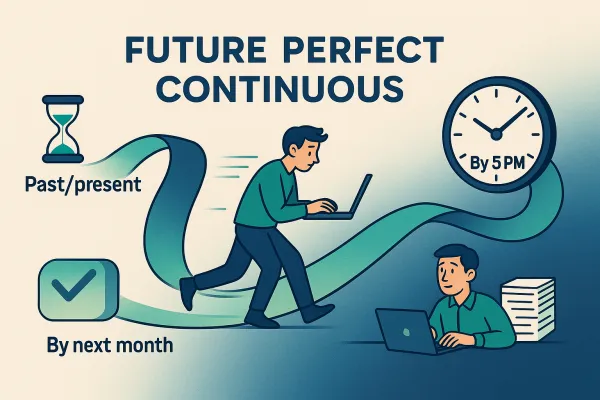
The Future Perfect Continuous tense is used to express:
-
An action that began in the past or present and will continue up to a specific point in the future: The action will still be in progress or will have just finished at the mentioned time, and we want to emphasize its continuity and duration.
Example: By 5 PM, I will have been working for eight hours. (The work started in the past/present and will continue until 5 PM.)
Example: This time next year, she will have been living in London for three years. (The act of living there started in the past and will continue until this time next year.)
-
An action that began in the past or present and will continue up to another action in the future: The action in this tense is a long-duration event that occurs first and continues until the second action (usually in the Present Simple).
Example: When you arrive, I will have been waiting for an hour. (The waiting starts before you arrive and continues until the moment you arrive.)
Future Perfect Continuous Formulas
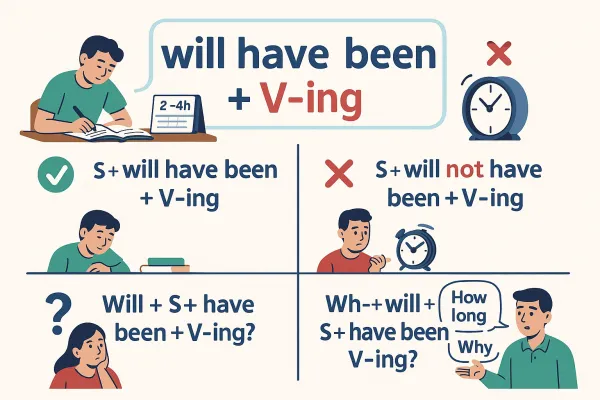
Mastering the formula helps you construct grammatically correct sentences, specifically by using the “will have been + V-ing” structure correctly.
(Note: S: Subject, V-ing: Present participle, O: Object, A: Adverbial) Contraction: will not = won’t
Special Note: The auxiliary verb “will have been” does not change based on the subject (regardless of singular/plural or first/second/third person). The main verb is always in the present participle (V-ing) form.
Detailed Usage of the Future Perfect Continuous
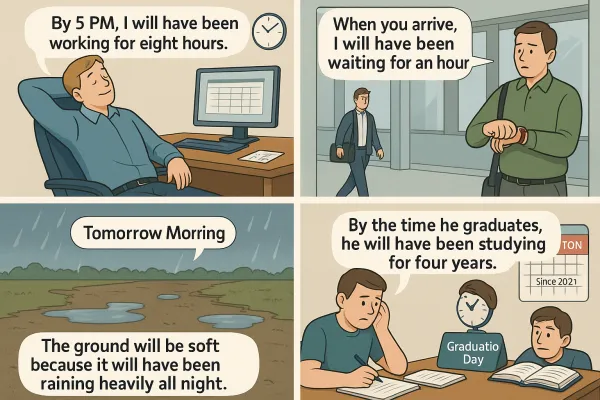
Understanding these usage cases helps you apply this tense flexibly and accurately, especially when emphasizing the continuity and duration of an action leading up to a future milestone.
Actions continuing up to a specific point in the future
- This is the primary usage, emphasizing the duration and process of an action that will be ongoing or just finished at a specific future time.
- It is often used with time expressions (for, since, all day/morning/week) and a future time phrase (by…, when…).
Example: By the time he retires next year, he will have been working for this company for 30 years.
Example: On Saturday, we will have been driving for 10 hours when we reach our destination.
- Comparison with Future Perfect Simple:
- Future Perfect Continuous (emphasizing process/duration): By the end of this month, I will have been studying English for six months. (Emphasizes the continuous process of studying.)
- Future Perfect Simple (emphasizing result/completion): By the end of this month, I will have completed six English modules. (Emphasizes the result that 6 modules are finished.)
- Note: State verbs such as know, believe, understand, like, love, hate, want, need, seem, possess, own, belong, have (possession)… are generally not used in continuous tenses. In these cases, use the Future Perfect Simple instead.
Example: By next year, I will have known her for five years. (DO NOT use I will have been knowing her).
Expressing the cause of a future event
- The action in the Future Perfect Continuous acts as a cause that has been ongoing and leads to a result or state in the Future Simple (or another future tense).
Example: He will be exhausted by tonight because he will have been working on the project all day.
Example: The ground will be soft because it will have been raining heavily for hours.
- Application: Adds depth to narratives or arguments by clarifying long-term causal relationships in the future.
In Reported Speech
When the direct speech is in the Present Perfect Continuous or Past Perfect Continuous, they often shift back or remain the same in reported speech, depending on the context.
Example: She said, “By next week, I will have been teaching for 10 years.” She said that by next week, she would have been teaching for 10 years. (Will shifts to would.)
Identifying the Future Perfect Continuous
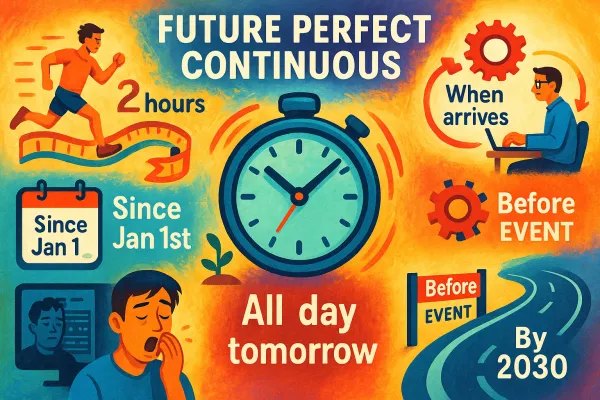
Correctly identifying the tense is crucial for understanding the meaning of a sentence. The Future Perfect Continuous is often accompanied by adverbs, time phrases, and conjunctions that establish sequence and continuity in the future.
Phrases indicating duration leading up to a future point:
- For + duration: for two hours, for ages, for a long time, for many years… (Usually followed by a future time marker).
Example: By the time she finishes, she will have been studying for six hours.
- Since + past/present time marker: since Monday, since 2020, since he left… (Usually followed by a future time marker).
Example: By next year, I will have been working here since 2020.
- All day / All morning / All week / All year (in the future):
Example: Tomorrow, I will have been travelling all day when I arrive at the destination.
Conjunctions connecting two actions/time points in the future: (The action in the Future Perfect Continuous happens first and continues until the action in the Present Simple).
- When:
Example: When you call, I will have been waiting for an hour.
- Before / By the time:
Example: By the time he graduates, he will have been learning English for 10 years.
Implicit Context: Sometimes, without specific connectors or adverbs, the reader/listener can still infer the cause-effect relationship extending into the future.
Example: He’ll be exhausted when he finishes the marathon. He will have been running for hours.
Rules for Conjugating the Future Perfect Continuous
Conjugating this tense correctly requires the use of the auxiliary “will have been” and the present participle (V-ing) form of the main verb.
Main verb in Present Participle (V-ing) form
This is a key rule. (The rules for adding -ing are the same as in the Present Continuous, Present Perfect Continuous, and Past Continuous).
- work working
- make making
- run running
- study studying
The auxiliary “will have been” remains unchanged
- This is a convenient aspect of the Future Perfect Continuous. The auxiliary phrase “will have been” is always used, regardless of whether the subject is first, second, or third person, singular or plural.
Example: I will have been studying.
Example: He will have been studying.
Example: They will have been studying.
The Future Perfect Continuous in Specific Contexts
a. In General Academic Writing
The Future Perfect Continuous is very useful when presenting predictions about ongoing processes or the development of trends in the future, and their continuous impact.
- Predicting research or development processes that will be ongoing:
Example: By the time the new vaccine is available, scientists will have been conducting clinical trials for over two years.
- Describing trends that will continue over a long period in the future:
Example: It is anticipated that artificial intelligence will have been transforming various industries for decades by the mid-century.
b. In IELTS Writing Task 1 (Academic – Describing charts, maps, processes)
This tense is less common in Task 1 but can be used when describing trends or activities that continue up to a specific point on a forecast chart.
Example: By 2050, the global population will have been growing exponentially for over a century, putting immense pressure on natural resources.
Note: Usually, Future Perfect Simple (“will have grown”) or Future Continuous (“will be growing”) are more common. Only use the continuous form when you want to clearly emphasize the continuity of the process up to that point.
c. In IELTS Writing Task 1 (General Training – Letter writing)
The Future Perfect Continuous is useful when you need to explain a situation that will be ongoing until a future point.
Example: I am writing to request an extension for the project deadline. By the original due date, I will have been working on another urgent task for two weeks, leaving me insufficient time.
d. In IELTS Writing Task 2 (Essay writing)
The Future Perfect Continuous helps add depth to arguments by describing trends, processes, or causes that will continue into the future.
- When predicting processes that will last into the future and their impacts:
Example: If current consumption patterns persist, environmental degradation will have been worsening for decades by the time effective global policies are implemented.
- Describing the continuous development of an issue:
Example: By the time students finish their higher education, they will have been relying on digital learning tools for most of their academic lives.
e. In IELTS Speaking Part 1 (Answering personal questions)
This tense is rarely used, but it can be used when you want to describe an action continuing up to a future point.
Example:
Q: What will you be doing by the time you’re 30? A: By the time I’m 30, I will have been working in my field for almost 8 years.
f. In IELTS Speaking Part 2 (Long Turn)
You can use the Future Perfect Continuous when describing a personal goal or a future event that you expect to achieve after a long process.
Example: (Describe a long-term goal) One of my biggest goals is to achieve fluency in English. By the end of next year, I will have been studying intensely for two years, and I hope to see significant progress.
Example: (Describe a future trip) By the time we reach our destination, we will have been travelling for over 24 hours. I’m sure it will be exhausting but worthwhile.
g. In IELTS Speaking Part 3 (In-depth discussion)
The Future Perfect Continuous helps discuss more complex predictions about the future, especially regarding long-term processes or trends.
- Discussing social or technological processes that will continue in the future:
Example: Do you think by 2050, humanity will have been exploring space for over a century, leading to potential colonization of other planets?
- Predicting the continuous development of an issue:
Example: If current rates of technological advancement continue, society will have been adapting to new digital tools at an unprecedented pace for many years.
Upgrading your expression with the Future Perfect Continuous in IELTS
To make your writing and speaking more natural, flexible, and impressive, using a variety of structures and adverbs with the Future Perfect Continuous is essential.
a. Using adverbs and phrases to emphasize duration/continuity:
- Continuously / Constantly / Relentlessly:
Example: By 2040, climate change will have been relentlessly impacting global ecosystems.
- For an extended period / For a sustained duration:
Example: The project team will have been collaborating on this complex issue for a sustained duration before finding a solution.
- Throughout [period]:
Example: Next month, I will have been working on my thesis throughout the entire semester.
b. Combining with other tenses accurately:
- Future Perfect Continuous + Present Simple (in time clauses):
Example: When the new regulations come into effect, companies will have been preparing for months.
- Future Perfect Continuous + Future Perfect Simple: (Continuous to emphasize the process, Simple to emphasize the result of that process).
Example: By the time I retire, I will have been teaching for 30 years, and I will have influenced thousands of students.
c. Using structures indicating prediction or possibility:
- It is likely that… will have been + V-ing:
Example: It is likely that by next year, the economy will have been recovering for some time.
- There is a strong possibility that… will have been + V-ing:
Example: There is a strong possibility that by then, technology will have been reshaping society in unprecedented ways.
Important notes for IELTS:
- Accuracy: Ensure the correct “will have been + V-ing” structure. Be especially careful with state verbs (switch to Future Perfect Simple).
- Range: Use the Future Perfect Continuous purposefully to emphasize continuity and duration. Avoid overusing it.
- Coherence and Cohesion: Use time conjunctions (“by”, “when”, “before”) and time adverbs (“for”, “since”, “all day”, “throughout”) accurately to link ideas and clarify time relationships.
- Lexical Resource: Using advanced adverbs and sophisticated expressions will help you achieve a higher score.
Exercises and Answer Key
Exercise 1: Conjugate the verbs in brackets (Future Perfect Continuous).
- By 6 PM, I (wait) ____________ for an hour.
- This time next year, she (study) ____________ at university for two years.
- When he arrives, we (work) ____________ on the project all morning.
- By the end of this month, I (learn) ____________ English for three years.
- How long (you / live) ____________ in this city by the time you graduate?
- He (not travel) ____________ for long when his car breaks down tomorrow.
- The company (build) ____________ this factory for five years by next December.
- By the time she finds a new job, she (look) ____________ for six months.
Exercise 2: Rewrite into complete sentences using the Future Perfect Continuous or Present Simple (for subordinate clauses).
- (By / next March / I / work / here / for / five years)
Chia sẻ:


 Khai giảng Khóa học Hè cực HOT.
No comments yet!