


Tóm Tắt Nội Dung Bài Viết
Have you ever tried to picture yourself at a specific moment in the future? Maybe you’re wondering what you’ll be doing at 8 PM tomorrow, or where you’ll be at this exact time next week. To talk about moments where an action will be in progress at a certain point in the future, we use a specialized grammatical tense: the Future Continuous Tense.
This tense allows you to “place yourself” in a future context and describe activities that will be ongoing. Mastering it not only makes your conversations about the future more vivid but also demonstrates a sophisticated command of English grammar. It is an essential tool, especially when you need to plan in detail or predict events that will be unfolding.
What is the Future Continuous?
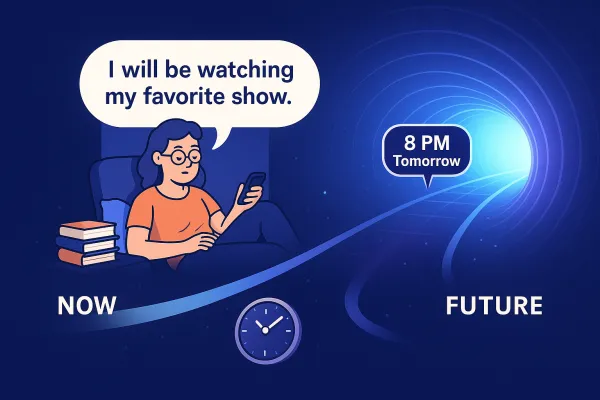
The Future Continuous tense is used to describe:
-
An action that will be in progress at a specific point in the future: The action starts before that moment and continues through it.
Example: At 8 PM tomorrow, I will be watching my favorite show.
Example: This time next year, they will be living in London.
-
Two or more actions happening in parallel in the future: These actions occur simultaneously.
Example: While I will be cooking dinner, my husband will be helping the kids with their homework.
Example: They will be working on the project, and we will be preparing the presentation.
-
An ongoing future action interrupted by a shorter one: The ongoing action (in Future Continuous) is interrupted by a shorter action (in Present Simple, as future time clauses do not use future tenses).
Example: I will be having dinner when you call me.
Example: She will be studying when her parents get home.
-
Asking or predicting what someone will be doing (politely):
Example: Will you be using the computer later?
Example: I wonder what he will be doing this time next week.
Future Continuous Formulas
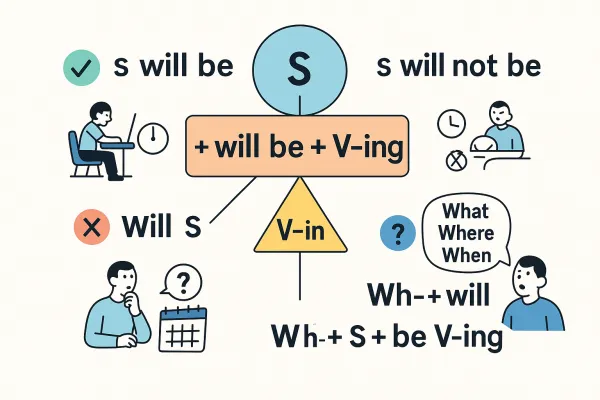
Mastering the formula helps you construct grammatically correct sentences, especially by using the “will be + V-ing” structure correctly.
(Note: S: Subject, V-ing: Present Participle, O: Object, A: Adverbial) Contraction: will not = won’t
Key Point: The auxiliary verb “will” does not change based on the subject (whether singular, plural, or first/second/third person). The verb “be” and the main verb with “-ing” also remain unchanged, making conjugation in this tense quite straightforward.
Detailed Usage of the Future Continuous
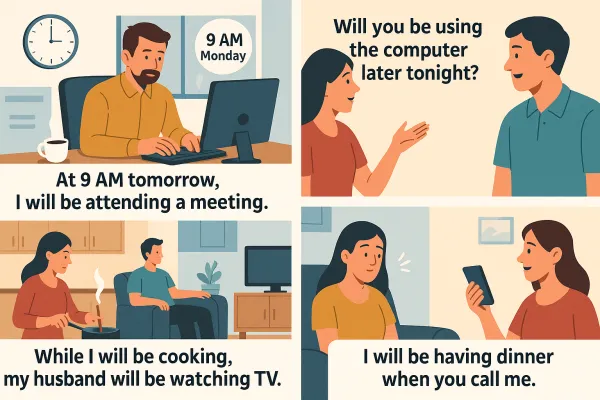
Understanding these use cases helps you apply the tense flexibly and accurately, especially when describing continuity, parallel actions, or the context of future events.
Actions in progress at a specific time in the future
- Emphasizes that the action will be ongoing and incomplete at a specific future milestone.
Example: At 10 AM tomorrow, I will be attending a meeting.
Example: This time next Monday, we will be flying over the Atlantic.
Application: Very useful for discussing schedules, specific future plans, or setting a scene.
Two or more parallel actions in the future
- Use “while” or “as” to connect clauses describing simultaneous actions.
Example: While I will be working on my laptop, my roommate will be playing video games.
Example: As the children will be sleeping, their parents will be watching a movie.
Application: Commonly used when planning simultaneous activities for multiple people or tasks.
Ongoing future action interrupted by a shorter action
- The long action uses Future Continuous (background action).
- The interrupting short action uses Present Simple (as it is a time clause for the future).
Example: She will be waiting when you arrive.
Example: I will be having lunch when you call me at 1 PM.
Application: Expressing situations where future events intersect.
Asking or predicting what someone will be doing
- This is often a more polite way to inquire about someone’s plans or speculate about their future activities.
Example: Will you be attending the conference next week? (Polite inquiry about a schedule.)
Example: I guess he will be studying for his exams all weekend.
Application: In daily communication, when you need to probe or make an uncertain assessment of someone else’s activities.
Describing a planned or expected event (less common than “be going to” or Present Simple)
- Can be used to describe something expected to happen as part of a larger plan or arrangement.
Example: The new stadium will be opening next year.
Example: The president will be meeting foreign dignitaries all morning.
Identifying the Future Continuous
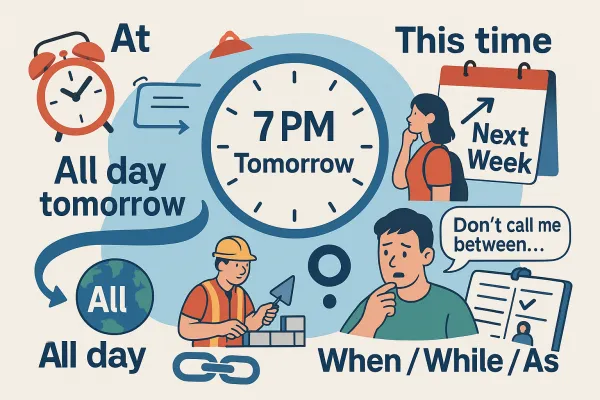
The Future Continuous is often accompanied by specific future time adverbs, phrases, or conjunctions connecting actions.
Specific future time markers:
- At + time: at 7 PM tomorrow, at 9 o’clock next Sunday…
Example: I will be having dinner at 7 PM tomorrow.
- This time + (future time marker): this time next week, this time next month…
Example: He will be flying to Japan this time next year.
- In + duration: (when discussing an action that will be continuous throughout that period).
Example: She will be travelling in the coming weeks.
- All day / All morning / All week / All year (in the future):
Example: It will be snowing all day tomorrow.
Conjunctions (for interrupted or parallel actions):
- When: (usually used with a Present Simple clause).
Example: He will be sleeping when you call.
- While / As: (connecting two parallel actions).
Example: While I will be working, my kids will be playing.
Implicit Context: Sometimes, the context alone is enough to imply the Future Continuous, especially when visualizing a future situation.
Example: Don’t call me between 2 and 3 PM. I will be having a meeting. (Implies the action will be continuous during that window.)
Conjugation Rules for Future Continuous
Accurate conjugation requires the correct use of the auxiliary “will be” and the main verb with the “-ing” suffix.
Adding “-ing” to the main verb (V-ing)
This follows the same rules as the Present Continuous and Present Perfect Continuous.
-
Basic rule: Add
-ingto the base form of the verb.- work working
- play playing
- study studying
-
Verbs ending in “-e”: Drop the “-e” and add “-ing”.
- make making
- write writing
- live living
-
One-syllable verbs ending in a consonant preceded by a vowel: Double the final consonant and add “-ing”.
- run running
- stop stopping
- swim swimming
-
Two-syllable verbs ending in a consonant preceded by a vowel, with stress on the final syllable: Double the final consonant and add “-ing”.
- begin beginning
- prefer preferring
The auxiliary “will be” remains constant
-
This is a major advantage of the Future Continuous. The auxiliary phrase “will be” is always used, regardless of the subject.
- Example: I will be studying.
- Example: He will be studying.
- Example: They will be studying.
Note: Stative verbs are generally not used in continuous tenses. In such cases, use the Future Simple (“will be”).
Example: I will be in London next week. (NOT I will be being in London).
Future Continuous in Specific Contexts
a. General Academic Writing
The Future Continuous can be used to describe projected phases of a process or trends that will be ongoing.
- Describing activities in a future study/project:
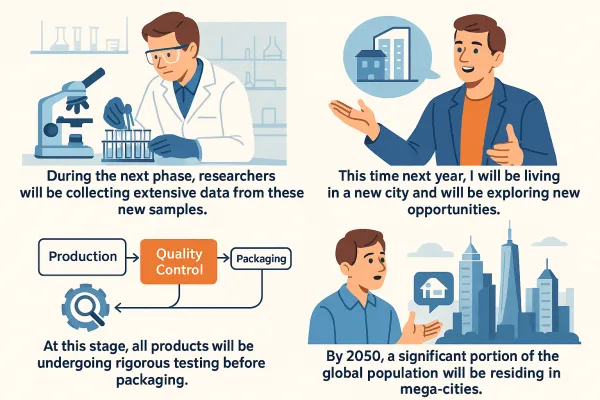
Example: During the next phase of the experiment, the researchers will be collecting data from the new sensors.
- Describing a trend that will continue:
Example: It is anticipated that global warming will be continuing to affect weather patterns significantly in the coming decades.
b. IELTS Writing Task 1 (Academic – Describing charts, maps, processes)
This tense is used to describe actions or processes that will be in progress at a specific time or over a period in the future, particularly in process diagrams.
- Describing stages in a future process:
Example: At the third stage, the products will be undergoing quality checks before packaging.
- Describing future developments on a map:
Example: In 2030, a new residential complex will be built in the north, and simultaneously, the existing park will be undergoing extensive renovation.
c. IELTS Writing Task 1 (General Training – Letter writing)
The Future Continuous is very useful when detailing your plans or predicting an upcoming event.
- Stating specific plans:
Example: I will be travelling to London next week, so I won’t be able to attend the meeting in person.
Example: Please don’t call me between 9 AM and 12 PM tomorrow, as I will be having an important exam.
d. IELTS Writing Task 2 (Essay writing)
The Future Continuous adds depth to arguments by describing trends or situations that will be unfolding.
- Predicting future trends:
Example: As automation advances, a significant portion of the workforce will be retraining for new roles.
- Describing a situation at a specific future point:
Example: By 2050, it is predicted that a large percentage of the world’s population will be living in urban areas.
e. IELTS Speaking Part 1 (Personal questions)
Use the Future Continuous when asked about activities at a specific future time.
- Activities at a specific milestone:
- Q: What will you be doing at 7 PM tonight? A: At 7 PM, I will be having dinner with my family.
- Q: Will you be working this weekend? A: Yes, I will be working on Saturday morning.
f. IELTS Speaking Part 2 (Long Turn)
Although this part often focuses on the past, you can use the Future Continuous when:
- Describing a future activity:
Example: (Describe your ideal weekend) On my ideal weekend, I will be waking up late, then I will be having a leisurely breakfast, and in the afternoon, I will be reading a book by the beach.
- Setting the scene for a future event:
Example: (Describe a future event you are looking forward to) Next month, I’m going to a concert. I can imagine that when the band will be playing their first song, everyone will be cheering loudly.
g. IELTS Speaking Part 3 (Discussion)
The Future Continuous helps discuss trends, predictions, or ongoing future situations.
- Discussing social trends or general issues:
- Q: How do you think technology will be impacting jobs in the next decade? A: I believe many traditional jobs will be becoming automated, and new roles requiring different skills will be emerging.
- Q: What changes will be happening in education in the future? A: I think students will be learning more independently through online platforms, and teachers will be playing a more facilitative role.
Elevating Your IELTS Expression
To make your writing and speaking more natural, flexible, and impressive, use a variety of structures and adverbs with the Future Continuous.
Chia sẻ:



 Khai giảng Khóa học Hè cực HOT.
No comments yet!