


Tóm Tắt Nội Dung Bài Viết
Are you dreaming of studying abroad, moving to another country, or simply looking to level up your English proficiency? IELTS is the key that unlocks those doors to a brighter future. If you are searching for a structured, scientifically designed study guide perfect for beginners, Focus on IELTS Foundation is an essential resource you shouldn’t overlook.
1. Introduction to the Focus on IELTS Foundation Series
1.1. Objectives of the Series
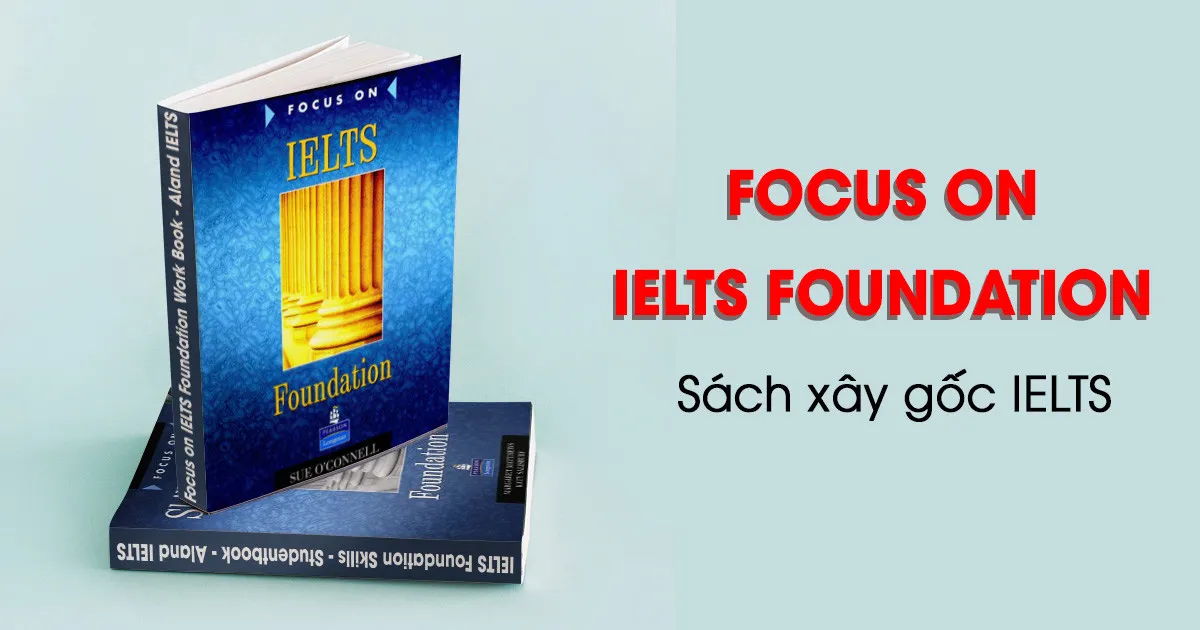
Focus on IELTS Foundation was developed by a team of language experts and experienced IELTS instructors at Pearson Longman. The series aims to:
- Provide a comprehensive foundation: Equip learners with the essential knowledge and skills to get comfortable with the IELTS exam, including vocabulary, grammar, and balanced development across all four skills: Listening, Speaking, Reading, and Writing.
- Establish a clear study roadmap: The series is designed with a scientific, logical structure, helping learners easily track their progress and achieve their goals.
- Foster engagement: Modern teaching methods, vivid illustrations, and diverse practice exercises keep learners motivated and interested in their studies.
- Suit a wide range of learners: The series is not just for beginners; it is also ideal for those looking to solidify their core knowledge before moving on to intensive IELTS preparation.
1.2. Key Highlights of Focus on IELTS Foundation
- Expertly curated: Developed by leading language experts and IELTS instructors, ensuring accuracy, relevance, and alignment with the latest IELTS exam trends.
- Reputable publisher: Pearson Longman is one of the world’s largest and most respected educational publishers, with years of experience in creating textbooks and IELTS prep materials.
- Modern approach: Blends theory with practice and academic knowledge with real-world application, helping learners develop their skills holistically.
- Rich supplementary materials: In addition to the Student’s Book, the series includes a Workbook and a Teacher’s Book, providing a complete learning ecosystem.
- Diverse, relatable topics: Lessons are built around familiar real-life themes and common IELTS topics, making it easy for learners to connect with and apply what they learn.
The Focus on IELTS Foundation series consists of 3 books:
- Focus on IELTS Foundation: Student’s Book (Skills Book): The core textbook for students, focusing on the comprehensive development of all four skills (Listening, Speaking, Reading, Writing) along with vocabulary and grammar.
- Focus on IELTS Foundation: Workbook: A supplementary practice book providing additional exercises to reinforce the knowledge gained in the Student’s Book.
- Focus on IELTS Foundation: Teacher’s Book: A guide for instructors, providing answer keys, teaching tips, and additional tests.
1.3. Target Audience
Focus on IELTS Foundation is the “perfect fit” for the following groups:
- Students: Those planning to study abroad or needing an IELTS certificate for future academic and career opportunities.
- Beginners: Those who are new to IELTS or have limited English proficiency (equivalent to A2-B1 on the CEFR scale).
- Foundation builders: Those looking to strengthen their grammar, vocabulary, and all four core skills before starting intensive IELTS training.
- English teachers: The series serves as a useful reference for teachers in planning lessons and guiding students through IELTS preparation.
2. Detailed Content of the Focus on IELTS Foundation Series
Focus on IELTS Foundation includes three main books:
- Focus on IELTS Foundation: Student’s Book (Skills Book)
- Focus on IELTS Foundation: Workbook
- Focus on IELTS Foundation: Teacher’s Book
2.1. Focus on IELTS Foundation: Student’s Book (Skills Book)
This book is the “heart” of the series, providing all the necessary knowledge and exercises for students to build a solid IELTS foundation.
Structure: The book is divided into 12 main units, each focusing on a familiar theme relevant to daily life and the IELTS exam (e.g., Education, Work, Health, Travel, Technology, etc.). Each unit follows a consistent structure, including:
-
- Getting Started: Introduces the topic, activates prior knowledge, and familiarizes students with related vocabulary and grammar.
- Vocabulary: Provides key topic-based vocabulary with definitions and illustrative examples.
- Grammar: Presents core grammar points in an easy-to-understand format with practice exercises.
- Listening: Practice for various IELTS listening task types (gap-fill, multiple choice, matching, etc.).
- Speaking: Diverse speaking practice (pronunciation, topic-based speaking, communication scenarios).
- Reading: Practice for various IELTS reading task types (comprehension, gap-fill, matching headings, etc.).
- Writing: Guidance on writing various IELTS task types (letters, essays, reports, etc.).
- Review: End-of-unit review to summarize knowledge and provide integrated practice exercises.
Detailed Lesson Content: Topics are carefully selected to cover a wide range of fields, helping students not only master IELTS-related vocabulary and grammar but also broaden their general knowledge of the world. For example:
-
- Unit 1: Education: Types of education, educational systems, benefits of learning, school subjects, etc.
- Unit 2: Work: Job types, essential work skills, job hunting, work environments, etc.
- Unit 3: Health: Healthcare, common illnesses, healthy lifestyles, nutrition, etc.
- … (and other topics)
Supplementary Materials:
-
- Grammar Reference: A summary of key grammar points.
- Vocabulary Bank: A list of topic-based vocabulary.
- Speaking Bank: Useful phrases and sentence patterns for the Speaking test.
- Writing Bank: Sample essays, sentence structures, and suggested vocabulary for the Writing test.
- Audioscripts: Transcripts for all listening exercises.
2.2. Focus on IELTS Foundation: Workbook
The Workbook is the perfect companion to the Student’s Book, offering extra exercises for students to practice and reinforce their learning.
Structure: The Workbook mirrors the structure of the Student’s Book, with each unit corresponding to a unit in the Student’s Book.
Content:
-
-
Vocabulary Practice: Diverse exercises to expand and reinforce vocabulary (gap-fills, matching, word formation, etc.).
-
Grammar Practice: Exercises to practice learned grammar structures (multiple choice, sentence writing, etc.).
-
Skills Practice:
- Listening: Additional listening tasks with various accents, speeds, and topics.
- Reading: Reading comprehension tasks with various question types.
- Writing: Writing exercises ranging from single sentences and paragraphs to short essays.
- Speaking: Additional topics and scenarios for speaking practice.
-
Check your progress: Self-assessment sections at the end of each unit to help students track their own progress.
-
Note: The Workbook typically does not include an answer key. Answers are provided in the Teacher’s Book.
2.3. Focus on IELTS Foundation: Teacher’s Book
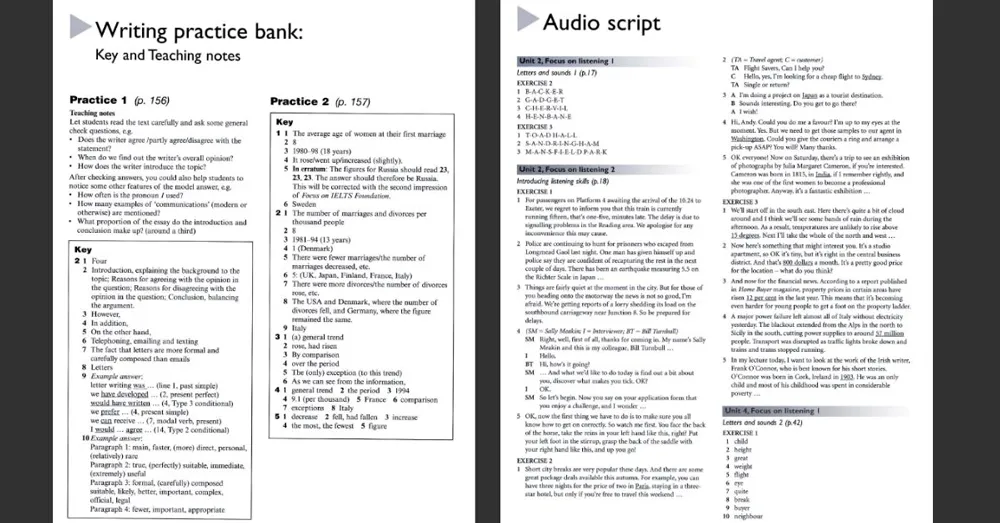
This book is a powerful tool for teachers, providing resources and support for classroom instruction.
Content:
-
- Answer Key: Detailed answers for all exercises in the Student’s Book and Workbook.
- Teaching Notes: Detailed guidance on how to teach each lesson, suggested activities, methodologies, and pedagogical tips.
- Extra Activities: Supplementary activities, games, and ideas to enrich your lessons.
- Tests: Mid-term and final tests to evaluate student progress.
- Cultural Notes: Information about cultures in English-speaking countries to help students understand communication contexts.
- Photocopiable Resources: Materials that can be copied for classroom use.
3. Pros and Cons (Detailed by Book)
3.1. Focus on IELTS Foundation: Workbook
Pros:
- Extra practice: Provides a large volume of exercises to help students reinforce their knowledge and skills.
- Aligned with the Student’s Book: Content is designed in parallel with the Student’s Book, ensuring a cohesive learning experience.
- Effective for self-study: Students can use the Workbook independently to review and test their knowledge.
Cons:
- No answer key: The Workbook usually doesn’t come with answers, which can be challenging for self-learners. (Answers are typically in the Teacher’s Book).
- Can be monotonous: Without interaction or guidance, doing exercises alone might lead to a decrease in motivation.
3.2. Focus on IELTS Foundation: Student’s Book
Pros:
- Comprehensive content: Covers all grammar, vocabulary, and the four core skills (Listening, Speaking, Reading, Writing).
- Clear structure: Each lesson is scientifically designed to help learners easily absorb and retain information.
- Modern approach: Uses vivid illustrations, diverse practice exercises, and relatable topics.
- Beginner-friendly: Accessible language, detailed explanations, and plenty of exercises ranging from basic to advanced.
- Rich supplementary materials: Grammar Reference, Vocabulary Bank, Speaking Bank, Writing Bank, and Audioscripts support effective self-study.
Cons:
- Limited focus on exam practice: As a foundation book, the number of full-length mock tests is limited.
- Some exercises may be too easy: For students with a higher level of English, some exercises might not be challenging enough.
3.3. Focus on IELTS Foundation: Teacher’s Book
Pros:
- Detailed and accurate answer keys: Saves teachers time and effort.
- Useful teaching guidance: Provides many ideas and suggestions for instructors.
- Supplementary tests: Helps teachers evaluate students comprehensively.
Cons:
- Cost: The Teacher’s Book is often more expensive than the Student’s Book.
- Unnecessary for self-study: If you are studying on your own, the Teacher’s Book may not be strictly necessary.
4. How to Study and Apply the Series Most Effectively
To maximize the effectiveness of the Focus on IELTS Foundation series, consider these study strategies, categorized by ECE:
4.1. Build a Roadmap and Adopt an Active Learning Approach:
-
Follow the sequence and plan ahead: Start from the first unit and follow the book’s order. The content is tightly integrated, so skipping lessons can cause difficulties later. Set clear goals (e.g., complete a certain number of units per week) and break them down into specific tasks (e.g., dedicate specific time each day to vocabulary, grammar, or listening practice).
-
Make the most of the book’s resources: Don’t just focus on the main lessons; utilize the supplementary sections like Grammar Reference, Vocabulary Bank, Speaking Bank, and Writing Bank. These are invaluable resources for reinforcing grammar, expanding vocabulary, and improving your speaking and writing skills.
4.2. Enhance Practice and Expand Learning Materials:
-
Practice diversely and consistently: Complete all exercises in both the Student’s Book and Workbook. Look for additional external resources such as online exercises, mock tests, or English learning apps. Diverse practice helps you get familiar with various task types and reinforces your knowledge.
-
Combine with other supplementary materials: Use dictionaries (both English-English and English-Vietnamese) to look up meanings and usage, refer to additional grammar books for deeper understanding, and use English learning apps for extra practice.
4.3. Create a Positive and Interactive Learning Environment:
-
Immerse yourself in English: Surround yourself with English as much as possible. Watch movies, listen to music, read news, or even change the language on your phone and computer to English. Regular exposure will help you get used to the language naturally.
-
Seek support and interaction: Study with friends, join English clubs, or enroll in an IELTS class. Group study provides extra motivation, opportunities to exchange knowledge, practice speaking, and receive guidance from teachers (if attending a class).
4.4. Develop Intensive Listening and Speaking Skills:
- Practice active and systematic listening: Listen to the audio tracks in the book repeatedly, while following along with the Audioscripts. Pay attention to pronunciation, intonation, and how native speakers link sounds. Listening practice not only improves your comprehension but also helps you learn standard pronunciation.
- Apply knowledge to real-life communication: Look for opportunities to use English in real-life situations. You can write emails, participate in online forums, or find a speaking partner.
4.5. Build Effective and Sustainable Study Habits:
- Take notes and review regularly: Keep a notebook for vocabulary, grammar structures, and useful phrases. Review your notes frequently to reinforce what you’ve learned.
- Self-assess and adjust: After each unit, test your knowledge by redoing exercises or finding online quizzes. Identify your strengths and weaknesses to adjust your study plan accordingly.
- Embrace mistakes and stay persistent: Learning a new language is a long journey. Don’t be afraid of making mistakes; see them as opportunities to learn and improve. Most importantly, stay motivated and don’t give up.
Focus on IELTS Foundation is an excellent series for anyone looking to start their journey toward conquering the IELTS. With its comprehensive content, modern approach, and scientific structure, this series will help you build a solid foundation and confidently step into more advanced preparation stages. Start studying today and turn your IELTS dreams into reality!
We hope this article has provided you with useful and detailed information about the Focus on IELTS Foundation series. Best of luck on your path to IELTS success!




 Khai giảng Khóa học Hè cực HOT.
No comments yet!