


Tóm Tắt Nội Dung Bài Viết
The reading passage “Fatal Attraction” is one of the most engaging yet challenging texts in the IELTS Reading module. It explores the fascinating world of carnivorous plants, covering everything from their hunting and digestive mechanisms to their evolutionary history. With detailed paragraphs on specific plant species and scientific research, this passage requires test-takers to possess strong scanning skills and the ability to identify specific information accurately.
ECE will help you break down the content, vocabulary, key structures, and provide detailed answer explanations along with effective strategies for tackling this passage.
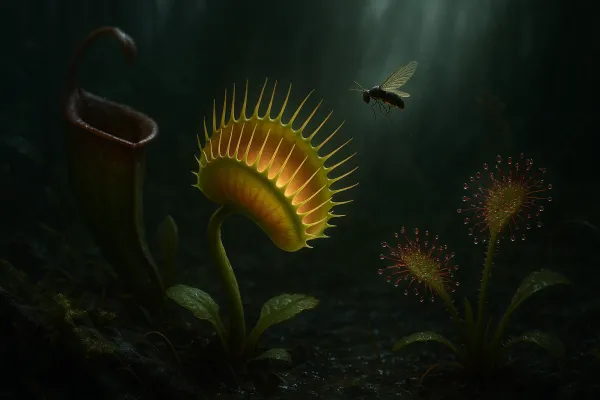
Fatal Attraction
Evolutionist Charles Darwin first marveled at flesh-eating plants in the mid-19th century. Today, biologists, using 21st-century tools to study cells and DNA, are beginning to understand how these plants hunt, eat and digest – and how such bizarre adaptations arose in the first place.
A
The leaves of the Venus flytrap plant are covered in hairs. When an insect brushes against them, this triggers a tiny electric charge, which travels down tunnels in the leaf and opens up pores in the leaf’s cell membranes. Water surges from the cells on the inside of the leaf to those on the outside, causing the leaf to rapidly flip in shape from convex to concave, like a soft contact lens. As the leaves flip, they snap together, trapping the insect in their sharp-toothed jaws.
B
The bladderwort has an equally sophisticated way of setting its underwater trap. It pumps water out of tiny bag-like bladders, making a vacuum inside. When small creatures swim past, they bend the hairs on the bladder, causing a flap to open. The low pressure sucks water in, carrying the animal along with it. In one five-hundredth of a second, the door swings shut again. The Drosera sundew, meanwhile, has a thick, sweet liquid oozing from its leaves, which first attracts insects, then holds them fast before the leaves snap shut. Pitcher plants use yet another strategy, growing long tube-shaped leaves to imprison their prey. Raffles’ pitcher plant, from the jungles of Borneo, produces nectar that both lures insects and forms a slick surface on which they can’t get a grip. Insects that land on the rim of the pitcher slide on the liquid and tumble in.
C
Many carnivorous plants secrete enzymes to penetrate the hard exoskeleton of insects so they can absorb nutrients from inside their prey. But the purple pitcher plant, which lives in bogs and infertile sandy soils in North America, enlists other organisms to process its food. It is home to an intricate food web of mosquito larvae, midges and bacteria, many of which can survive only in this unique habitat. These animals shred the prey that fall into the pitcher, and the smaller organisms feed on the debris. Finally, the plant absorbs the nutrients released.
D
While such plants clearly thrive on being carnivorous, the benefits of eating flesh are not the ones you might expect. Carnivorous animals such as ourselves use the carbon in protein and the fat in meat to build muscles and store energy. Carnivorous plants instead draw nitrogen, phosphorus, and other critical nutrients from their prey in order to build light-harvesting enzymes. Eating animals, in other words, lets carnivorous plants do what all plants do: carry out photosynthesis, that is, grow by harnessing energy directly from the sun.
E
Carnivorous plants are, in fact, very inefficient at converting sunlight into tissue. This is because of all the energy they expend to make the equipment to catch animals – the enzymes, the pumps, and so on. A pitcher or a flytrap cannot carry out much photosynthesis because, unlike plants with ordinary leaves, they do not have flat solar panels that can grab lots of sunlight. There are, however, some special conditions in which the benefits of being carnivorous do outweigh the costs. The poor soil of bogs, for example, offers little nitrogen and phosphorus, so carnivorous plants enjoy an advantage over plants that obtain these nutrients by more conventional means. Bogs are also flooded with sunshine, so even an inefficient carnivorous plant can photosynthesise enough light to survive.
F
Evolution has repeatedly made this trade-off. By comparing the DNA of carnivorous plants with other species, scientists have found that they evolved independently on at least six separate occasions. Some carnivorous plants that look nearly identical turn out to be only distantly related. The two kinds of pitcher plants – the tropical genus Nepenthes and the North American Sarracenia – have, surprisingly, evolved from different ancestors, although both grow deep pitcher-shaped leaves and employ the same strategy for capturing prey.
G
In several cases, scientists can see how complex carnivorous plants evolved from simpler ones. Venus flytraps, for example, share an ancestor with Portuguese sundews, which only catch prey passively, via ‘flypaper’ glands on their stems. They share a more recent ancestor with Drosera sundews, which can also curl their leaves over their prey. Venus flytraps appear to have evolved an even more elaborate version of this kind of trap, complete with jaw-like leaves.
H
Unfortunately, the adaptations that enable carnivorous plants to thrive in marginal habitats also make them exquisitely sensitive. Agricultural run-off and pollution from power plants are adding extra nitrogen to many bogs in North America. Carnivorous plants are so finely tuned to low levels of nitrogen that this extra fertilizer is overloading their systems, and they eventually burn themselves out and die.
Humans also threaten carnivorous plants in other ways. The black market trade in exotic carnivorous plants is so vigorous now that botanists are keeping the location of some rare species a secret. But even if the poaching of carnivorous plants can be halted, they will continue to suffer from other assaults. In the pine savannah of North Carolina, the increasing suppression of fires is allowing other plants to grow too quickly and outcompete the flytraps in their native environment. Good news, perhaps, for flies. But a loss for all who, like Darwin, delight in the sheer inventiveness of evolution.
Questions 14 – 18: Complete the notes below. Choose NO MORE THAN TWO WORDS from the passage for each answer.
How a Venus flytrap traps an insect
• Insect touches (14)…………………………….on leaf of plant
• Small (15)……………………………..passes through leaf
• (16)…………………………….in cell membrane open
• Outside cells of leaves fill with (17)…………………………….
• Leaves change so that they have a (18)………………………………..shape and snap shut
Questions 19 – 22: Look at the following statements (Questions 19-22) and the list of plants. Match each statement with the correct plant, A, B, C, D or E. Write the correct letter, A, B, C, D or E, in boxes 19-22 on your answer sheet.
19. It uses other creatures to help it digest insects.
20. It produces a slippery substance to make insects fall inside it.
21. It creates an empty space into which insects are sucked.
22. It produces a sticky substance which traps insects on its surface.
List of plants
A Venus flytrap
B bladderwort
C Drosera sundew
D Raffles’ pitcher plant
E purple pitcher plant
Questions 23 – 26
Reading Passage 2 has nine paragraphs, A-I.
Which paragraph contains the following information?
23 a mention of a disadvantage of the leaf shape of some carnivorous plants
24 an example of an effort made to protect carnivorous plants
25 unexpected information about the origins of certain carnivorous plants
26 an example of environmental changes that shorten the life cycles of carnivorous plants
Overview of the Reading Passage
“Fatal Attraction” is a compelling scientific piece inspired by Charles Darwin’s early discoveries regarding carnivorous plants. This article goes beyond mere description, delving into their complex predatory mechanisms and their remarkable evolutionary journey.
The content is divided into several sections, each revealing a unique aspect:
- Sophisticated hunting mechanisms: You will learn how plants like the Venus flytrap, sundew, and pitcher plant use unique tactics—from snap traps and sticky traps to vacuum traps—to capture prey.
- The true purpose of carnivory: The passage explains the surprising fact that these plants do not consume insects for energy, but rather to absorb essential nutrients like nitrogen and phosphorus, which they cannot obtain from infertile soil.
- Independent evolution: You will discover that carnivorous plants, despite their similar appearances, have evolved independently in many cases, demonstrating nature’s ingenuity in adapting to harsh environments.
- Existing threats: The passage highlights the dangers posed by humans and the environment to these rare species, ranging from illegal trade to pollution.
In short, “Fatal Attraction” is a comprehensive reading passage that blends plant biology with evolutionary history, helping readers improve their knowledge while honing deep reading comprehension skills.
Key Vocabulary & Structures
Mastering academic vocabulary and industry-specific terms is key to understanding this passage.
Detailed Answer Key and Explanations for Fatal Attraction
1. Task Type: Flow Chart Completion
This task requires you to find specific information following a sequence. The tip is to fill in keywords from the passage into the chart, adhering to word limits and the order of information.
- Question 14: hairs
- Location: “The leaves of the Venus flytrap plant are covered in hairs.”
- Question 15: (electric) charge
- Location: “When an insect brushes against them, this triggers a tiny electric charge.”
- Question 16: pores
- Location: “…and opens up pores in the leaf’s cell membranes.”
- Question 17: water
- Location: “Water surges from the cells on the inside of the leaf to those on the outside…”
- Question 18: concave
- Location: “…the leaf to rapidly flip in shape from convex to concave…”
2. Task Type: Matching Plants
This task requires you to connect descriptions to the corresponding plant. The tip is to locate each plant name in the text and read the surrounding information carefully.
- Question 19: It uses other creatures to help it digest insects.
Answer: E. purple pitcher plant.
Location: Paragraph C states that the purple pitcher plant “enlists other organisms to process its food.”
- Question 20: It produces a slippery substance to make insects fall inside it.
Answer: D. Raffles’ pitcher plant.
Location: Paragraph B mentions that Raffles’ pitcher plant “produces nectar that both lures insects and forms a slick surface on which they can’t get a grip.”
- Question 21: It creates an empty space into which insects are sucked.
Answer: B. bladderwort.
Location: Paragraph B states that the bladderwort “pumps water out of tiny bag-like bladders, making a vacuum inside.”
- Question 22: It produces a sticky substance which traps insects on its surface.
Answer: C. Drosera sundew.
Location: Paragraph B mentions that the Drosera sundew “has a thick, sweet liquid oozing from its leaves, which first attracts insects, then holds them fast…”
3. Task Type: Matching Information
This task requires you to find the paragraph containing specific information. The tip is to skim the paragraphs for the main idea, then use scanning skills to find keywords.
- Question 23: a mention of a disadvantage of the leaf shape of some carnivorous plants.
Answer: E.
Location: Paragraph E states: “A pitcher or a flytrap cannot carry out much photosynthesis because, unlike plants with ordinary leaves, they do not have flat solar panels that can grab lots of sunlight.” This is a disadvantage due to leaf shape.
- Question 24: an example of an effort made to protect carnivorous plants.
Answer: H (Note: Paragraph H contains the protection effort).
Location: Paragraph H mentions that botanists are “keeping the location of some rare species a secret.” This is an effort to protect them from poaching.
- Question 25: unexpected information about the origins of certain carnivorous plants.
Answer: F.
Location: Paragraph F states: “Some carnivorous plants that look nearly identical turn out to be only distantly related… The two kinds of pitcher plants… have, surprisingly, evolved from different ancestors…”
- Question 26: an example of environmental changes that shorten the life cycles of carnivorous plants.
Answer: H.
Location: Paragraph H discusses “Agricultural run-off and pollution… adding extra nitrogen to many bogs… this extra fertilizer is overloading their systems, and they eventually burn themselves out and die.”
Conclusion
The reading passage “Fatal Attraction” is a clear demonstration that IELTS Reading tests not only your reading ability but also your general knowledge and analytical skills. By mastering scanning strategies, identifying synonyms, and carefully analyzing each question type, you will easily handle complex passages like this one. We hope this detailed analysis from ECE English helps you feel more confident on your journey to achieving a high band score in your upcoming IELTS exam.




 Khai giảng Khóa học Hè cực HOT.
No comments yet!