


Tóm Tắt Nội Dung Bài Viết
In IELTS Writing Task 2, lexical flexibility and range are key factors in achieving a high band score. One of the most effective ways to demonstrate this is through the strategic use of synonyms. Utilizing synonyms not only helps you avoid redundant repetition—making your writing more coherent and natural—but also serves as clear evidence of a wide-ranging vocabulary, which is a core component of the Lexical Resource criterion.
Furthermore, mastering synonyms allows you to effectively paraphrase the prompt and your main ideas, showcasing a deep understanding of the topic and an ability to express yourself fluidly. This is particularly important for ensuring the examiner sees that you are not merely copying the prompt, but are capable of transforming language into an academic style. Let’s join ECE in exploring this topic in detail!
What Are Synonyms and Why Are They Essential?
Fundamentally, synonyms are words with the same or very similar meanings. A simple example would be beautiful and pretty. However, in an academic environment like IELTS, a deep understanding of synonyms goes far beyond this basic definition. It is rare for two English words to be perfectly synonymous and interchangeable in every context without altering the tone or level of formality.
The key differences lie in nuance, formality, and context. For instance, big, huge, enormous, and colossal all mean “large,” but colossal implies something “extraordinarily large” and is typically used in formal contexts or to emphasize extreme intensity. Choosing the right synonym with the appropriate nuance will elevate your writing, rather than just acting as a word replacement. A poor choice can make a sentence feel awkward or even distort the original meaning.
Common Synonym Groups by Topic and Function in IELTS Writing Task 2
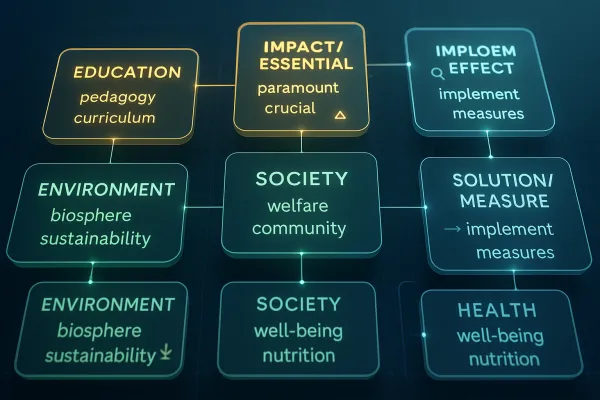
To help you approach and apply synonyms effectively, we have categorized them into two main groups: functional words (applicable across many topics) and topic-specific words common in IELTS Writing Task 2. Each group includes an analysis of nuance, collocations, and specific examples.
A. Functional Synonym Groups (Commonly used in all essays)
- Words for “Important/Essential”:
- Common words: important, crucial, essential, vital, significant, pivotal, indispensable, paramount, fundamental.
- Analysis & Collocations:
- Crucial/Essential/Vital: Expresses absolute necessity. E.g., It is crucial for governments to address global warming.
- Significant: Meaningful or substantial. E.g., There has been a significant increase in online learning.
- Pivotal: Acting as a key turning point. E.g., Education plays a pivotal role in societal development.
- Indispensable: Something that cannot be done without. E.g., Internet access has become indispensable in modern life.
- Paramount: Of the highest importance. E.g., Public health is of paramount importance.
- Fundamental: Basic or foundational. E.g., Access to clean water is a fundamental human right.
- Words for “Impact/Effect”:
- Common words: impact, effect, influence, consequence, repercussion, ramification.
- Analysis & Collocations:
- Impact/Effect/Influence: The most common terms. E.g., Technology has a profound impact on daily life.
- Consequence: A result (usually neutral or negative). E.g., The economic crisis had severe consequences for many families.
- Repercussion: A negative consequence that is often unintended and far-reaching. E.g., Environmental degradation has long-term repercussions for future generations.
- Ramification: A complex, often unwelcome consequence with many branches. E.g., The new policy has complex ramifications for various sectors.
- Words for “Problems/Challenges”:
- Common words: problem, issue, challenge, dilemma, predicament, difficulty, concern.
- Analysis & Collocations:
- Issue/Concern: A general matter or point of worry. E.g., Poverty remains a pressing issue in many developing countries.
- Challenge: A difficulty that needs to be overcome. E.g., One significant challenge facing modern society is youth unemployment.
- Dilemma: A difficult situation where one must choose between two often undesirable options. E.g., Governments often face a dilemma between economic growth and environmental protection.
- Predicament: A difficult, unpleasant, or embarrassing situation that is hard to get out of. E.g., Many elderly people find themselves in a financial predicament.
- Words for “Solutions/Measures”:
- Common words: solution, measure, approach, strategy, remedy, intervention.
- Analysis & Collocations:
- Solution: The answer to a problem. E.g., Finding a sustainable solution to plastic waste is crucial.
- Measure/Strategy: An action or plan taken to achieve a goal. E.g., Governments should implement effective measures to curb air pollution.
- Approach: A way of dealing with something. E.g., A multi-faceted approach is needed to tackle social inequality.
- Remedy: A way of solving or correcting a problem. E.g., Education is often seen as a remedy for social ills.
- Intervention: Action taken to improve a situation. E.g., Governmental intervention may be necessary to protect endangered species.
- Words for “Agree/Disagree”:
- Common words (Agree): agree, concur, endorse, advocate, support, subscribe to the view.
- Analysis & Collocations:
- Concur: To be of the same opinion (more formal than agree). E.g., I concur with the idea that lifelong learning is essential.
- Endorse/Advocate: To publicly support or recommend. E.g., Many experts advocate for stricter regulations on social media usage.
- Subscribe to the view: To agree with a specific perspective. E.g., I subscribe to the view that parents play a primary role in a child’s education.
- Common words (Disagree): disagree, oppose, refute, challenge, dispute, reject the notion.
- Analysis & Collocations:
- Oppose: To be against something. E.g., Some argue that capital punishment is morally opposed to human rights.
- Refute: To prove a statement or theory to be wrong. E.g., It is difficult to refute the claim that fossil fuels contribute to climate change.
- Dispute: To question whether a statement is true or valid. E.g., Many people dispute the claim that fast food can be part of a healthy diet.
B. Topic-Specific Synonym Groups
- Topic: “Education”:
- Education: schooling, learning, instruction, academia, pedagogy, upbringing.
- Students: learners, pupils, trainees, undergraduates, postgraduates, scholars, apprentices.
- Teachers: educators, instructors, lecturers, professors, tutors.
- Curriculum: syllabus, course, programme of study, educational content.
- Example: Modern pedagogy often emphasizes student-centered learning over traditional instruction. Many scholars advocate for continuous learning throughout one’s life.
- Topic: “Environment”:
- Environment: ecosystem, natural world, biosphere, surroundings, habitat.
- Pollution: contamination, degradation, deterioration, effluence, emission, fumes, waste.
- Protect: preserve, conserve, safeguard, sustain, shield, defend.
- Distinction: Protect (general protection from danger). Preserve (to keep in its original state). Conserve (to protect or use resources wisely). Safeguard (to protect from harm).
- Global warming: climate change, greenhouse effect, rising global temperatures.
- Traffic congestion: traffic jam, peak hour, rush hour.
- Example: Protecting the biosphere is a shared responsibility, especially given the threat of climate change. Governments must implement measures to reduce harmful emissions.
- Topic: “Society”:
- Society: community, populace, public, citizens, inhabitants, population, civilization.
- People: individuals, human beings, populace, citizenry, residents, inhabitants.
- Government: authorities, administration, regime, ruling body, state.
- Poverty: destitution, indigence, impoverishment, hardship.
- Equality: equity, fairness, parity, impartiality.
- Example: Governments play a crucial role in improving the living standards of the populace and tackling social inequality. Addressing poverty requires collective efforts from the community.
- Topic: “Technology”:
- Technology: innovation, advancements, digital tools, ICT (Information and Communication Technology), modern machinery.
- Development: progress, evolution, advancement, growth, expansion.
- Internet: online platforms, cyberspace, digital realm, virtual world, World Wide Web.
- Example: Rapid advancements in ICT have transformed various aspects of daily life, creating a global digital realm. The constant evolution of technology presents both opportunities and challenges.
- Topic: “Health”:
- Health: well-being, welfare, public health, physical fitness, mental health.
- Illness: disease, ailment, malady, infirmity, sickness, condition.
- Healthcare: medical services, public health system, clinical care, health provision.
- Example: Promoting public well-being should be a priority for all nations, requiring robust healthcare systems. Many people suffer from chronic ailments due to unhealthy lifestyles.
Related articles:
How to Write Advantages & Disadvantages Essays in IELTS Writing Task 2
How to Write “Discuss Both Views” Essays in IELTS Writing Task 2
Effective Strategies for Learning and Applying Synonyms in IELTS Writing Task 2
Learning synonyms is more than just memorizing a list of words. To use them naturally and accurately in the exam, you should apply the following strategies:
- Learn by Topic and Collocations: Instead of learning isolated words, group them by topic and learn the phrases they typically appear in. For example, instead of just learning problem, learn address a problem, tackle an issue, face a challenge.
- Use Dictionaries and Thesauruses Wisely: When looking up a word, don’t just stop at the definition. Look at the suggested synonyms, read their definitions, and study the example sentences. Pay close attention to labels (formal/informal, C/U – countable/uncountable) and how they are used in context.
- Practice Active Paraphrasing: Regularly practice rewriting exam prompts and your own topic sentences in multiple ways, using various synonyms and grammatical structures.
- Read Widely and Take Selective Notes: Read news articles, scientific journals, academic books, or high-band IELTS sample essays. When you encounter a new word or an interesting synonym, record it in your vocabulary notebook along with its context, collocations, and an original example sentence.
- Create Your Own Vocabulary “Collection”: Maintain a well-organized notebook or digital document where you note synonym groups by topic, important collocations, and effective paraphrasing structures. This makes it easier to review and consolidate your knowledge.
Common Pitfalls When Using Synonyms and How to Avoid Them
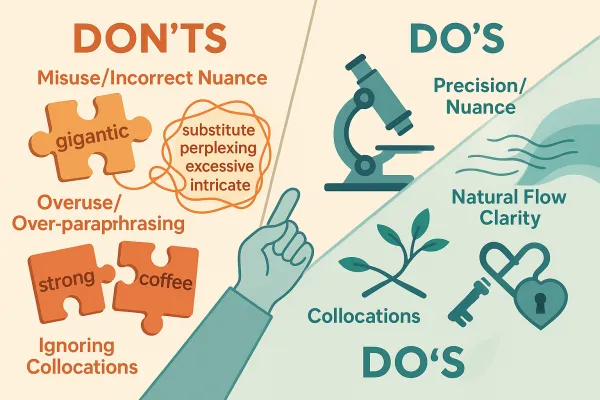
While synonyms are vital, using them incorrectly can backfire and lower your score. Here are common mistakes and how to fix them:
- Misusing Nuance or Context:
- The Problem: Using massacre instead of kill in an inappropriate context, making the sentence sound hyperbolic or incorrect.
- How to avoid: Always double-check the definition, nuance, and examples of a new synonym in a dictionary. If you are unsure, stick to a simpler, safer word.
- Over-paraphrasing or Overuse:
- The Problem: Trying to replace every single word in a sentence with a synonym, which makes the writing feel forced, unnatural, and difficult to follow. This often destroys the coherence and cohesion of the essay.
- How to avoid: Use synonyms only when necessary to avoid repeating key terms or when you want to express a more precise nuance. Not every word needs to be replaced. Sometimes, repeating a key term is necessary for clarity.
- Choosing Overly Obscure or Unfamiliar Vocabulary:
- The Problem: Using rare or overly academic words that you don’t fully understand, leading to grammatical or contextual errors. This can give the impression that you are trying to show off rather than demonstrating proficiency.
- How to avoid: Prioritize accuracy and naturalness over complexity. Choose words you feel confident with and have seen used in standard academic contexts. The goal is clear and effective communication.
- Ignoring Collocations:
- The Problem: Focusing only on replacing individual words without considering the surrounding phrases, resulting in unnatural or ungrammatical word combinations. For example, saying do a decision instead of make a decision.
- How to avoid: Learn synonyms alongside their collocations. When you learn the word tackle, immediately associate it with tackle a problem/an issue. This helps you use the language as fluently and accurately as a native speaker.
In summary, mastering and flexibly using synonyms is an indispensable skill for achieving a high band score in IELTS Writing Task 2. It not only helps you avoid repetition but also allows you to demonstrate a rich vocabulary, effective paraphrasing skills, and sophistication in choosing words that fit the academic tone and context.
Remember, the key lies in deeply understanding each word, practicing regularly, and avoiding common pitfalls. By applying these learning strategies and using synonyms intelligently, you will significantly improve the quality of your writing and feel more confident facing the IELTS Writing Task 2 challenge.





 Khai giảng Khóa học Hè cực HOT.
No comments yet!