


Tóm Tắt Nội Dung Bài Viết
When deciding to learn English, many students find themselves torn between two paths: ESL (English as a Second Language) and IELTS (International English Language Testing System). While both aim to improve proficiency, their nature, objectives, and the opportunities they provide are vastly different. Understanding these core differences will not only save you time and effort but also help you design an effective learning roadmap tailored to your personal goals.
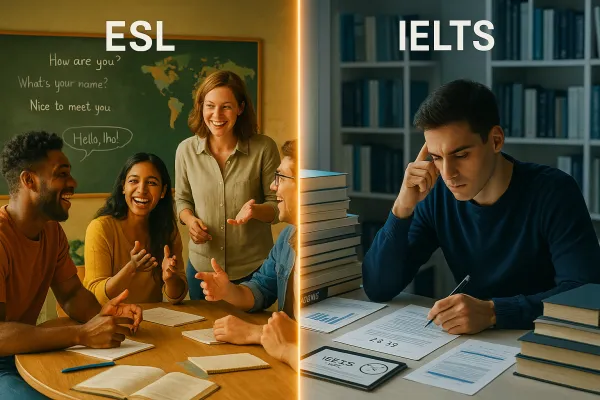
In-Depth Analysis: A Look at Educational Philosophy
This is the most profound difference that general articles rarely mention. ESL and IELTS differ not just in content, but in their teaching philosophy and their very reason for existing.
1. ESL: Language as a Life Skill
- Philosophy: ESL is an English training program focused on immersion and natural language usage. This philosophy views English not as a subject to be studied, but as a tool for communication, thinking, and integration. ESL courses are designed around real-life contexts, helping learners acquire the language through interactive activities, cultural discussions, and everyday problem-solving. The goal is to break down psychological barriers and help learners express ideas confidently, without being overly burdened by absolute grammatical precision or academic structures.
- Target Audience: Ideal for beginners, those looking to improve communication for travel, or anyone needing a solid foundation before moving to advanced levels. This is the “tool” you need to live and work in an English-speaking country.
2. IELTS: Language as an Academic Standard
- Philosophy: IELTS is a proficiency assessment system based on international academic standards. The philosophy of this exam is not to teach you how to speak English, but to test your ability to use English in academic and professional environments. Each section has a specific objective: Reading requires analytical thinking, Writing demands coherent argumentation, Listening tests information retrieval, and Speaking evaluates fluency and accuracy.
- Target Audience: Mandatory for those aiming to study abroad, work, or immigrate to countries like the UK, Australia, Canada, and New Zealand. IELTS is the “certification” that proves you have the linguistic capability to succeed in a university program or a professional setting.
Practical Comparison: Costs and Outcomes
Once you understand the philosophy, consider the practical factors that will influence your decision.
Should You Take IELTS or ESL?
Instead of viewing ESL and IELTS as mutually exclusive choices, you should see them as two stages of an effective English learning journey.
- The Foundational Phase (Study ESL):
- If you are a beginner or lack confidence in communication, spend time studying ESL. This is the stage where you build the “foundation” of your English house.
- Goal for this phase: Overcome hesitation, achieve basic conversational ability, understand simple stories or news, and express ideas clearly.
- The Goal-Oriented Phase (IELTS Preparation):
- Once you have a solid foundation, transition to IELTS preparation. Having developed good listening and speaking skills during the ESL phase, you will find it much easier to adapt to the exam structure and quickly reach your target band score.
- Goal for this phase: Achieve the IELTS score required by the school, company, or organization you are applying to.
Pro Tip: Do not rush into IELTS preparation if your foundation is not yet solid. Doing so is not only a waste of money but can also lead to burnout and frustration. View ESL as an investment in life skills, and IELTS as an investment in your academic and professional future.
ESL is the path to living your life in English, while IELTS is the tool to prove you can live and study in English. Clearly define your goals and accurately assess your current level to make the best decision. The right choice will help you not only reach your targets but truly master this incredible language.





 Khai giảng Khóa học Hè cực HOT.
No comments yet!