


Tóm Tắt Nội Dung Bài Viết
Entertainment & Engineering topics always make for fascinating reading in IELTS. The passage “Roller Coaster” not only explores the history of these rides—from Russian ice slides to the modern-day “metal monsters”—but also explains the physics behind the thrill.
This article from ECE Language Center provides the full reading passage, a bilingual translation, a breakdown of technical vocabulary, and detailed explanations for every answer. Let’s dive in!
IELTS Reading Passage: Roller Coaster
Paragraph A 600 years ago, roller coaster pioneers never would have imagined the advancements that have been made to create the roller coasters of today. The tallest and fastest roller coaster in the world is the Kingda Ka, a coaster in New Jersey that launches its passengers from zero to 128 miles per hour in 3.5 seconds (most sports cars take over four seconds to get to just 60 miles per hour). It then heaves its riders skyward at a 90-degree angle (straight up) until it reaches a height of 456 feet, over one and a half football fields, above the ground, before dropping another 418 feet (Coaster Grotto “Kingda Ka”). With that said, roller coasters are about more than just speed and height; they are about the creativity of the designers that build them, with each coaster having its own unique way of producing intense thrills at a lower risk than the average car ride. Roller coasters have evolved drastically over the years, from their primitive beginnings as Russian ice slides to the metal monsters of today. Their combination of creativity and structural elements makes them one of the purest forms of architecture.
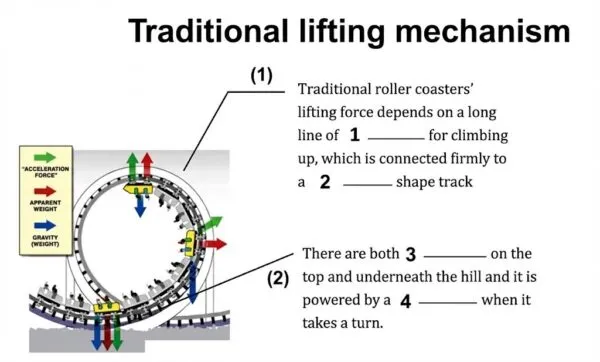
Paragraph B At first glance, a roller coaster is something like a passenger train. It consists of a series of connected cars that move on tracks. But unlike a passenger train, a roller coaster has no engine or power source of its own. For most of the ride, the train is moved by gravity and momentum. To build up this momentum, you need to get the train to the top of the first hill or give it a powerful launch. The traditional lifting mechanism is a long length of chain running up the hill under the track. The chain is fastened in a loop, which is wound around a gear at the top of the hill and another one at the bottom. The gear at the bottom of the hill is turned by a simple motor. This turns the chain loop so that it continually moves up the hill like a long conveyor belt. The coaster cars grip onto the chain with several “chain dogs,” sturdy hinged hooks. When the train rolls to the bottom of the hill, the dogs catch onto the chain links. Once the chain dog is hooked, the chain simply pulls the train to the top of the hill. At the summit, the chain dog is released and the train starts its descent down the hill.
Paragraph C Roller coasters have a long, fascinating history. The direct ancestors of roller coasters were monumental ice slides—long, steep wooden slides covered in ice, some as high as 70 feet—that were popular in Russia in the 16th and 17th centuries. Riders shot down the slope in sleds made out of wood or blocks of ice, crash-landing in a sand pile. Coaster historians diverge on the exact evolution of these ice slides into actual rolling carts. The most widespread account is that a few entrepreneurial Frenchmen imported the ice slide idea to France. The warmer climate of France tended to melt the ice, so the French started building waxed slides instead, eventually adding wheels to the sleds. In 1817, the Russes a Belleville (Russian Mountains of Belleville) became the first roller coaster where the train was attached to the track (in this case, the train axle fit into a carved groove). The French continued to expand on this idea, coming up with more complex track layouts, with multiple cars and all sorts of twists and turns.
Paragraph D In comparison to the world’s first roller coaster, there is perhaps an even greater debate over what was America’s first true coaster. Many will say that it is Pennsylvania’s own Mauch Chunk-Summit Hill and Switch Back Railroad. The Mauch Chunk-Summit Hill and Switch Back Railroad was originally America’s second railroad and is considered by many to be the greatest coaster of all time. Located in the Lehigh Valley, it was originally used to transport coal from the top of Mount Pisgah to the bottom of Mount Jefferson, until Josiah White, a mining entrepreneur, had the idea of turning it into a part-time thrill ride. Because of its immediate popularity, it soon became strictly a passenger train. A steam engine would haul passengers to the top of the mountain before letting them coast back down, with speeds rumored to reach 100 miles per hour! The reason it was called a “switchback” railroad was that a switchback track was located at the top, where the steam engine would let the riders coast back down. This type of track featured a dead end where the steam engine would detach its cars, allowing riders to coast down backwards. The railway went through a couple of minor track changes and name changes over the years, but managed to last from 1829 to 1937, over 100 years.
Paragraph E The coaster craze in America was just starting to build. The creation of the Switch Back Railway by La Marcus Thompson gave roller coasters national attention. Originally built at New York’s Coney Island in 1884, Switch Back Railways began popping up all over the country. The popularity of these rides may puzzle the modern-day thrill seeker, due to the mild ride they gave in comparison to the modern-day roller coaster. Guests would pay a nickel to wait in line up to five hours just to go down a pair of side-by-side tracks with gradual hills that vehicles coasted down at a top speed of around six miles per hour. Regardless, Switchback Railways were very popular and sparked many people, including Thompson, to design coasters that were bigger and better.
Paragraph F The 1910s and 1920s were probably the best decade the roller coaster has ever seen. The new wave of technology, such as the “understop wheels”—an arrangement that kept a coaster’s wheels to its tracks by resisting high gravitational forces—showed coasters a realm of possibilities that had never been seen before. In 1919, North America alone had about 1,500 roller coasters, a number that was rising rampantly. Then, the Great Depression dealt a crushing blow to amusement parks all over America. As bad as it was, amusement parks had an optimistic look on the future in the late 1930s. But in 1942, roller coasters could already feel the effects of World War Two, as they were forced into a shadow of neglect. Most, nearly all of America’s roller coasters were shut down. To this very day.
Questions
Questions 1-4: Diagram Labeling A diagram that explains the mechanism and working principles of a roller coaster. Choose NO MORE THAN TWO WORDS AND/OR A NUMBER from the passage for each answer.
-
………………………………
-
………………………………
-
………………………………
-
………………………………
Questions 5-10: Summary Completion Complete the following summary of the paragraphs of the Reading Passage, using NO MORE THAN TWO WORDS from the Reading Passage for each answer.
The first roller coaster perhaps originated in Russia, which was covered by 5 …………………. This was introduced into France, and it was modified to 6 ………………….. because the temperature there would 7 ………………….. the ice. This time, 8 ……………… were installed on the board.
In America, the first roller coaster was said to appear in Pennsylvania; it was actually a railroad designed to send 9 ………………………. between two mountains. Josiah White turned it into a thrill ride; it was also called a switchback track, and a 10 ………………………. there allowed riders to slide downward back again.
Questions 11-14: YES/NO/NOT GIVEN Do the following statements agree with the information given in the Reading Passage? In boxes 11-14 on your answer sheet, write:
-
YES if the statement agrees with the view of the writer
-
NO if the statement contradicts the view of the writer
-
NOT GIVEN if it is impossible to say what the writer thinks about this
11. The most exciting roller coaster in the world is in New Jersey.
12. The French added more innovations to the Russian ice slide, including both cars and tracks.
13. Switch Back Railways began to gain popularity after their first construction in New York.
14. The Great Depression affected amusement parks but did not shake the significant role of US roller coasters in the world.
Summary of the Reading Passage
-
Paragraph A: Introduces the rapid development of roller coasters (from 600 years ago to the present), using Kingda Ka—the world’s tallest and fastest coaster—as an example. Roller coasters are a blend of creativity and architecture.
-
Paragraph B: Explains the operating principle: Roller coasters have no engine of their own and move via gravity and momentum. The traditional lifting mechanism uses a chain and motor to pull the train to the top of the first hill.
-
Paragraph C: History of the origin from ice slides in Russia in the 16th-17th centuries. The French imported this idea but replaced ice with wax (waxed slides) and added wheels due to the warmer climate.
-
Paragraph D: The debate over the first roller coaster in the US. The “Mauch Chunk-Summit Hill and Switch Back Railroad” in Pennsylvania was originally used to transport coal before becoming a tourist ride. It used a steam engine to pull the train to the top before letting it coast down (gravity).
-
Paragraph E: The boom of roller coasters in the US with La Marcus Thompson’s “Switch Back Railway” at Coney Island (1884). Despite the slow speed (6 mph), it was very popular.
-
Paragraph F: The golden age (1910s-1920s) with “understop wheels” technology. This was followed by a decline due to the Great Depression and WWII, which caused many amusement parks to close.
Key Vocabulary Summary
| Vocabulary | Part of Speech | Vietnamese Meaning | Context in Passage |
| Momentum | (n) | Quán tính, đà | The train moves thanks to gravity and momentum. |
| Gravity | (n) | Trọng lực | The force pulling the train down the slope. |
| Mechanism | (n) | Cơ chế | The lifting mechanism. |
| Entrepreneurial | (adj) | (Thuộc) Khởi nghiệp/Doanh nhân | Entrepreneurial Frenchmen. |
| Descend / Descent | (v/n) | Đi xuống / Sự đi xuống | The train begins its descent from the summit. |
| Summit | (n) | Đỉnh (núi/đồi) | At the summit, the chain is released. |
| Rampantly | (adv) | Lan tràn, mạnh mẽ | The number of coasters was rising rampantly. |
| Optimistic | (adj) | Lạc quan | An optimistic look on the future. |
| Neglect | (n) | Sự bỏ bê, lãng quên | Forced into a shadow of neglect. |
Useful Structures:
-
Diverge on…: To have different opinions about… (Coaster historians diverge on the exact evolution…).
-
Spark someone to do something: To trigger or motivate someone to do something (Sparked many people… to design coasters…).
Answers & Detailed Explanations
Questions 1-4: Diagram Labeling
Requirement: Fill in the blanks for the diagram explaining the roller coaster mechanism (based on Paragraph B).
1. Chain
-
Location: Paragraph B: “The traditional lifting mechanism is a long length of chain running up the hill under the track.”
-
Explanation: The traditional lifting mechanism is a long chain running up the hill.
2. Loop
-
Location: Paragraph B: “The chain is fastened in a loop, which is wound around a gear…”
-
Explanation: The chain is fastened into a loop.
3. Gear
-
Location: Paragraph B: “…wound around a gear at the top of the hill and another one at the bottom…”
-
Explanation: The chain is wound around a gear at the top and another at the bottom of the hill.
4. (Simple) motor
-
Location: Paragraph B: “The gear at the bottom of the hill is turned by a simple motor.”
-
Explanation: The gear at the bottom is turned by a simple motor.
Questions 5-10: Summary Completion
Requirement: Complete the summary of the passage.
5. Ice
-
Location: Paragraph C: “…long, steep wooden-slides covered in ice…”
-
Explanation: The first roller coasters originated in Russia and were covered in ice.
6. Waxed slides
-
Location: Paragraph C: “…so the French started building waxed slides instead…”
-
Explanation: When imported to France, they were modified into waxed slides.
7. Melt
-
Location: Paragraph C: “The warmer climate of France tended to melt the ice…”
-
Explanation: The reason for switching to wax was that the French climate would melt the ice.
8. Wheels
-
Location: Paragraph C: “…eventually adding wheels to the sleds.”
-
Explanation: Wheels were eventually added to the sleds.
9. Coal
-
Location: Paragraph D: “…originally used to transport coal from the top of Mount Pisgah…”
-
Explanation: In America, the Pennsylvania railroad was originally designed to transport coal between two mountains.
10. Steam engine
-
Location: Paragraph D: “…where the steam engine would let the riders coast back down.”
-
Explanation: A steam engine allowed riders to coast back down. (Note: The passage mentions the “steam engine would detach its cars” at a “dead end,” allowing them to coast).
Questions 11-14: YES/NO/NOT GIVEN
11. NOT GIVEN
-
Question: The most exciting roller coaster in the world is in New Jersey.
-
Explanation: Paragraph A states that Kingda Ka in New Jersey is the “tallest and fastest,” but it does not claim it is the “most exciting.” Excitement is subjective.
12. YES
-
Question: The French added more innovations to the Russian ice slide, including both cars and tracks.
-
Explanation: Paragraph C states the French were “adding wheels to the sleds” (cars) and “coming up with more complex track layouts” (tracks). The information matches.
13. YES
-
Question: Switch Back Railways began to gain popularity after their first construction in New York.
-
Explanation: Paragraph E: “Originally built at New York’s Coney Island in 1884, Switch Back Railways began popping up all over the country… Regardless, Switchback Railways were very popular…”. The information matches.
14. NO
-
Question: The Great Depression affected amusement parks but did not shake the significant role of US roller coasters in the world.
-
Explanation: Paragraph F states: “Then, the Great Depression dealt a crushing blow… nearly all of America’s roller coasters were shut down.” The mass closure shows that their role was severely affected, contradicting the idea that it “did not shake” their position.
The “Roller Coaster” passage is a classic example of how IELTS tests often integrate technical knowledge (operating mechanisms) and history into familiar entertainment topics. Mastering this passage not only expands your vocabulary in mechanics and physics but also trains the meticulousness required for “Diagram Labeling” and “Summary Completion” tasks.
We hope this detailed analysis has helped you grasp the logic needed to find the correct answers. Turn this knowledge into skill by regularly reviewing the vocabulary and applying the strategies learned to similar reading passages. Stay persistent, and you will reach your target band score!




 Khai giảng Khóa học Hè cực HOT.
No comments yet!