


Tóm Tắt Nội Dung Bài Viết
Bondi Beach is one of Australia’s most iconic beaches, celebrated not only for its natural beauty but also for its rich historical and cultural significance. This IELTS reading passage, Bondi Beach, provides learners with a comprehensive overview of this landmark—from its Aboriginal heritage and urban development to its role in modern Olympic history.
Through this text, candidates can practice common question types such as True/False/Not Given, Short Answer, and Summary Completion, while honing their skills in analysis, summarization, and extracting specific details. It is an excellent opportunity to improve reading comprehension while gaining deeper insight into one of Australia’s most famous cultural and tourist icons.
Reading Content & Questions
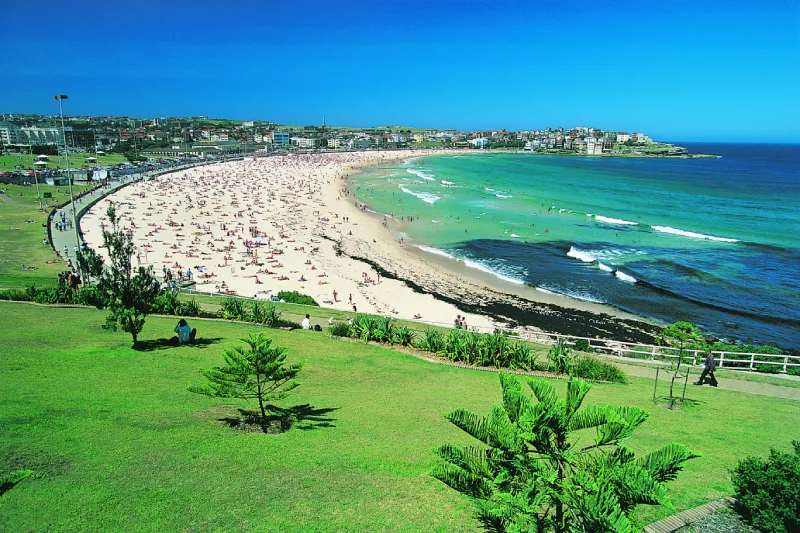
(A) Bondi Beach, Australia’s most famous beach… “Bondi” or “Boondi” is an Aboriginal word meaning water breaking over rocks or the sound of breaking waves… There are Aboriginal rock carvings on the northern end of the beach…
(B) The indigenous people of the area at the time of European settlement have generally been referred to as the Sydney people or the Eora… A number of place names within Waverley, most famously Bondi, are derived from Aboriginal languages…
(C) From the mid-1800s, Bondi Beach was a favorite location for family outings and picnics… In 1809, William Roberts received… a grant of 81 hectares… In 1851, Edward Smith Hall and Francis O’Brien purchased 200 acres… naming it “The Bondi Estate.” Between 1855 and 1877, O’Brien purchased Hall’s share… and made the beach and surrounding land available to the public as a picnic ground and amusement resort. However, the Municipal Council believed that the Government needed to intervene to make the beach a public reserve.
(D) During the 1900s, the beach became associated with health, leisure, and democracy—a playground everyone could enjoy equally. Bondi Beach was a working-class suburb throughout most of the twentieth century… The first tramway reached the beach in 1884. Following this, the tram became the primary form of public transportation in Bondi. By the 1930s, Bondi was drawing not only local visitors but also people from across Australia and overseas. Advertising at the time referred to Bondi Beach as the “Playground of the Pacific.”
(E) The increasing popularity of sea bathing during the late 1800s and early 1900s raised concerns about public safety… In response, the world’s first formally documented surf lifesaving club, the Bondi Surf Bathers’ Life Saving Club, was formed in 1907. This was powerfully reinforced by the dramatic events of “Black Sunday” at Bondi in 1938, where lifesavers rescued 300 people—the largest mass rescue in the history of surf bathing…
(F) Bondi Beach is the endpoint of the City to Surf Fun Run, held each year in August… A Royal Surf Carnival was held at Bondi Beach for Queen Elizabeth II during her first visit to Australia in 1954. …Many wealthy people spend Christmas Day at the beach. However, housing shortages occur when crowds flock to the seaside. Manly is the seaside town that helped solve this problem. Nevertheless, people still choose Bondi as their preferred destination over Manly.
(G) Bondi Beach has a commercial area along Campbell Parade… It is depicted as entirely modern and European… The valley running down to the beach is famous worldwide for its view of distinctive red-tiled roofs. This architecture is deeply influenced by British coastal towns.
(H) Bondi Beach hosted the beach volleyball competition at the 2000 Summer Olympics. A temporary 10,000-seat stadium… was set up… Campaigners opposed both the social and environmental consequences of the development… arguing it would seriously restrict public access… People protested for their right to enjoy an unspoiled seaside…
(I) …“They’re prepared to risk lives and risk the Bondi beach environment for the sake of eight days of volleyball”… Other environmental concerns include the possibility that soil dredged up from below the sand will acidify…
Questions
Question 1 – 5: Do the following statements agree with the information given in the Reading Passage? In boxes 1-5 on your answer sheet, write
TRUE if the statement is true
FALSE if the statement is false
NOT GIVEN if the information is not given
- The name of Bondi Beach was first given by British settlers.
- Aboriginal culture in Australia is different when compared with European culture.
- The Bondi Beach area contains many contemporary hotels.
- The seaside town of Bondi is influenced by British culture in its characteristic red color.
- Living near Bondi Beach is not beneficial for one’s health.
Question 6 – 9
Answer the questions below using NO MORE THAN TWO WORDS AND/OR NUMBERS from the passage for each answer.
Write your answers in boxes 6-9 on your answer sheet.
6. At the end of the 19th century, what public transport did people use to reach Bondi?
7. When did the British Royalty first visit Bondi?
8. Which Olympic event did Bondi host during the 2000 Sydney Olympic Games?
9. What would be damaged if the stadium were built for that Olympic event?
Question 10 – 13
Complete the following summary of the paragraphs of the Reading Passage, using no more than two words from the Reading Passage for each answer. Write your answers in boxes 10-13 on your answer sheet.
Bondi Beach hosts featured sports activities every year, which attracts many 10.__________ who choose to stay in the area during the holidays. However, local accommodation cannot keep up with the expanding population. A nearby town, 11.__________, was the first suburb to offer a solution, yet people still prefer 12.__________ as their top choice. Its seaside buildings are world-renowned for the distinctively colored 13.__________ on the roofs and the refreshing scent of the sea.
Bondi Beach Reading Summary
The reading paints a vibrant picture of Bondi Beach, from its etymological roots and Aboriginal heritage to its evolution into a world-famous tourist destination:
- Origins & Heritage: “Bondi” originates from an Aboriginal word, and ancient rock carvings remain present, highlighting a deep connection to indigenous culture.
- Early Development: From the mid-19th century, Bondi became a favorite picnic spot, later being sold and opened to the public as an amusement resort.
- Accessibility & Popularity: The arrival of trams in the late 19th century transformed Bondi from a retreat for the wealthy into a “playground for everyone,” attracting visitors from far and wide.
- Safety & Lifesaving: The rise in sea bathing led to the formation of the world’s first surf lifesaving club at Bondi in 1907, a legacy reinforced by the dramatic “Black Sunday” event in 1938.
- Events & Culture: Bondi hosts major events like the City to Surf Fun Run and Royal Surf Carnivals (such as Queen Elizabeth II’s 1954 visit), and remains a popular Christmas destination for the affluent.
- Architecture & Urban Development: The area features a bustling commercial district with cafes, restaurants, and hotels. Notably, the red-tiled roofs, inspired by British coastal towns, are a striking architectural feature.
- Olympics & Controversy: Bondi hosted beach volleyball during the 2000 Sydney Olympics, though the event faced opposition due to environmental concerns and restricted public access.
Key Vocabulary from the Bondi Beach Reading
- Aboriginal (adj/n): Relating to or being an indigenous inhabitant (especially of Australia).
- Stigma (n): A mark of disgrace or negative association.
- Disparity (n): A great difference or inequality.
- Conventional wisdom (n phrase): A generally accepted belief or opinion.
- Indigenous (adj): Originating naturally in a particular place; native.
- Amusement resort (n phrase): A place for leisure and entertainment.
- Reinforced (v): Strengthened or supported.
- Svelte (adj): Slender and elegant (often used for architecture or figures).
- Dredged up (phrasal v): To bring up or extract (soil, mud, etc.) from the bottom of a body of water.
- Acidify (v): To make or become acidic.
Suggested Answers and Detailed Analysis
1. FALSE
- Evidence (Paragraph A): “Bondi” or “Boondi” is an Aboriginal word meaning water breaking over rocks…
- Explanation: The name “Bondi” has Aboriginal origins, not British.
2. NOT GIVEN
- Explanation: The text mentions Aboriginal culture and European settlement but does not explicitly compare the two cultures.
3. NOT GIVEN
- Evidence (Paragraph G): Bondi Beach has a commercial area… featuring many popular cafes, restaurants, and hotels, with views of the contemporary beach.
- Explanation: The text mentions hotels and views of the “contemporary beach,” but does not explicitly describe the hotels themselves as “contemporary.”
4. TRUE
- Evidence (Paragraph G): The valley running down to the beach is famous world over for its view of distinctive red-tiled roofs. This architecture is deeply influenced by British coastal towns.
- Explanation: The distinctive red-tiled roofs are confirmed to be influenced by British coastal architecture.
5. FALSE
- Evidence (Paragraph D): During the 1900s, the beach became associated with health, leisure, and democracy – a playground everyone could enjoy equally.
- Explanation: Contrary to the statement, Bondi is associated with health and leisure, implying benefits to the public.
6. Tram
- Evidence (Paragraph D): The first tramway reached the beach in 1884. Following this, the tram became the first public transportation in Bondi.
- Explanation: 1884 is in the late 19th century, and the tram was the first public transport.
7. 1954
- Evidence (Paragraph F): A Royal Surf Carnival was held at Bondi Beach for Queen Elizabeth II during her first visit to Australia in 1954.
- Explanation: Queen Elizabeth II visited Bondi for the first time in 1954.
8. Beach volleyball
- Evidence (Paragraph H): Bondi Beach hosted the beach volleyball competition at the 2000 Summer Olympics.
- Explanation: The 2000 Olympics at Bondi featured “beach volleyball.”
9. Bondi beach environment
- Evidence (Paragraph I): “They’re prepared to risk lives and risk the Bondi beach environment for the sake of eight days of volleyball”.
- Explanation: The text explicitly states that the “Bondi beach environment” would be at risk.
10. wealthy people
- Evidence (Paragraph F): Many wealthy people spend Christmas Day at the beach.
- Explanation: Sports activities and events at Bondi attract “wealthy people” during the holidays.
11. Manly
- Evidence (Paragraph F): Manly is the seaside town which solved this problem.
- Explanation: “Manly” is mentioned as the town that helped address the accommodation shortage.
12. Bondi
- Evidence (Paragraph F): However, people still choose Bondi as the satisfied destination rather than Manly.
- Explanation: Despite Manly’s availability, people still prefer “Bondi.”
13. red-tiled roofs
- Evidence (Paragraph G): The valley running down to the beach is famous world over for its view of distinctive red-tiled roofs.
- Explanation: Bondi’s famous architecture is defined by its “red-tiled roofs.”
Bondi Beach is not just a stunning location but a treasure trove of history and culture, and this IELTS reading passage offers many fascinating perspectives. Academically, this passage reinforces the importance of detailed reading, keyword identification, and paraphrasing.
Specifically, for question types like True/False/Not Given, you must be careful to distinguish between information present in the text and information not explicitly mentioned. We hope that through this analysis by ECE, you can successfully “surf” through the Bondi Beach reading and accumulate valuable strategies for your IELTS journey.





 Khai giảng Khóa học Hè cực HOT.
No comments yet!