


Tóm Tắt Nội Dung Bài Viết
When starting your journey to conquer the IELTS, the Listening section is often one of the first major hurdles for many learners. To build a solid foundation and get comfortable with the test format, finding the right study material is crucial. Among the many options, Basic IELTS Listening stands out as an indispensable “secret weapon.”
Is this book truly effective? What makes its content special, and how can you make the most of it? This article from ECE English provides a comprehensive, detailed overview to help you make an informed decision before you begin your studies.
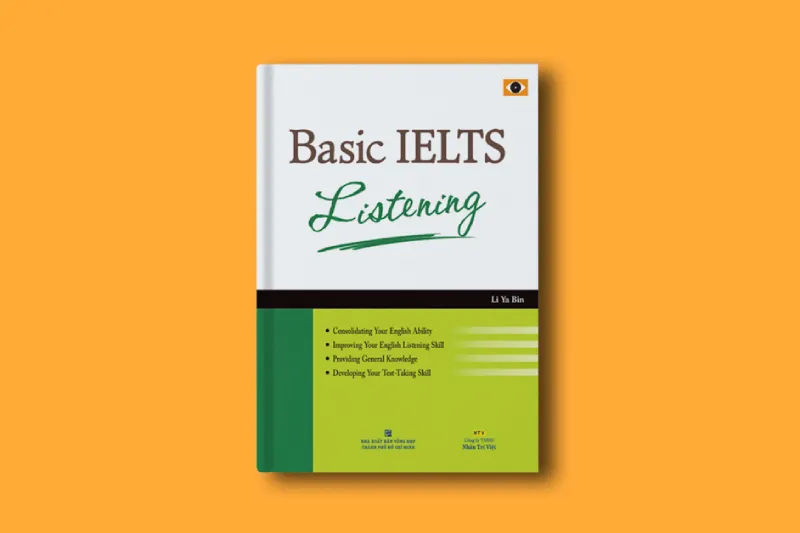
Overview of Basic IELTS Listening
- Title: Basic IELTS Listening
- Author: Li Ya Bin
- Publisher:
- Original Publisher: Beijing Language and Culture University Press (published in 2010).
- Publisher in Vietnam: General Publishing House of Ho Chi Minh City (published in 2014).
- Page count: Approximately 190 – 193 pages.
- Features: Part of the Basic IELTS series (which also includes Reading, Speaking, and Writing). The book comes with audio files (usually via CD or a downloadable PDF+Audio link) for listening practice.
Who is this book for?
Basic IELTS Listening is specifically designed for:
- Beginners: An ideal choice for those who do not yet have a strong English foundation and want to familiarize themselves with the IELTS Listening format.
- IELTS Band 3.0 – 3.5 level: The book provides fundamental knowledge and exercises that are easy to grasp. After completing the book, learners can expect to reach a target band score of 4.0 – 4.5.
- Self-study learners: With its logical, clear structure and detailed answer keys, the book is perfect for those who want to study at home without the help of a tutor.
- Students: Beyond exam preparation, the book helps improve general English listening comprehension through topics relevant to daily life.
Detailed Review of Basic IELTS Listening Content
The book is divided into four main parts, organized scientifically to guide learners from foundational knowledge to intensive practice.
- Part 1: IELTS Overview
- Provides an overview of the IELTS test structure, with a deep dive into the Listening section.
- Introduces common question types, conversation styles, and useful tips and strategies compiled by the author.
- Part 2: Main Content (5 Units)
- This is the core of the book, divided into 5 familiar IELTS Listening topics:
- Names and Places
- Numbers
- Survival English
- Popular Science
- Academic English
- Each unit includes numerous short exercises (from 5 to 15) designed to match the actual test format, with increasing levels of difficulty.
- The book offers a variety of listening materials, such as conversations, news reports, and short stories, helping learners get used to different contexts.
- Notably, each exercise includes notes on common mistakes and points to watch out for, helping learners avoid unnecessary errors.
- This is the core of the book, divided into 5 familiar IELTS Listening topics:
- Part 3: Vocabulary & Phonetic Symbols
- Provides a system of new vocabulary words found in the listening exercises.
- Words are underlined in the scripts and include accurate phonetic transcriptions to help learners build their vocabulary and improve pronunciation.
- Part 4: Scripts & Answer Key
- Located at the back of the book, this section includes full transcripts of the listening exercises and detailed answer keys.
- Learners can easily check their results, analyze mistakes, and understand why they missed certain answers.
Reference links:
- Basic IELTS Listening PDF
- Basic IELTS Listening Audio 1
- Basic IELTS Listening Audio 2
- Basic IELTS Listening Audio 3
Pros and Cons
Pros
- Scientific and accessible layout: The book is presented logically and clearly, helping beginners easily grasp knowledge from basic to advanced levels. Important headings and notes are often bolded or boxed.
- Content aligned with the actual test: Exercises and question types are modeled after the real IELTS Listening format, helping learners build familiarity and confidence.
- High-quality audio files: The included audio is recorded clearly, supporting effective listening practice.
- Focus on fundamentals: The book concentrates on basic topics and provides test-taking strategies, which is very helpful for beginners.
- Reasonable price: Compared to other materials, the book is affordable and easy to obtain.
Cons
- Simple content: As a “Basic” book, the content focuses primarily on foundations and may not be suitable for those who already have a strong command of English.
- Lack of detailed explanations: The book provides answer keys but does not explain the reasoning behind each question, which may be challenging for some learners.
- Written entirely in English: For absolute beginners, reading and understanding the instructions or strategies in the book might be slightly difficult.
How to Study Listening Effectively with This Book
To maximize the value of this book, you should apply a scientific study strategy rather than just listening randomly.
- Study the overview: Spend time reading the Overview section to clearly understand the test structure, question types, and tips before you begin.
- Practice in order: The book is arranged from easy to difficult, so work through each unit sequentially to build a solid foundation.
- Simulate the test: When doing exercises, try to listen only 1-2 times. This helps you train your focus and speed, just like in the actual exam room.
- Check and correct mistakes: After finishing, compare your answers with the Answer Key and Scripts. Analyze your mistakes: did you get it wrong because of new vocabulary, pronunciation, or because you were “tricked” by the question? This is the most important step for improvement.
- Note down vocabulary: Keep a notebook to record new words and note their pronunciation. Learning vocabulary in the context of the listening exercises will help you remember them more effectively.
- Review regularly: Before starting a new unit, take time to review the knowledge and vocabulary from the previous one. This reinforces your learning and creates strong connections.
- Combine with other materials: To reach a higher band score, you should combine Basic IELTS Listening with more advanced materials like Get Ready for IELTS Listening or the Cambridge IELTS series.
Conclusion
Overall, Basic IELTS Listening is an excellent starting point for anyone who wants to self-study and build a solid foundation for the IELTS Listening skill. Despite a few minor limitations, its clear layout, content aligned with the actual test, and scientific approach make it a top choice for beginners.
With persistence and a reasonable study plan, using this book will help you not only get comfortable with the test format but also gain the confidence to conquer higher band scores in the future.





 Khai giảng Khóa học Hè cực HOT.
No comments yet!