


Tóm Tắt Nội Dung Bài Viết
Hi everyone, “Autumn Leaves” is a classic reading passage from the Cambridge IELTS series, frequently appearing in actual exams. While the scientific theme can be daunting, don’t worry—this article from ECE Language Center will not only provide the answers but also “deconstruct” every layer of the text, from vocabulary and structure to the most subtle “traps.”
Our goal is to turn this reading passage into a valuable lesson, giving you the confidence to handle any similar task.
Autumn Leaves Reading Passage
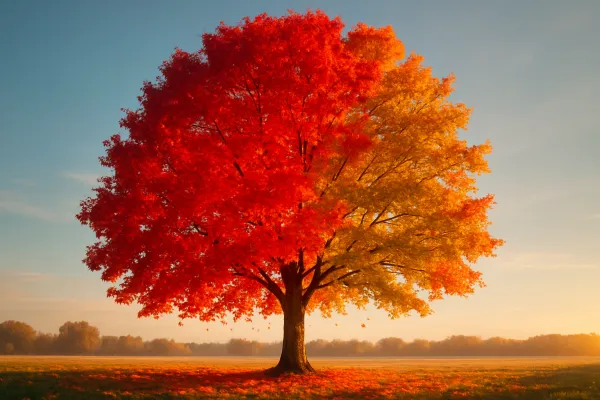
Canadian writer Jay Ingram investigates the mystery of why leaves turn red in the fall
A One of the most captivating natural events of the year in many areas throughout North America is the turning of the leaves in the fall. The colours are magnificent, but the question of exactly why some trees turn yellow or orange, and others red or purple, is something which has long puzzled scientists.
B Summer leaves are green because they are full of chlorophyll, the molecule that captures sunlight converts that energy into new building materials for the tree. As fall approaches in the northern hemisphere, the amount of solar energy available declines considerably. For many trees – evergreen conifers being an exception – the best strategy is to abandon photosynthesis* until the spring. So rather than maintaining the now redundant leaves throughout the winter, the tree saves its precious resources and discards them. But before letting its leaves go, the tree dismantles their chlorophyll molecules and ships their valuable nitrogen back into the twigs. As chlorophyll is depleted, other colours that have been dominated by it throughout the summer begin to be revealed. This unmasking explains the autumn colours of yellow and orange, but not the brilliant reds and purples of trees such as the maple or sumac.
C The source of the red is widely known: it is created by anthocyanins, water-soluble plant pigments reflecting the red to blue range of the visible spectrum. They belong to a class of sugar-based chemical compounds also known as flavonoids. What’s puzzling is that anthocyanins are actually newly minted, made in the leaves at the same time as the tree is preparing to drop them. But it is hard to make sense of the manufacture of anthocyanins – why should a tree bother making new chemicals in its leaves when it’s already scrambling to withdraw and preserve the ones already there?
D Some theories about anthocyanins have argued that they might act as a chemical defence against attacks by insects or fungi, or that they might attract fruit-eating birds or increase a leafs tolerance to freezing. However there are problems with each of these theories, including the fact that leaves are red for such a relatively short period that the expense of energy needed to manufacture the anthocyanins would outweigh any anti-fungal or anti-herbivore activity achieved.* photosynthesis: the production of new material from sunlight, water and carbon dioxide.
E It has also been proposed that trees may produce vivid red colours to convince herbivorous insects that they are healthy and robust and would be easily able to mount chemical defences against infestation. If insects paid attention to such advertisements, they might be prompted to lay their eggs on a duller, and presumably less resistant host. The flaw in this theory lies in the lack of proof to support it. No one has as yet ascertained whether more robust trees sport the brightest leaves, or whether insects make choices according to colour intensity.
F Perhaps the most plausible suggestion as to why leaves would go to the trouble of making anthocyanins when they’re busy packing up for the winter is the theory known as the ‘light screen’ hypothesis. It sounds paradoxical, because the idea behind this hypothesis is that the red pigment is made in autumn leaves to protect chlorophyll, the light-absorbing chemical, from too much light. Why does chlorophyll need protection when it is the natural world’s supreme light absorber? Why protect chlorophyll at a time when the tree is breaking it down to salvage as much of it as possible?
G Chlorophyll, although exquisitely evolved to capture the energy of sunlight, can sometimes be overwhelmed by it, especially in situations of drought, low temperatures, or nutrient deficiency. Moreover, the problem of oversensitivity to light is even more acute in the fall, when the leaf is busy preparing for winter by dismantling its internal machinery. The energy absorbed by the chlorophyll molecules of the unstable autumn leaf is not immediately channelled into useful products and processes, as it would be in an intact summer leaf. The weakened fall leaf then becomes vulnerable to the highly destructive effects of the oxygen created by the excited chlorophyll molecules.
H Even if you had never suspected that this is what was going on when leaves turn red, there are clues out there. One is straightforward: on many trees, the leaves that are the reddest are those on the side of the tree which gets most sun. Not only that, but the red is brighter on the upper side of the leaf. It has also been recognised for decades that the best conditions for intense red colours are dry, sunny days and coo nights, conditions that nicely match those that make leaves susceptible to excess light. And finally, trees such as maples usually get much redder the more north you travel in the northern hemisphere. It’s colder there, they’re more stressed, their chlorophyll is more sensitive and it needs more sunblock.
I What is still not fully understood, however, is why some trees resort to producing red pigments while others don’t bother, and simply reveal their orange or yellow hues. Do these trees have other means at their disposal to prevent overexposure to light in autumn? Their story, though not as spectacular to the eye, will surely turn out to be as subtle and as complex.
Autumn Leaves Reading Questions
Questions 14 – 18: Reading Passage 204 has nine paragraphs, A-l. Which paragraph contains the following information?
Write the correct letter, A-l, in boxes 14-18 on your answer sheet.
NB You may use any letter more than once.
Check answers
14. a description of the substance responsible for the red colouration of leaves
15. the reason why trees drop their leaves in autumn
16. some evidence to confirm a theory about the purpose of the red leaves
17. an explanation of the function of chlorophyll
18. a suggestion that the red colouration in leaves could serve as a warning signal.
Questions 19 – 22: Complete the notes below. Choose ONE WORD ONLY from the passage for each answer. Write your answers in boxes 19 – 22 on your answer sheet.
Check answers
Why believe the ‘light screen’ hypothesis?
- The most vividly coloured red leaves are found on the side of the tree facing the 19. .
- The 20. surfaces of leaves contain the most red pigment.
- Red leaves are most abundant when daytime weather conditions are 21. and sunny.
- The intensity of the red colour of leaves increases as you go further 22. .
Questions 23 – 25: Do the following statements agree with the information given in Reading Passage 204?
In boxes 23-25 on your answer sheet, write
TRUE if the statement agrees with the information
FALSE if the statement contradicts the information
NOT GIVEN if there is no information on this
Check answers
23. It is likely that the red pigments help to protect the leaf from freezing temperatures.
24. The ‘light screen’ hypothesis would initially seem to contradict what is known about chlorophyll.
25. Leaves which turn colours other than red are more likely to be damaged by sunlight.
Question 26: Choose the correct letter A, B, C or D. Write the correct letter in box 26 on your answer sheet.
For which of the following questions does the writer offer an explanation?
Check answers
A. why conifers remain green in winter
B. how leaves turn orange and yellow in autumn
C. how herbivorous insects choose which trees to lay their eggs in
D. why anthocyanins are restricted to certain trees
In-Depth Analysis – The Science Behind Autumn Leaves 🍂
Before diving into the answers, take 2 minutes to grasp the main narrative. This will give you a “mental map” and help you locate information much faster.
- Context: Why do leaves change color in the fall? Specifically, why do some turn a brilliant red?
- The Fundamental Process (Paragraph B):
- In summer, leaves are green due to chlorophyll, the “factory” that produces energy from sunlight.
- In autumn, as light fades, the tree decides to “shut down the factory” and stop photosynthesis.
- The tree withdraws chlorophyll into the twigs for storage. When the green layer disappears, yellow and orange pigments (carotenoids) that were already present in the leaf are revealed. This explains the yellow/orange foliage.
- The Real Mystery (Paragraph C): Red (anthocyanins) is different. These are not pre-existing; they are deliberately created by the tree just before the leaves drop. Why would a tree waste energy doing this?
- Theories and Explanations (Paragraphs D, E, F, G):
- Rejected Theories: To defend against insects, fungi, or cold? (Illogical because the red phase is too short). To “warn” insects? (No supporting evidence).
- The Most Plausible Theory – The “Light Screen Hypothesis”: Red pigments are produced to protect the chlorophyll itself from light overload. It sounds paradoxical, but while the tree is “dismantling” its chlorophyll, it is weak and vulnerable to excess light. The red acts like a layer of sunscreen, allowing the tree to safely withdraw nutrients.
- Evidence (Paragraph H): Leaves on the sunnier side are redder, and the upper side of the leaf is redder than the bottom. Dry, sunny days and cool nights are ideal conditions. The further north you travel, the redder the leaves become because the cold makes the trees more “stressed” and in need of more protection.
High-Value Academic Vocabulary in “Autumn Leaves”
Detailed Question Analysis – Understanding the Examiner’s Logic
This is the most critical part. We won’t just find the answers; we’ll understand why they are correct and why other options are wrong.
Questions 14 – 18: Matching Information
Strategy: Read the questions first, underline key terms, then “hunt” for the information in the paragraphs.
14. a description of the substance responsible for the red colouration of leaves
- Logic: “Substance,” “red colouration.” I need to find a scientific name. Scanning the text, Paragraph C stands out immediately: “The source of the red is widely known: it is created by anthocyanins…”
- Answer: C
15. the reason why trees drop their leaves in autumn
- Logic: “Reason,” “drop leaves.” I need to find the cause. Paragraph B explains that the tree must stop photosynthesis to “save its precious resources and discards them (drops the leaves).”
- Answer: B
16. some evidence to confirm a theory about the purpose of the red leaves
- Logic: “Evidence,” “confirm.” Look for words like clues, evidence, proof, reasons. Paragraph H starts with a very clear sentence: “…there are clues out there,” followed by a list of evidence.
- Answer: H
17. an explanation of the function of chlorophyll
- Logic: “Function,” “chlorophyll.” Paragraph B contains the sentence: “…chlorophyll, the molecule that captures sunlight converts that energy…”. This defines its function.
- Answer: B
18. a suggestion that the red colouration in leaves could serve as a warning signal.
- Logic: “Warning signal.” Look for ideas related to “scaring” or “warning” something. Paragraph E discusses trees using red to “…convince herbivorous insects that they are healthy and robust…” and refers to these as “such advertisements.” This is a form of signaling.
- Answer: E
Questions 19 – 22: Note Completion
Strategy: Answers usually follow the order of the text. Find the section containing the heading “Why believe the ‘light screen’ hypothesis?”. This is Paragraph H. Now, simply fill in the blanks.
- 19. …facing the 19. ____________ . -> Paragraph H: “…on the side of the tree which gets most sun.” -> Answer: sun
- 20. The 20. ____________ surfaces of leaves… -> Paragraph H: “…brighter on the upper side of the leaf.” -> Answer: upper
- 21. …weather conditions are 21. ____________ and sunny. -> Paragraph H: “…best conditions… are dry, sunny days and cool nights…” -> Answer: dry
- 22. …as you go further 22. ____________. -> Paragraph H: “…get much redder the more north you travel…” -> Answer: north
Questions 23 – 25: True / False / Not Given
Strategy: This task tests your attention to detail. “False” means the text says the opposite. “Not Given” means the information is not mentioned at all.
23. It is likely that the red pigments help to protect the leaf from freezing temperatures.
- Logic: Look for “freezing.” Paragraph D mentions this theory: “increase a leaf’s tolerance to freezing.” BUT! Immediately after, the author states, “However there are problems with each of these theories…”. This means the text mentions the theory but rejects it. Therefore, the statement “It is likely” CONTRADICTS the author’s view.
- Trap: Students see the word “freezing” and choose True. This is a classic trap.
- Answer: FALSE
24. The ‘light screen’ hypothesis would initially seem to contradict what is known about chlorophyll.
- Logic: Look for “light screen hypothesis” and “contradict.” Paragraph F says: “It sounds paradoxical…”. “Paradoxical” is a synonym for “seems to contradict.”
- Answer: TRUE
25. Leaves which turn colours other than red are more likely to be damaged by sunlight.
- Logic: Does the text compare red leaves and other colored leaves (yellow, orange) regarding sunlight damage? Paragraph B explains yellow/orange leaves appear because chlorophyll disappears. Paragraph I notes we still don’t fully understand why some trees don’t turn red. There is no sentence comparing the level of sun damage between these types of leaves.
- Answer: NOT GIVEN
Question 26: Multiple Choice
26. For which of the following questions does the writer offer an explanation?
- Logic: This tests overall comprehension. What did the author actually explain?
- A. why conifers remain green…: Paragraph B only calls them “an exception” but does not explain why. -> Eliminate A.
- B. how leaves turn orange and yellow…: Paragraph B explains this clearly: chlorophyll is withdrawn, revealing pre-existing yellow/orange pigments. This is a complete explanation. -> Choose B.
- C. how herbivorous insects choose…: Paragraph E proposes a theory but then says, “The flaw in this theory lies in the lack of proof…”. It remains unexplained. -> Eliminate C.
- D. why anthocyanins are restricted to certain trees: The final paragraph (I) admits: “What is still not fully understood…”. Clearly no explanation is given. -> Eliminate D.
- Answer: B
By analyzing “Autumn Leaves” in depth, we hope you’ve not only found the right answers but also mastered the methodology, trap identification, and logical thinking required by IELTS. Apply this approach to other readings for noticeable improvement. ECE wishes you the best of luck in your IELTS journey!





 Khai giảng Khóa học Hè cực HOT.
No comments yet!