


Tóm Tắt Nội Dung Bài Viết
With scattered resources, complex grammar, a lack of motivation, and an unsupportive learning environment, self-studying for IELTS Writing often feels like an uphill battle. Do you feel lost or directionless on your journey to that target band score? Don’t worry—ECE is here to share an A-to-Z roadmap to help you conquer your fear of IELTS Writing and walk into the exam with confidence!
IELTS Writing Overview
The IELTS Writing test lasts 60 minutes and is divided into two parts. Task 1 takes 20 minutes and requires at least 150 words, while Task 2 takes 40 minutes and requires at least 250 words.
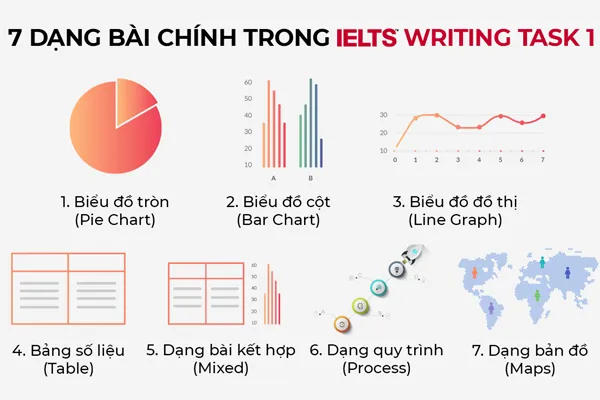
In Task 1, you must present and summarize information from data provided in charts, graphs, or tables. You may also be asked to describe a process or explain how something works. Common task types include:
- Line Graph
- Bar Chart
- Pie Chart
- Mixed Charts
- Map
- Table
- Process
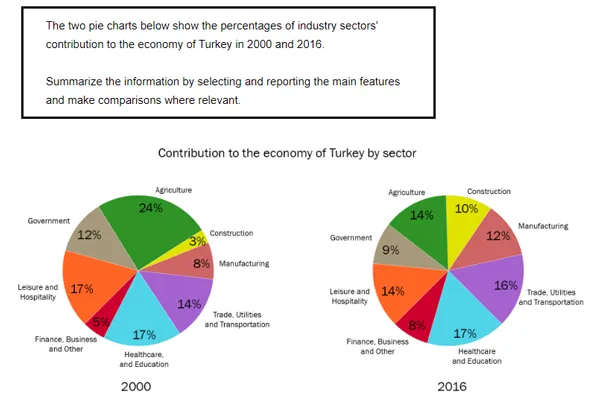
Task 1 Example:
In Writing Task 2, you must write an essay presenting your opinion and arguments regarding a specific social issue. Key task types include:
- Discuss Both Views
- Problems – Causes – Solutions
- Opinion Essay
- 2-Part Questions
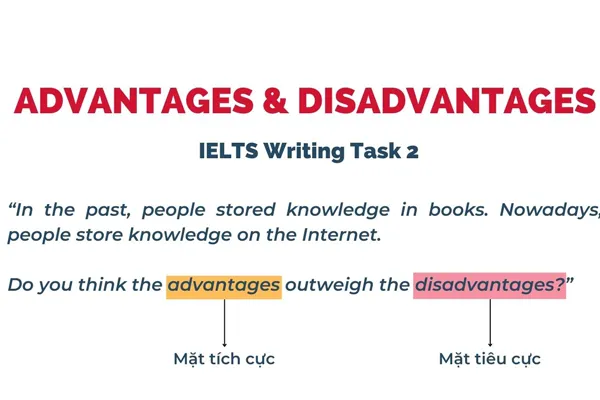
- Advantages and Disadvantages
Task 2 Example:
Assessment Criteria
To achieve a high score in IELTS Writing, you must master the four “golden” assessment criteria:
The table below details the IELTS Writing (Academic) assessment criteria for both Task 1 and Task 2, broken down by band scores from 6 to 9:
| Criterion | Band 6 | Band 7 | Band 8 | Band 9 |
| Task Achievement | Addresses the task requirements, though some parts may be underdeveloped or lack detail. | Addresses all requirements, though some points may lack full development or clear argumentation. | Addresses all requirements; information is clearly developed and detailed. | Fully addresses all requirements; ideas are clear and coherently developed. |
| Coherence and Cohesion | Coherent, but may lack clear linking between ideas; paragraphing may be unclear or illogical. | Coherent with clear linking, though occasional repetition or unnatural transitions may occur. | Very coherent with clear linking; effective use of cohesive devices and logical paragraph structure. | Excellent coherence and cohesion; ideas are organized seamlessly with perfect flow. |
| Lexical Resource | Basic vocabulary; occasional repetition or misuse of words in context. | Sufficient range of vocabulary; generally accurate, though sometimes lacking variety. | Wide and precise vocabulary; uses less common items accurately. | Extremely wide and precise vocabulary; uses words naturally and demonstrates high proficiency. |
| Grammatical Range and Accuracy | Uses basic structures; frequent errors in grammar and spelling may affect clarity. | Uses complex structures; few errors, though minor slips may occur without affecting meaning. | Wide range of structures with high accuracy; few to no errors, easy to follow. | Uses complex structures naturally and accurately; error-free, clear, and sophisticated. |
We hope this table helps you better understand how your writing is evaluated and the differences between band scores, giving you the confidence to master this skill!
IELTS Writing Roadmap for Beginners
Below is an IELTS Writing Academic roadmap for beginners, divided into levels: 0–4.5, 4.5–6.5, and 6.5+. This roadmap will help you focus on specific skills and improve gradually across both Task 1 and Task 2.
Phase 1: Level 0 – 4.5
Goals:
- Grammar: Improve basic grammar to minimize errors and use sentence structures correctly.
- Vocabulary: Build a foundational vocabulary based on common IELTS Writing topics.
- Skills: Get familiar with the structure of IELTS Writing Task 1 and Task 2.
In this phase, your main goal is to build a solid foundation. You don’t need to dive straight into exam strategies yet. IELTS Writing is challenging, and starting too early without a strong base can be overwhelming. Instead, focus on strengthening your Vocabulary and Grammar. Break your learning into manageable stages to achieve the best results.
Grammar
At this stage, you should master basic grammar, including:
- Verb tenses
- Parts of speech (nouns, verbs, adjectives, adverbs, etc.)
- Word order
- Passive voice
- Dummy subjects (It/There)
- Relative clauses
- Gerunds and infinitives
- Modal verbs
- Conditionals
Vocabulary
Building your vocabulary can go hand-in-hand with learning grammar. Focus on A1, A2, and B1 level words, as these are the most versatile. Don’t rush into C1 or C2 vocabulary yet, as they are often too complex for your current level.
However, learning theory isn’t enough. You must apply what you learn. A great way to do this is by combining Speaking and Writing practice. Try drafting answers for Speaking Part 1 or 2; writing gives you the time to edit and refine your sentences, which significantly improves your grammatical accuracy and vocabulary usage.
Phase 2: Level 4.5 – 6.5
Goals:
- Improve idea development
- Use complex sentence structures
- Expand vocabulary range
In this phase, you start learning the core concepts of IELTS Writing and the requirements for each task. Your main focus should be on the elaboration of ideas.
Now that you have a grasp of basic grammar and vocabulary, it’s time to upgrade your writing by supporting your main ideas with explanations and examples. To do this:
- Read sample essays to understand how to develop a coherent argument. Practice writing by following models with clear, logical structures.
- Continue refining your grammar and vocabulary. In addition to general B1/B2 vocabulary, start learning topic-specific vocabulary to help you expand on your ideas.
Common IELTS topics include Education, Environment, Business, Media, Work, Health, and Social Issues.
Phase 3: Level 6.5+
Aiming for a 6.5 or 7.0 is a common goal. It requires time and effort, but it is entirely achievable if you ensure your writing meets all four assessment criteria.
Vocabulary
In this phase, focus on three types of vocabulary:
- Topic-related Vocabulary: Essential for developing deep, insightful supporting ideas and examples.
- Academic Vocabulary: Makes your writing sound formal and objective, which is a requirement for IELTS Academic.
- Collocations: Using natural word combinations makes your writing flow smoothly and saves time during the exam.
Remember: only use complex vocabulary if you are certain of the context. Misusing high-level words can actually lower your score.
Grammar
Beyond using a variety of simple, compound, and complex sentences, focus on precision. Small errors can cost you points.
Manage your time effectively so you have 3–5 minutes at the end to proofread your work. Keep in mind that grammar is just a tool to convey your ideas—don’t force complex structures if they make your writing sound stiff or unnatural.
In conclusion, mastering IELTS Writing is a journey that requires patience and persistence. With a clear roadmap and specific goals, you can overcome any challenge. Start with a solid foundation, then gradually improve your ability to develop ideas and structure your essays.
Don’t forget that consistent practice and attention to detail will lead to rapid improvement. ECE wishes you confidence and success on your path to a high IELTS Writing score!





 Khai giảng Khóa học Hè cực HOT.
No comments yet!