


Tóm Tắt Nội Dung Bài Viết
Idiomatic expressions are one of the most fascinating—and sometimes challenging—aspects of the English language. They don’t just make your speech more vivid and natural; they also play a pivotal role in assessing your proficiency in international exams like IELTS, especially in the Speaking section. In this article, ECE English will dive deep into their definition, importance, and the most effective strategies for learning and using idioms naturally.
I. What are Idiomatic Expressions? Nature and Classification
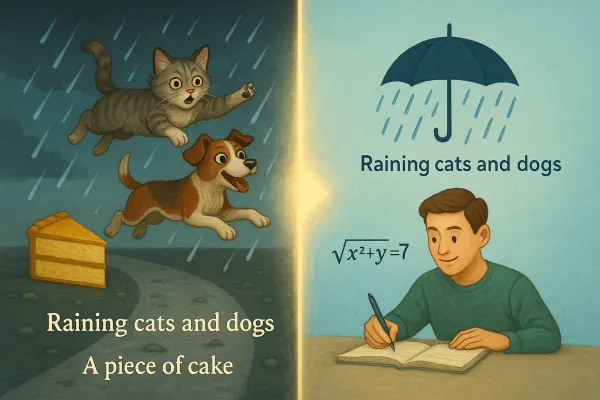
Have you ever heard the phrase “It’s raining cats and dogs” and wondered if it was actually raining animals? Or “a piece of cake” having nothing to do with dessert? These are classic examples of idiomatic expressions.
Idiomatic expressions are groups of words whose overall meaning cannot be deduced from the literal definitions of the individual words. They carry figurative or cultural meanings that have evolved over time through native speaker usage.
To better understand them, we can categorize them into smaller groups:
- Colloquial Idioms: Phrases widely used in everyday conversation, usually informal in tone.
Example: “Spill the beans” (to reveal a secret), “Hit the books” (to study hard).
- Idiomatic Phrasal Verbs: Some phrasal verbs have meanings entirely different from the literal combination of the verb and the particle, making them idiomatic.
Example: “Break down” (to stop working or have an emotional collapse), “Get over” (to recover).
- Proverbs: While proverbs usually offer advice or a universal truth and have a more complete sentence structure, they still possess “idiomaticity” because their meaning is rarely literal.
Example: “Actions speak louder than words.” While we often group these under “idioms,” in IELTS Speaking, examiners look for colloquial idioms and idiomatic phrasal verbs more than proverbs.
- Sayings/Expressions: Broader than idioms, these are fixed, common ways of expressing ideas that aren’t necessarily highly figurative.
Example: “To tell you the truth,” “No worries.”
Their unique nature: The most distinctive feature of idioms is that their meaning is often tied to the culture, history, and customs of a community. Understanding the origin or the story behind an idiom (e.g., “to add insult to injury” from the fable “The Bald Man and the Fly”) not only helps you remember them longer but also provides deeper insight into the culture itself.
II. The Importance of Idiomatic Expressions in IELTS
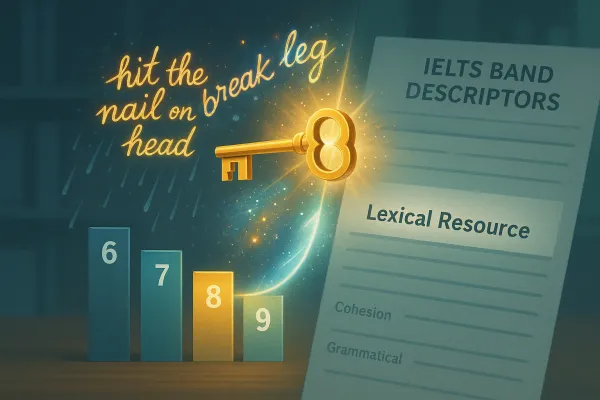
In the IELTS exam, particularly in the Speaking section and to some extent in Writing, using idiomatic expressions is crucial for demonstrating your language proficiency.
1. In IELTS Speaking: The “Lexical Resource” Criterion
This is where idioms have the most impact. The Lexical Resource criterion in the IELTS Speaking Band Descriptors specifically mentions the use of “idiomatic language” and “less common vocabulary” to achieve a high score:
- Band 7: “Uses some less common and idiomatic vocabulary; shows some awareness of style and collocation, with some inappropriate choices.”
- Band 8: “Uses less common and idiomatic vocabulary skilfully, with occasional inaccuracies.”
- Band 9: “Uses idiomatic language naturally and accurately.”
What does this mean?
- Band 7 and above: You need to start actively incorporating idioms into your speech. This demonstrates flexibility and a rich vocabulary that goes beyond the basics.
- Band 8 and above: The requirements for “skilfully” and “naturally and accurately” are emphasized. It’s not just about knowing idioms; it’s about using them in the right place and context, like a true native speaker. This is the deciding factor between a “good” and an “excellent” performance.
2. In IELTS Writing: Naturalness and Style
Although Writing Task 2 requires an academic and formal tone, you can still use certain idioms to make your writing more natural and persuasive, especially in introductions or conclusions. However, be extremely careful not to overuse them or use idioms that are too informal for an academic context. Idiomatic phrasal verbs are generally more acceptable than colloquial idioms.
III. Learning and Using Idiomatic Expressions Effectively
Learning idioms isn’t just about memorizing definitions; it’s about practicing how to use them naturally and accurately.
1. Learn in context, don’t just memorize

This is the most important advice. Idioms are often hard to guess if learned in isolation.
- Listen and read: Actively look for idioms in movies, podcasts, articles, and books. When you encounter a new one, don’t just look up the meaning; pay attention to how it’s used in the sentence and paragraph.
- Note examples: When learning a new idiom, write down the example sentence you found or create your own. For example, instead of just noting “a piece of cake = very easy,” write “The math problem was a piece of cake for him.”
- Use flashcards with images/stories: Since idioms are figurative, combining them with images or brief notes on their origin will help you remember and understand them more deeply.
2. Don’t overdo it and ensure they are “current”
These are the two most common mistakes Vietnamese candidates make:
- Don’t overdo it: Stuffing too many idioms into your speech will make it sound forced, unnatural, and even confusing. Examiners will easily notice if you are “showing off” vocabulary rather than communicating naturally. The goal is naturalness, not quantity. Using 1-2 well-placed idioms per answer is enough to impress.
- “Current” and “Regional” usage: English is a living language that is always changing. Many archaic idioms are no longer used in modern conversation. Furthermore, some idioms may be popular in the UK but less known in the US (or vice versa).
- Check: When looking up idioms in reputable dictionaries (like the Cambridge Dictionary or Oxford Learner’s Dictionaries), pay attention to labels like “old-fashioned” or “British English/American English.” Prioritize learning idioms that are widely used today.
3. Practice Seamless Integration
Using an idiom isn’t just about inserting it into a sentence; it’s about making it a natural part of the flow of your story.
- Speaking practice: Say the idioms out loud in your sentences. Try using them when answering IELTS Speaking practice questions or when chatting with friends and teachers.
- Use introductory phrases: Sometimes, you can introduce an idiom more naturally. For example: “Well, as they say, ‘every cloud has a silver lining’…”, or “To cut a long story short…”.
- Learn by topic: Instead of learning randomly, group idioms by topic (e.g., work, education, emotions) to make them easier to recall when answering related questions.
IV. Distinguishing Idioms from Other Expressions
Confusion between idioms, proverbs, and even collocations is quite common.
- Collocation: These are natural word combinations (e.g., “make a decision,” “take a shower”). While important for Lexical Resource, they are not idioms because their meaning can be understood from the literal meaning of each word.
- Proverb: As mentioned, proverbs are complete sayings that carry a message or piece of advice. They have “idiomatic” qualities but are generally less expected in IELTS Speaking than colloquial idioms. Overusing proverbs can make your speech sound stiff or unnatural.
Important advice: In the IELTS Speaking exam, focus on fluency, coherence, and naturalness. If you aren’t sure how to use an idiom, or if it feels forced, avoid it. Instead, use precise and flexible vocabulary. A clear, coherent response that uses varied but safe vocabulary will always be rated higher than one that tries to cram in idioms but makes mistakes.
Idiomatic expressions are an essential part of achieving a high score in IELTS Speaking and making your English sound more natural. However, learning and using them requires patience, a deep understanding of context, and cultural awareness. Study smart, practice regularly, and always prioritize naturalness and accuracy in your communication.
Thank you for following this article from ECE. If you need advice or want to learn more about our IELTS courses at ECE, please contact us today!





 Khai giảng Khóa học Hè cực HOT.
No comments yet!