


Tóm Tắt Nội Dung Bài Viết
“Accommodation” is a familiar topic that frequently appears in the IELTS Speaking test. Whether you live in a compact apartment, a spacious house, or are dreaming of your future home, being able to talk about where you live with fluency and confidence is essential. This article from the ECE language center provides an overview of the “accommodation” topic, including useful vocabulary, sentence structures, and sample answers for all three parts of the IELTS Speaking test.
Introduction to the Accommodation topic in IELTS Speaking
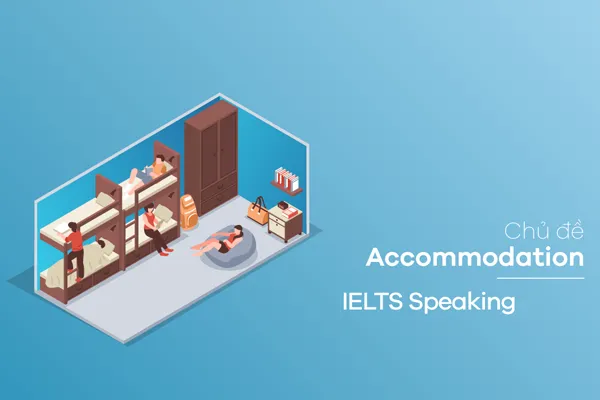
In IELTS Speaking, the “accommodation” topic can appear in various forms. You might be asked about:
- Where you currently live: The type of house or apartment, a detailed description, what you like about it, and if you would like to change anything.
- Your dream home: Where you would like to live, the type of house, its design, and why you would like to live there.
- Comparing types of housing: Renting vs. buying, living in the city vs. the countryside, and current vs. future housing.
- Housing-related issues: Costs, amenities, and the impact of housing on daily life.
Useful vocabulary & structures for IELTS Accommodation
Below are some vocabulary words and sentence structures you can use to talk about “accommodation” in a more impressive and natural way:
Types of housing
- Apartment/Flat
- Studio apartment: an open-plan living space without separate rooms
- Dormitory (dorm)
- House
- Detached house: a standalone house
- Semi-detached house: a house joined to another on one side
- Terraced house: a house in a row of similar houses
- Bungalow: a one-story house
- Cottage: a small house in the countryside
- Villa
Describing your home
- Spacious
- Cramped
- Cozy
- Well-lit
- Airy
- Modern
- Traditional
- Minimalist
- Well-equipped
- Fully-furnished
Phrases and idioms
- On my own
- Kitchenette
- Creature comforts
- Sanctuary
- Recharge my batteries
- Coat of paint
- Light shades of blue
- Tranquility
- Put me on the spot
- Make a house a home
- Me time
- Loved ones
- Year-round
- Escape the hustle and bustle of city life
- Vibrancy
- Chronically disrupted sleep
- Do wonders for
- A slower pace of life
- Secluded
- Amenities
- Within walking distance
- Serenity
- Abundant
- Mod cons
- In stark contrast to
- There’s not enough room to swing a cat
- Chill out
- In a nutshell
- The perfect blend
- Aesthetic appeal
- Strain
- Inadequate housing
- With the advent of
- Place of residence
- Multi-functionality
- A breeze
- Going through the roof
- Way better
- Upfront costs
- Intangible benefits
- Customize
- One-size-fits-all answer
- Hinge on
- Cultural norms
- Filial piety
- Proximity
- Near and dear
- Encompass
Sentence structures
- “I’m currently living in…”
- “My favorite room is… because…”
- “I would like to live in… in the future.”
- “One thing I’d change about my home is…”
- “What makes a house a home is…”
IELTS Speaking Part 1 Sample Answers: Accommodation
-
Do you live in a house or an apartment?
Sample 1: I’m currently living on my own in an apartment which has a small living room and a kitchenette. The apartment is quite small, but it provides me with the bare minimum of creature comforts.
Sample 2: I live in a three-story terraced house with my family. It’s not huge, but it’s comfortable enough for the four of us.
-
Which is your favourite room in your home? Why?
Sample 1: I love my bedroom because it is more than just a place to sleep. For me, it serves as a sanctuary where I can get rid of the stresses of the outside world and recharge my batteries after a long day at work.
Sample 2: My favorite room is the living room. It’s where my family gathers to watch movies, chat, and spend quality time together. It’s always filled with laughter and warmth.
-
Would you change anything about your home? Why / why not?
Sample 1: Well, I suppose I’m too old for a pink bedroom. It needs another coat of paint, light shades of blue for instance. This color may evoke a feeling of calmness and tranquility.
Sample 2: If I could, I’d add a small balcony to our apartment. It would be nice to have an outdoor space to enjoy a cup of coffee in the morning or read a book in the evening.
-
What do you think makes a house feel like a home?
Sample 1: Well, this question puts me on the spot, but I guess what makes a house a home is a sense of comfort and belonging. It gives people me time and is filled with personal touches through the presence of their loved ones.
Sample 2: I believe a home is more than just bricks and mortar. It’s the memories created within those walls, the love shared, and the feeling of safety and security that truly make it a home.
-
Would you like to move to a different home in the future?
Sample 1: After retiring from work, I would like to move to Da Lat province where the weather is cool year-round. It is a perfect place to escape the hustle and bustle of city life.
Sample 2: Yes, I dream of living in a small cottage by the sea someday. I love the sound of the waves and the fresh sea air.
Related articles:
IELTS Speaking Part 2 Sample Answer: Accommodation
Describe a house or apartment you would like to live in the future.
You should say:
- Where it is
- What kind of accommodation it is
- What it is like
- And how you feel about this dream house/apartment.
Sample Answer
I’ve always dreamt of living in a detached house located on the outskirts of a peaceful city, perhaps somewhere in the European countryside. I’m not looking for complete isolation, though. Ideally, it would be within walking distance of essential amenities like shops, cafes, and maybe a small cinema. I’ve lived in a bustling megacity for years, and while I appreciate the vibrancy, I’ve also suffered from chronically disrupted sleep. Living in a more suburban area, with a slower pace of life, would do wonders for my well-being.
It would be a two-story detached house, not too big, but spacious enough for a small family. The exterior would be painted in a calming shade of blue, perhaps with white trim around the windows. Speaking of windows, I’d want large windows throughout the house to allow abundant natural light to flood in. This would create a bright, airy, and inviting atmosphere.
Inside, the house would have a modern, minimalist design. I’d love a spacious, open-plan kitchen, fully equipped with all the mod cons – a far cry from my current cramped kitchen where there’s barely enough room to swing a cat! The living room would be cozy, with a comfortable sofa and a fireplace for chilly evenings. Upstairs, there would be at least three bedrooms, each with its own bathroom.
But the most striking feature would be a large, well-maintained garden. I envision a beautiful front garden with colorful flowers and a vegetable patch where I could grow my own food. This garden wouldn’t just be aesthetically pleasing; it would be a functional space where I could relax, connect with nature, and enjoy the outdoors. Perhaps have friends around to enjoy it with me.
This dream house represents the perfect blend of aesthetic appeal and functionality. It’s a place where I could truly relax, recharge, and enjoy a peaceful, fulfilling life. It embodies a sense of tranquility and a connection to nature that I deeply crave. It’s more than just a house; it’s a sanctuary.
IELTS Speaking Part 3 Sample Answers: Accommodation
-
Do you think homes will look different in the future?
Sample 1: Well, I think that in the future, homes are likely to be smaller, particularly in urban areas. This is primarily due to overpopulation, which puts a significant strain on infrastructure and leads to inadequate housing. We’re already seeing this trend in megacities like Tokyo and Hong Kong. Additionally, with the advent of technology, the construction of places of residence will likely focus on multi-functionality and sustainability. For example, homes might incorporate renewable energy sources like solar panels and rainwater harvesting systems to manage lighting, temperature, and water usage, making them more cost-effective and environmentally friendly.
-
How easy is it to find a place to live in your country?
Sample: It depends on where you’re looking. In smaller towns and rural areas, finding affordable accommodation is generally a breeze. There’s less demand and more available space. However, things get considerably trickier when you move to major cities like Hanoi or Ho Chi Minh City, which are known for their high demand, limited space, and property prices that are going through the roof. Competition for housing is fierce in these urban centers.
-
Do you think it’s better to rent or to buy a place to live in?
Sample 1: I believe that owning a home is, in the long run, way better than renting. While renting offers flexibility and lower upfront costs, and often means the landlord is responsible for maintenance and repairs, it doesn’t build equity. Homeownership, on the other hand, provides intangible benefits, such as a sense of stability, security, and belonging. It also gives you the freedom to customize your living space to your liking, creating a truly personal environment. This sense of ownership and control can allow homeowners to feel more grounded and concentrate on their professional and personal goals.
-
Do you agree that there is a right age for young adults to stop living with their parents?
Sample: Personally, I reckon this is a complex issue, and there’s no one-size-fits-all answer. It really hinges on individual circumstances, financial stability, and cultural norms. For instance, in many Asian cultures, it’s common and even expected for children to live with their parents even after reaching adulthood, often until they get married, or even after. This is deeply rooted in the concept of filial piety – the idea of treating parents and elders with honor and respect, and providing care for them in their old age.
-
What factors will contribute to whether a place is good to live in or not?
Sample: For me, a place is considered to be suitable for living when it fulfills factors such as safety, affordability, access to healthcare and education, as well as proximity to people’s near and dear. Speaking of affordability, for instance, it encompasses not just housing costs, but also the overall cost of living which can strain a family’s budget and lower their quality of life.
Conclusion:
The “accommodation” topic in IELTS Speaking may be familiar, but it has many aspects to explore. By preparing thoroughly with vocabulary, sentence structures, and practicing with sample answers, you can confidently demonstrate your language proficiency and achieve a high score in this part of the test. Most importantly, try to speak naturally, honestly, and show your personality in your answers. Good luck!
 Khai giảng Khóa học Hè cực HOT.
No comments yet!