


6th Grade English Essentials cover key topics that form the foundation for your entire middle school education, building upon and expanding the knowledge you gained in primary school. It’s common for students to feel a bit overwhelmed or unsure when starting this new level. Don’t worry! Let’s join ECE in reviewing the essential English grammar topics you need to master for this grade.
Comprehensive 6th Grade English Grammar Guide
Part 1: English Tenses for 6th Grade
One of the core components of 6th-grade English is mastering three key tenses: the Simple Present, the Present Continuous, and the Simple Future.
1. The Simple Present Tense
* Definition: The Simple Present is used to express facts, general truths, habits, or actions that happen repeatedly.
* Structure:
With the verb “to be”:
(+): S + are/ is/ am + O
Ex: She usually gets up at 6 o’clock.
(-): S + are/ is/ am + not + O
Ex: Henry isn’t a doctor.
(?): Are/ is/ Am + S + O?
Answer: Yes, S + are/ is/ am OR No, S + are/ is/ am + not.
Ex: Are they your family?
Yes, they are my family.
With ordinary verbs:
(+): S + V-s/ es + O
Ex: I have a black shirt.
(-): S + do/ does + not + V-inf + O
Ex: He doesn’t have gray hair.
(?): Do/ does + S + V-inf + O?
Answer: Yes, S + do/ does OR No, S + do/ does + not.
Ex: Do they have English on Tuesday?
Yes, they do.
* Recognition cues
If the sentence contains frequency adverbs like: usually, always, sometimes, never, seldom, rarely, every day, every time, every month, every year, once a week, twice a year, etc., it is in the Simple Present tense.
2. The Present Continuous Tense
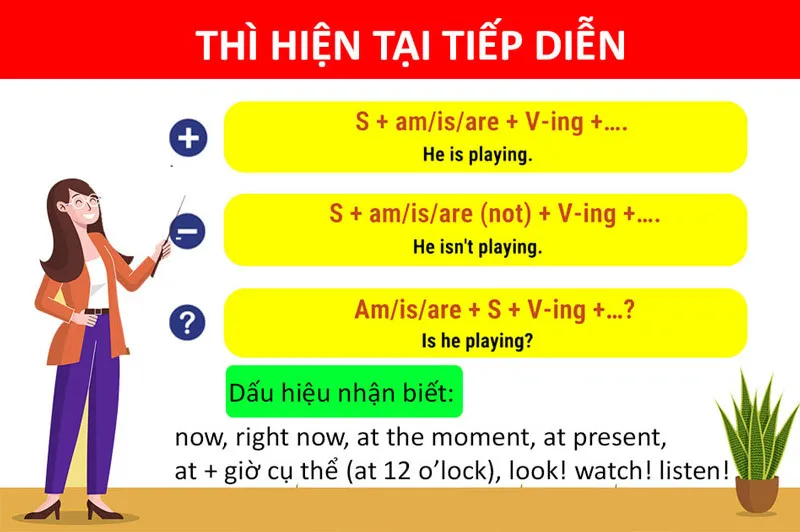
The Present Continuous tense is used to describe an action or event happening right at the moment of speaking or around that time. In other words, the action is ongoing and not yet finished.
* Structure
(+): S + are/ is/ am + V-ing + O
Ex: I am learning English at the moment.
(-): S + are/ is/ am + not + V-ing + O
Ex: She isn’t playing basketball now.
(?): Are/ is/ am + S + V-ing + O?
Answer: Yes, S + are/ is/ am OR No, S + are/ is/ am not.
Ex: Are they joining the party at the moment?
No, they aren’t.
* Recognition cues
If the sentence contains words like: now, at the moment, at present, right now, listen, look, etc., it is in the Present Continuous tense.
Special note: Do not use the Present Continuous with state verbs related to perception or cognition, such as: be, hear, see, feel, remember, know, realize, want, like, understand, forget, think, smell, love, hate, glance, etc.
Ex: She hates going to the zoo now.
3. The Near Future Tense
In the new 6th-grade English curriculum, students are introduced to the Near Future tense. This is used to express an intention, a plan, or a prediction based on present evidence.
* Structure
(+): S + are/ is/ am + going to + V-inf + O
Ex: He is going to join a birthday party tonight.
(-): S + are/ is/ am + not + going to + V-inf + O
Ex: I am not going to buy a new house before August.
(?): Are/ is/ am + S + going to + V-inf + O?
Ex: Are they going to hold the car race next week?
* Recognition cues
Sentences containing words like: tonight, tomorrow, next day, next week, next month, next year, or “in” + a short period of time (e.g., in 1 hour) are in the Near Future tense.
See more here: Middle School English Roadmap with 9 stages from grade 6 to grade 9.
Part 2: Comparisons
Beyond tenses, the new 6th-grade English curriculum introduces comparative and superlative structures.
1. Comparative Adjectives/Adverbs
Comparatives are used to compare two subjects based on their characteristics or traits. There are two types of structures:
Comparative with short adjectives/adverbs
Structure: S + V + Adj/ Adv + er + than + O/ N/ Pronoun/ S2 + Auxiliary V
Ex: Tom learns English better than his brother.
This book is thinner than that one.
Comparative with long adjectives/adverbs
Structure: S + V + more + Adj/ Adv + than + O/ N/ Pronoun/ S2 + Auxiliary V
Ex: Mary is more beautiful than me.
My mother drives more carefully than me.
Note: To emphasize the comparison, you can add “much” or “far” before the comparative phrase.
2. Superlative Adjectives/Adverbs
Superlatives are used to compare one subject against all others in a group.
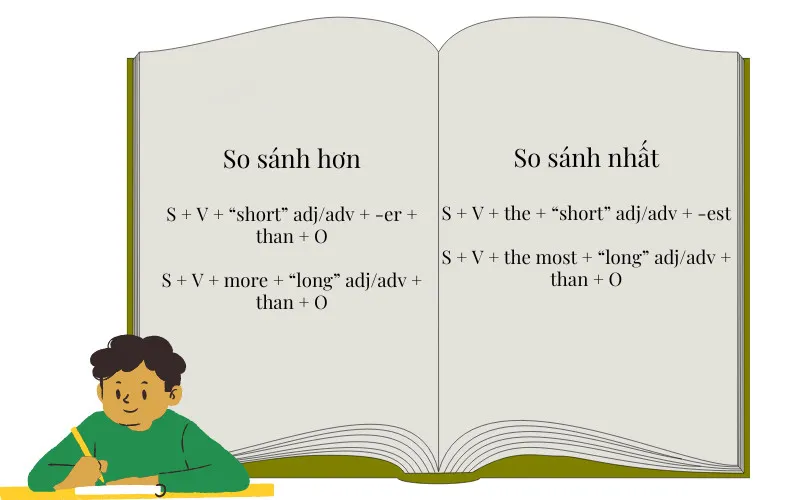
S + V + the + Adj/ Adv + est + O
Ex: David is the biggest person in the class.
Superlative with long adjectives/adverbs
S + V + the + most + Adj/ Adv + O
Ex: This concert is the most wonderful I’ve ever watched.
Part 3: Prepositions of Time and Place
Next, let’s look at prepositions of time and place. Please refer to the tables below for details.
1. Prepositions of Time
Prepositions of time are used to indicate when an action or event occurs. They typically precede nouns, noun phrases, or clauses.
| Preposition | Pronunciation | Meaning |
| At | /æt/ | at |
| After | /ˈɑːf.tər/ | after |
| Before | /bɪˈfɔːr/ | before |
| By | /baɪ/ | by, near |
| During | /ˈdʒʊə.rɪŋ/ | during |
| For | /fɔːr/ | for |
| From | /frɒm/ | from |
| In | /ɪn/ | in |
| On | /ɒn/ | on |
| Since | /sɪns/ | since |
| Throughout | /θruːˈaʊt/ | throughout |
| Until | /ʌnˈtɪl/ | until |
| Within | /wɪˈðɪn/ | within |
2. Prepositions of Place
Prepositions of place are used to describe the location of an object or event. They typically precede nouns, noun phrases, or clauses.
| Preposition | Pronunciation | Meaning |
| Above | /əˈbʌv/ | above |
| Across | /əˈkrɒs/ | across |
| At | /æt/ | at |
| Behind | /bɪˈhaɪnd/ | behind |
| Below | /bɪˈləʊ/ | below |
| Beneath | /bɪˈniːθ/ | beneath |
| Beside | /bɪˈsaɪd/ | beside |
| Beyond | /biˈjɒnd/ | beyond |
| By | /baɪ/ | near |
| In | /ɪn/ | in |
| On | /ɒn/ | on |
| Over | /ˈəʊ.vər/ | over |
| Through | /θruː/ | through |
| To | /tuː/ | to |
| Toward | /twɔːrd/ | toward |
| Under | /ˈʌn.dər/ | under |
| Within | /wɪˈðɪn/ | within |
Part 4: Wh-Questions
A core part of 6th-grade English is mastering Wh-Questions:
| Question Word | Pronunciation | Meaning |
| What | /wɒt/ | What |
| When | /wen/ | When |
| Where | /weər/ | Where |
| Who | /huː/ | Who |
| Why | /waɪ/ | Why |
| Whose | /huːz/ | Whose (possession) |
| Which | /wɪtʃ/ | Which (choice) |
| How | /haʊ/ | How |
Sentence structure: Wh-Question + auxiliary verb or modal verb + S + V + O?
Example:
How many people are there in your office?
What do you do?
Part 5: Yes/No Questions
Teachers will also introduce Yes/No questions, which require a “yes” or “no” answer and do not use Wh-question words.
With the verb “to be”
Structure: To be (are/ is/ am) + S + O?
Ex: Are you a professor?
Yes, I am.
With ordinary verbs
Structure: Do/ Does + S + V-inf + O?
Ex: Do you want to travel with me?
Yes, I do.
Part 6: Personal Pronouns, Possessive Pronouns, and Possessive Adjectives
Personal Pronouns
These are used in communication to refer to people or things. There are 8 personal pronouns divided into 3 persons (first, second, and third) in singular and plural forms.
| Person | Plural | Singular |
| First Person | We | I |
| Second Person | You | You |
| Third Person | They | She, He, It |
Possessive Pronouns and Possessive Adjectives
These indicate possession and can function as subjects, objects, or follow prepositions. Possessive pronouns are often used to avoid repeating a noun phrase.
Ex: Her skin is softer than mine.
In 6th grade, you will learn the following 7 possessive pronouns and adjectives:
| Personal Pronoun | Possessive Pronoun | Possessive Adjective |
| I | mine | my |
| You | yours | your |
| We | ours | our |
| They | theirs | their |
| He | his | his |
| She | hers | her |
| It | its | its |
Part 7: Demonstrative Pronouns
Demonstrative pronouns are used to indicate distance, time, concepts, or space.
6th graders will learn these 4 demonstrative pronouns:
- This: singular, near.
- These: plural, near.
- That: singular, far.
- Those: plural, far.
Ex: This is my mom.
Those are my pencils.
Part 8: Rules for Pluralizing Nouns
In 6th grade, you will frequently need to convert singular nouns to plural. Remember these rules:
- Generally, add “s” to the end of the noun. Ex: ducks, apples, tables.
- For nouns ending in CH, SH, S, or X, add “es”. Ex: buses, watches, fishes.
- For nouns ending in Z, add “zes”. Ex: quizzes.
- For nouns ending in a consonant + Y, change Y to I and add “es”. Ex: ladies, babies.
- For nouns ending in a consonant + O, add “es”. Ex: tomatoes, potatoes.
- For nouns ending in F, FE, or FF, remove the F/FE/FF and add “VES”. Ex: wife -> wives, wolf -> wolves.
In this article, ECE English has summarized 8 key areas of 6th-grade English knowledge. These basics will provide a strong foundation for your middle school English studies. Thank you for reading!





 Khai giảng Khóa học Hè cực HOT.
No comments yet!