


Tóm Tắt Nội Dung Bài Viết
1. Top 3 Free IELTS Vocabulary Apps
1.1 Quizlet
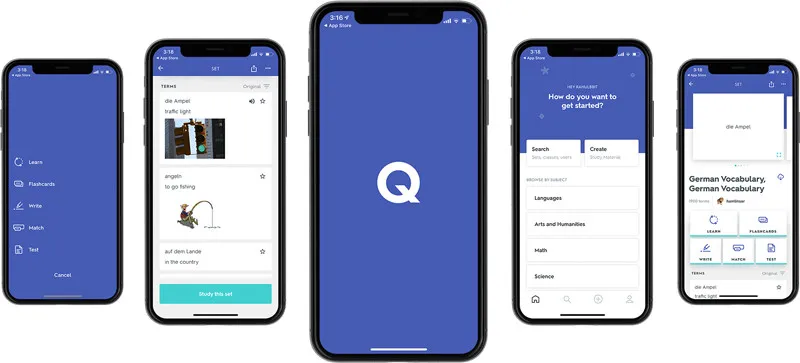
Overview: Quizlet is one of the world’s most popular flashcard apps, boasting over 10 million downloads and millions of monthly active users. It utilizes a flashcard-based learning method combined with engaging practice modes to help learners memorize words quickly and effectively.
Key Features:
- Create and customize flashcards: Users can build their own vocabulary sets, add images, and use automatic pronunciation. Quizlet also allows you to search for sets created by other users, saving you time.
- Diverse study modes: Includes “Learn” (meaning-based), “Write,” “Spell,” “Test,” and games like “Match” and “Gravity” to make learning fun.
- Group study: Users can create study groups and share flashcards with friends or colleagues for collaborative learning.
Pros:
- Extensive flashcard library: With thousands of community-created sets, it’s easy to find existing IELTS vocabulary decks.
- Flexible and varied study modes: Multiple modes help improve retention.
- User-friendly interface: Easy to navigate for both beginners and advanced learners.
Cons:
- Limited free features: Some advanced features, such as offline learning, are locked behind a paywall.
- No official IELTS-standard curriculum: Learners must rely on community-curated sets.
- User Ratings: Quizlet holds an average rating of 4.7/5 stars from millions of users on Google Play and the App Store, with users praising its convenience and ease of use.
How to use:
- Step 1: Download the Quizlet app from Google Play or the App Store and create a free account.
- Step 2: Search for “IELTS vocabulary” and select a set that matches your level and study goals.
- Step 3: Use study modes like “Flashcards” (to flip through terms), “Learn” (for automated practice), and “Test” (to check your retention).
- Step 4: Use “Match” or “Gravity” to boost your recall speed through short, interactive games.
- Step 5: Join IELTS classes on Quizlet (if available) to engage with the community and practice through group challenges and tests.
1.2 Memrise
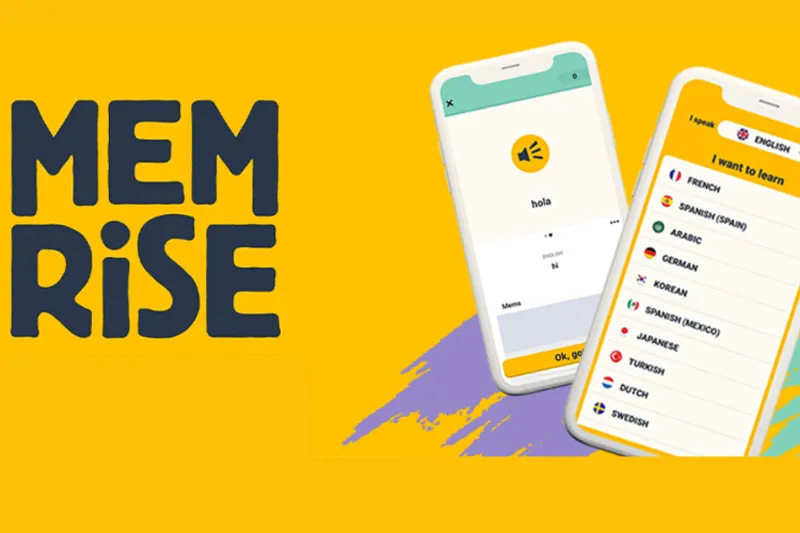
Overview: With over 50 million downloads, Memrise focuses on language acquisition through unique courses and mnemonic techniques that make vocabulary memorable and engaging. It offers IELTS vocabulary courses based on real-world context and visual aids.
Key Features:
- Ready-made IELTS courses: Access specialized IELTS vocabulary courses or create your own.
- Visual learning: Each word is paired with an image or a short video to boost retention.
- Contextual learning: Vocabulary is presented with example sentences and real-life scenarios to help you understand usage.
Pros:
- Intuitive, user-friendly interface: Designed for quick and effective learning.
- Engaging methodology: Uses mnemonics, images, and audio to help words stick in your long-term memory.
- Large community: Benefit from shared courses created by other learners.
Cons:
- Free account limitations: Free users are limited in the number of lessons they can access and must upgrade for full features.
How to use:
- Step 1: Download Memrise and create an account.
- Step 2: Search for “IELTS vocabulary” and choose highly-rated or official Memrise courses.
- Step 3: Use Memrise’s Spaced Repetition System (SRS) to learn words through mini-quizzes and systematic review.
- Step 4: Use the “Difficult Words” mode to focus on words you haven’t mastered yet.
- Step 5: If you have time, participate in “Listening Skills” lessons to practice recognizing words in audio contexts—a vital skill for the IELTS exam.
1.3 Magoosh Vocabulary Builder
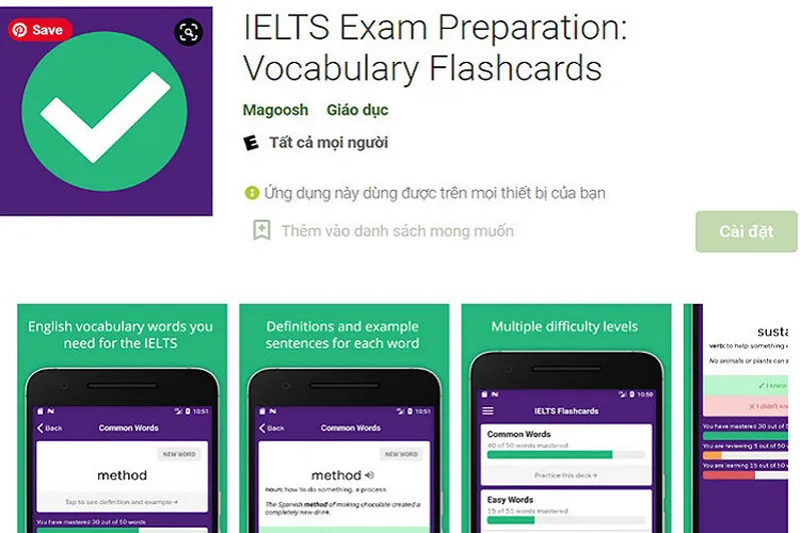
Overview: Magoosh is a specialized vocabulary app for exams like IELTS, GRE, and TOEFL, with over 1 million downloads on Google Play. It is a free tool suitable for learners from basic to advanced levels.
Key Features:
- Tiered vocabulary: Words are categorized by difficulty (basic, intermediate, advanced), making it easy to choose the right level.
- Quizzes and assessments: Each word comes with a definition, example sentence, and a quiz.
- Progress tracking: Magoosh tracks your learning progress, helping you see clear improvements.
Pros:
- Tailored for academic exams: Vocabulary is specifically selected for the IELTS test.
- Simple, distraction-free interface: Keeps you focused on your studies.
Cons:
- Lacks advanced features: No support for images or rich contextual media.
- Limited vocabulary size: Some users find the word bank could be more diverse.
How to use:
Account Setup:
- Step 1: Open the app and sign up or log in. Creating a free account allows you to sync your progress.
- Step 2: Select your level. For IELTS, we recommend choosing intermediate or advanced levels.
Setting Goals:
- Step 3: Define your study path. Magoosh offers categorized sets for SAT, GRE, TOEFL, and IELTS. Select “IELTS Vocabulary” to focus on high-frequency exam words.
- Step 4: Choose your daily study volume (e.g., 10–20 words per session) based on your personal pace.
Study and Practice:
- Step 5: The app displays words with definitions, examples, and quiz questions. Synonyms are provided to help you recognize words in context.
- Step 6: Magoosh provides immediate feedback. If you answer incorrectly, the word is flagged and will reappear later until you master it.
Spaced Repetition:
- Step 7: Magoosh uses spaced repetition to re-test words you haven’t mastered, ensuring long-term retention.
- Step 8: Mark difficult words to review later or add them to your “Favorites” list.
Tracking Progress:
- Step 9: Visit the “Progress” section to see how many words you’ve learned and which ones need review.
- Step 10: Take mini-quizzes after completing a set to assess your retention and understanding.
Reminders:
- Step 11: Set daily reminders to stay consistent with your study schedule.
Challenges:
- Step 12: Participate in daily and weekly challenges to review learned words and expand your vocabulary effectively.
2. Top 3 Free IELTS Vocabulary Websites
2.1 Vocabulary.com
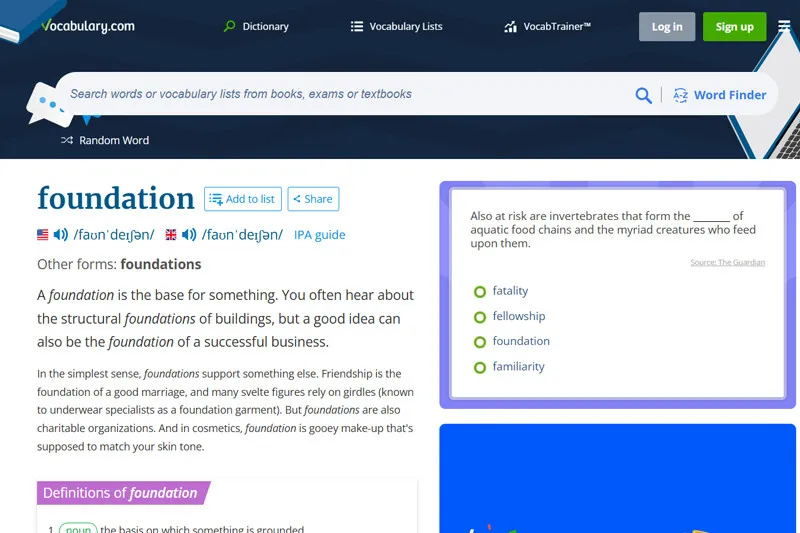
Overview: Vocabulary.com is a renowned site with millions of monthly visits, offering vocabulary practice through real-world context. It is an excellent tool for IELTS learners looking to expand their vocabulary naturally.
Key Features:
- Contextual learning: Every word includes clear definitions and example sentences.
- Practice and quizzes: Various exercises help reinforce what you’ve learned.
- Progress tracking: Monitor your mastery and learning journey.
Pros:
- Clear, accessible definitions: Great for learners of all levels with vivid examples.
- Diverse practice tools: Multiple quiz formats to solidify knowledge.
Cons:
- No IELTS-specific curriculum: You need to search for relevant lists or pair it with an IELTS course.
How to use:
1. Getting Started
- Step 1: Visit Vocabulary.com and create a free account to sync your progress across devices.
- Step 2: Log in and explore the dashboard to search for words or join challenges.
2. Finding IELTS Lists
- Step 3: Search for “IELTS vocabulary” to find existing lists or create your own custom sets.
- Step 4: To create a list, select “Create a List” and input your words. You can use the site’s suggested definitions to save time.
3. Study Modes
- Step 5: The site uses spaced repetition and interactive quizzes. You’ll be presented with definitions and context, followed by questions to test your understanding.
- Step 6: Answering questions helps with long-term retention, with the frequency of review adjusted based on your performance.
4. The Challenge
- Step 7: Use “The Challenge” feature—a short, fast-paced quiz—to improve your recall speed.
- Step 8: Set daily or weekly goals to maintain consistency.
5. Tracking Progress
- Step 9: Check “My Progress” to see your learned words and mastery levels.
- Step 10: Flag difficult words to prioritize them in your future study sessions.
6. Group Study
- Step 11: Create or join a study group to stay motivated by sharing progress with friends.
- Step 12: Participate in group challenges and share vocabulary sets.
7. Reminders
- Step 13: Set email reminders to ensure you never miss a study session.
- Step 14: Use the “Word of the Day” feature to learn new terms without feeling overwhelmed.
8. Tips for IELTS
- Read and Learn: Use the site to look up words you encounter in academic texts. Learning words in context is highly effective.
- Practice Writing: Create your own sentences using new words and check them. This helps immensely with IELTS Writing and Speaking.
Related article: 5000 IELTS Vocabulary Words by Topic
2.2 Oxford Learner’s Dictionaries
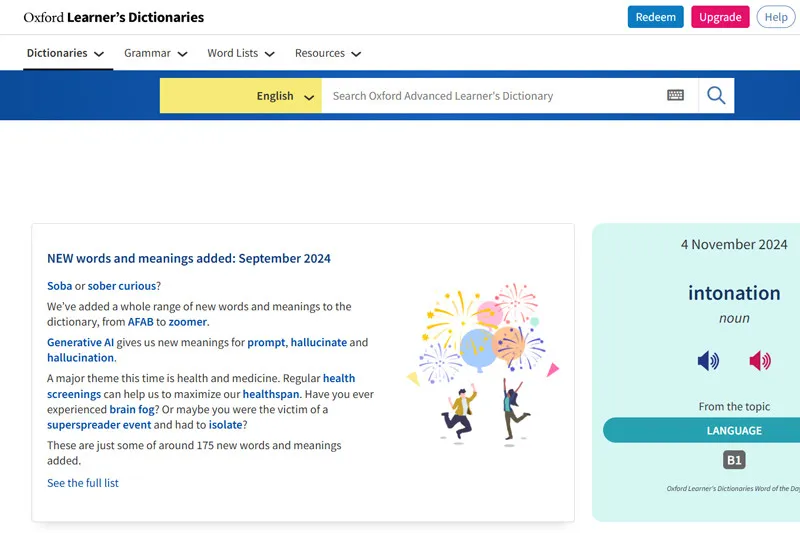
Overview: Oxford Learner’s Dictionaries is a highly reputable resource from Oxford University Press. It is a go-to for IELTS learners due to its accuracy and clear, academic definitions.
Key Features:
- Detailed definitions and examples: Includes British and American pronunciation, plus usage examples.
- Level-based vocabulary: Categorized by CEFR levels (B1-B2, C1-C2).
- Thesaurus and Synonyms: Helps you understand nuances and expand your range.
- Quizzes and Word of the Day: Quick practice tools to reinforce learning.
Pros:
- High reliability: Developed by Oxford, ensuring top-tier accuracy.
- Rich academic resources: Perfect for IELTS-level vocabulary.
Cons:
- Lacks a structured practice system: No built-in spaced repetition or extensive exercise library.
- Premium features: Some advanced tools require a paid subscription.
How to use:
1. Searching
- Step 1: Enter your word in the search bar. You’ll get detailed, easy-to-understand definitions.
- Step 2: Check the synonyms and related information to broaden your knowledge.
2. Pronunciation
- Step 3: Listen to both British and American pronunciations to improve your Speaking skills.
3. Contextual Examples
- Step 4: Note down examples that relate to common IELTS topics.
4. Word Lists
- Step 5: Create an account to save words and track your progress.
5. Topic Lists
- Step 6: Explore “Topic Lists” (e.g., Education, Environment, Health) to master vocabulary relevant to IELTS themes.
6. Collocations and Word Families
- Step 7: Study collocations and word families to improve your fluency and academic writing.
7. Word of the Day
- Step 8: Subscribe to “Word of the Day” for daily vocabulary enrichment.
Tips:
- Note-taking: Always write down new words and create your own sentences.
- Listen and Repeat: Practice pronunciation daily to boost your Speaking score.
See also: Best IELTS Vocabulary Books
2.3 BBC Learning English – English Vocabulary
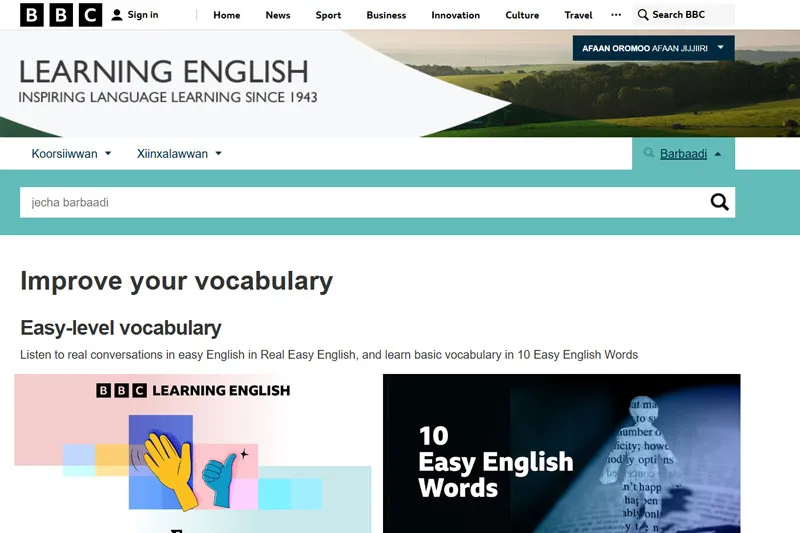
Overview: BBC Learning English is a world-famous educational site. It offers a wealth of academic content, including free vocabulary lessons that attract millions of learners globally.
Key Features:
- Contextual lessons: Vocabulary is taught through real-world news, culture, and science.
- Video and quizzes: Lessons are paired with videos to improve listening and pronunciation.
- Popular series: “6 Minute English” and “The English We Speak” are excellent for IELTS preparation.
Pros:
- Rich, updated content: Reflects modern, real-world English.
- Suitable for all levels: Easy to find content that matches your proficiency.
- Improves listening: Great for understanding words in natural, spoken contexts.
Cons:
- Limited interactive exercises: Focuses more on content consumption than active recall.
- No progress tracking: You’ll need to manage your own study path.
How to use:
1. Explore Vocabulary
- Step 1: Visit the Vocabulary section on the BBC Learning English website.
- Step 2: Choose topics relevant to IELTS (e.g., “News Review,” “6 Minute English”).
2. Video Lessons
- Step 3: Watch the videos to learn words in natural contexts.
- Step 4: Listen multiple times to grasp the nuances of usage.
3. The English We Speak
- Step 5: Use this series to learn common idioms and phrases for a more natural IELTS Speaking score.
- Step 6: Note down phrases that can be used in your Speaking test.
4. Interactive Quizzes
- Step 7: Take the quizzes provided after each lesson to check your understanding.
- Step 8: Practice these words in your Writing tasks.
5. 6 Minute English
- Step 9: Use this series to practice listening and vocabulary simultaneously.
6. Daily Notes
- Step 10: Keep a vocabulary journal to review new words regularly.
Tips:
- Watch videos daily to improve your listening and retention.
- Practice using new words in your own sentences to build confidence for the exam.
Learning IELTS vocabulary through free apps and websites like Quizlet, Memrise, Magoosh, Oxford Learner’s Dictionaries, and BBC Learning English allows you to study anytime, anywhere. Each tool offers a unique approach, from flashcards and mnemonics to detailed dictionary entries and engaging videos.
To achieve the best results, combine these resources and focus on academic vocabulary relevant to IELTS topics. With patience and a consistent study method, these tools will be your greatest allies in conquering the IELTS exam and enriching your English proficiency.




 Khai giảng Khóa học Hè cực HOT.
No comments yet!