


Tóm Tắt Nội Dung Bài Viết
In IELTS Speaking, the topic of getting lost frequently appears across various question formats, particularly in Part 2 and Part 3. This is a common topic, and students can build strong responses by combining vocabulary from several related areas, such as directions, maps, navigation, landmarks, asking for help, and dealing with unexpected situations.
In this article, Ms. Thanh Thuy has compiled essential vocabulary and sentence structures, along with band-9 sample answers for IELTS Speaking Part 1, Part 2, and Part 3 on this topic.
Essential Vocabulary & Structures for “Getting Lost”
1.1. Directions and Navigation Vocabulary
| Word / Phrase | Phonetics | Meaning |
| get lost | /ɡet lɒst/ | to lose one’s way / become lost |
| lose my way | /luːz maɪ weɪ/ | to lose track of the right path |
| be unfamiliar with an area | /biː ʌn.fəˈmɪl.i.ər/ | not knowing a location well |
| find my bearings | /faɪnd maɪ ˈbeə.rɪŋz/ | to figure out where one is |
| get my bearings | /ɡet maɪ ˈbeə.rɪŋz/ | to become familiar with one’s surroundings |
| navigate my way around | /ˈnæv.ɪ.ɡeɪt/ | to find one’s way through an area |
| follow the directions | /ˈdɪˌrek.ʃənz/ | to go according to instructions/maps |
| take a wrong turn | /teɪk ə rɒŋ tɜːn/ | to turn onto the wrong street |
| go in the wrong direction | /ɡəʊ ɪn ðə rɒŋ dɪˈrek.ʃən/ | to travel away from the intended path |
| lose track of where I am | /luːz træk əv weər aɪ æm/ | to no longer know one’s location |
| have no idea where I am | /hæv nəʊ aɪˈdɪə weər aɪ æm/ | to be completely disoriented |
| ask someone for directions | /ɑːsk ˈsʌmwʌn fə dɪˈrek.ʃənz/ | to request help to find a route |
| check a map | /tʃek ə mæp/ | to look at a map for guidance |
| use a navigation app | /juːz ə ˌnæv.ɪˈɡeɪ.ʃən æp/ | to use GPS mapping software |
| use GPS | /juːz ˌdʒiː.piːˈes/ | to use satellite location tracking |
| look for a landmark | /lʊk fə ə ˈlænd.mɑːk/ | to search for a noticeable feature |
| recognisable landmark | /ˈrek.əɡ.naɪ.zə.bəl ˈlænd.mɑːk/ | an easily identified point of interest |
| a dead end | /ə ded end/ | a street with no exit / cul-de-sac |
| a shortcut | /ə ˈʃɔːt.kʌt/ | a faster, alternative route |
| a roundabout | /ə ˈraʊn.də.baʊt/ | a circular road junction |
1.2. Natural Collocations
Instead of relying solely on I got lost, try using these natural collocations to diversify your answers:
- get completely lost: to become entirely disoriented
- get hopelessly lost: to be so lost that you don’t know what to do
- lose my sense of direction: to lose one’s ability to orientate oneself
- struggle to find my way: to have a difficult time finding the destination
- have trouble navigating: to encounter difficulties finding the right route
When describing how you solved the situation and found your way back, consider these expressions:
- rely heavily on GPS: to depend mostly on satellite navigation
- ask a local for directions: to seek assistance from a nearby resident
- retrace my steps: to go back along the route you just took
- find my way back: to return successfully to a familiar location
- figure out where I was: to work out your current position
- recognise a familiar landmark: to spot a place or building you know
- end up somewhere unexpected: to arrive at an unplanned destination
1.3. Useful Storytelling Phrases for Part 2
- Setting the Scene
It happened when I was…
I remember it quite clearly because…
It was the first time I had ever…
- Describing the Turning Point
It wasn’t until I had been walking for about 20 minutes that I realised I was lost.
At first, I thought I was heading in the right direction, but then I realised that nothing looked familiar.
- Describing Emotions
I started to feel a little anxious.
I was confused and didn’t know which way to go.
I began to panic slightly, but I tried to stay calm.
- Describing the Action / Solution
The first thing I did was…
I decided to… rather than…
Luckily, I managed to…
Eventually, I found my way back by…
- Reflecting on the Experience
Looking back, I realised that…
Since then, I’ve always made sure to…
It taught me that…
- Sample IELTS Speaking Answers for “Getting Lost”
IELTS Speaking Part 1 – Directions & Maps
Question 1: Are you good at following directions?
I’d say I’m fairly good at following directions, especially if they’re clear and straightforward. I usually remember landmarks rather than street names, so I tend to think in terms of places like cafés, shops or major buildings. However, if I’m in an unfamiliar area, I normally rely on GPS just to be on the safe side.
Key Vocabulary:
- fairly good at
- clear and straightforward
- remember landmarks
- an unfamiliar area
- rely on GPS
- to be on the safe side
Question 2: Do you often use maps?
Yes, quite often. Whenever I visit a new place, I usually check the map beforehand so that I have a rough idea of where everything is. I don’t necessarily memorise the whole route, but I like to know the general direction and identify a few landmarks along the way. It makes me feel more confident when I’m travelling around an unfamiliar area.
Question 3: Can you read a paper map?
Yes, although I wouldn’t say I’m particularly good at it. I can understand the basic symbols and work out the general direction, but I sometimes struggle with complicated maps with lots of roads and intersections. These days, I usually use digital maps because they’re much more convenient and can show me exactly where I am.
Key Vocabulary:
- paper map
- basic symbols
- work out the direction
- intersections
- digital maps
- show me exactly where I am
Question 4: Have you ever gotten lost?
Yes, a few times, actually. The most memorable occasion was when I was visiting a new city and decided to walk around on my own. I took a wrong turn and ended up in a residential area that I didn’t recognise at all. Luckily, I had my phone with me, so I eventually managed to find my way back.
IELTS Speaking Part 2: Describe an occasion when you got lost and didn’t know where you were.
You should say:
- where you were
- what you were doing
- how you got lost
- and explain how you found your way back
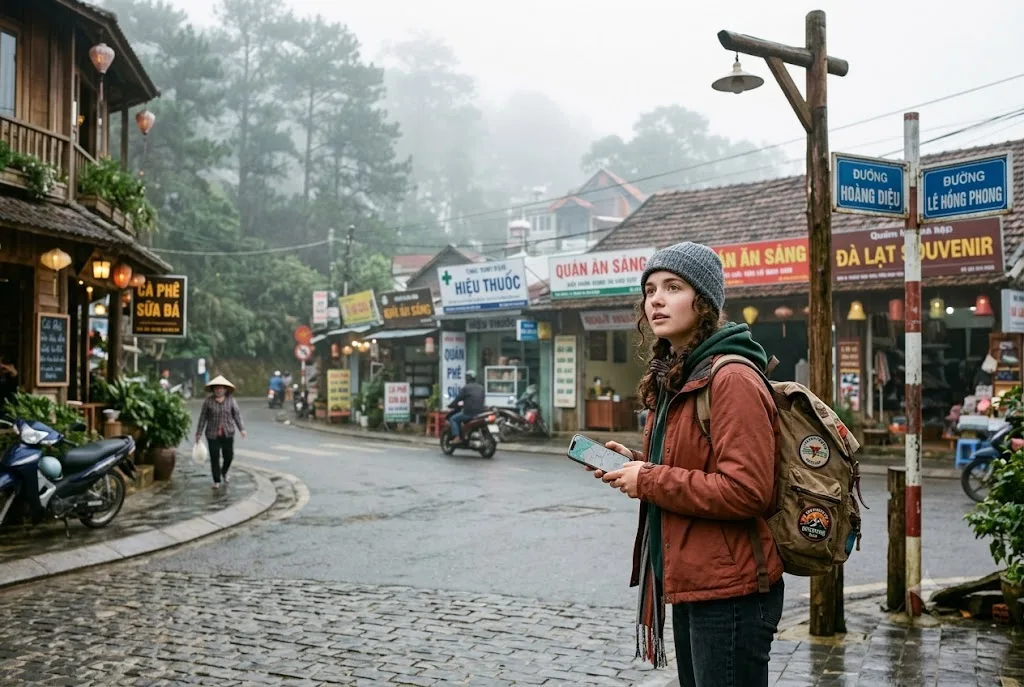
I’d like to talk about an occasion when I got completely lost while I was visiting Da Lat with a couple of friends. It happened about two years ago, when we decided to explore the city on foot instead of taking a taxi.
We had just finished having lunch in the city centre, and I suggested that we take a shortcut to a café that one of my friends had recommended. I was quite confident that I knew the way, so I didn’t bother checking Google Maps. Unfortunately, I took a wrong turn at an intersection, and we ended up walking down a small road that none of us recognised.
At first, I wasn’t too worried because I assumed we’d eventually come across a familiar street. However, after about twenty minutes, I realised that we had completely lost our way. There were very few people around, and I had no idea where we were. To make matters worse, my phone battery was running low, so I couldn’t rely on GPS for very long.
I tried to re



 Khai giảng Khóa học Hè cực HOT.
No comments yet!