


Tóm Tắt Nội Dung Bài Viết
Tucked away on the banks of the Limpopo River in southern Africa, the ancient kingdom of Mapungubwe was once one of the most vibrant and prosperous indigenous civilizations between the 11th and 13th centuries. Challenging historical stereotypes of a primitive pre-colonial wilderness, archaeological discoveries at Mapungubwe have revealed a sharply stratified society, maritime trade networks extending all the way to the Indian Ocean, and exquisite gold-leaf craftsmanship — epitomized by the legendary golden rhinoceros figurine. The reading passage Mapungubwe (Cambridge IELTS 21 – Test 2, Passage 2) invites readers to travel back in time and explore the social structure, economy, and mysterious decline of this ancient stone kingdom.
Centering on Archaeology & Ancient Civilizations, this reading passage tests candidates across three key task types: Matching Information, Multiple Choice (Two Choices), and Summary Completion. The detailed breakdown, full translation, and core academic vocabulary system below will help you tackle the exam with absolute confidence and precision.
1. Reading Passage
Mapungubwe
Located in southern Africa just below the Limpopo River, the kingdom of Mapungubwe flourished between the 11th and 13th century CE.
[Paragraph A] Mapungubwe, which was one of the first states in southern Africa, was formed by Bantu-speaking peoples who were farmers. The area controlled by the rulers of Mapungubwe had at its heart a large sandstone plateau, which was easily defended due to its inaccessibility. As with other kingdoms in the region of southern Africa, cattle herding and other types of farming brought plenty of food and a surplus that could be traded for needed goods. Archaeology has revealed extensive layers of bones and manure, which indicate that from the 9th century CE there were large cattle herds, the traditional source of political power in southern African communities. The archaeological record for the 10th century shows a marked increase in the number of domesticated cattle in the area as well as cotton cultivation and weaving, as indicated by abundant finds of spindle whorls.
[Paragraph B] The total population of Mapungubwe at its peak in the mid-13th century was around 5,000 people. The chief or king of Mapungubwe was likely the wealthiest individual in the society, and would have owned more cattle and precious materials than anyone else. The king and his advisers dwelt in a stone enclosure composed of stone walls and housing built on the highest level of the community’s territory, a natural sandstone hill which is some 30 metres high and 100 metres in length. Occupation on the hill dates from the 11th century and the entire complex was surrounded by a wooden palisade*, as indicated by postholes made in the rock. The rest of the community lived in mud and thatch housing spread out below the hill, although there is one stone structure here. This settlement, known as Babandyanalo, covers around 5 hectares (12.3 acres) and predates the hilltop structures.
[Paragraph C] The kings of Mapungubwe were buried at the top of the hill site in a demarcated area away from the dwellings, while other members of the community were buried at the surrounding valley level. A wooden staircase connected the two levels, the sockets for the steps being clearly visible in the sandstone cliff face. There were some grander residences dotted around the outskirts of Babandyanalo, and these probably belonged to male relatives of the king. There are many other smaller but still impressive sites across the Mapungubwe plateau, which are located anywhere from 15 to 100 kilometres from the major hill site. Containing stone residences and walls, they likely belonged to local chiefs who acted as servants to the king.
[Paragraph E] Archaeological discoveries reveal that pottery was produced on a scale large enough to suggest the presence of professional potters, and is another indicator of the prosperity of Mapungubwe society. Archaeological finds include spherical vessels with short necks, beakers, and bowls, many of which have decorative stamps. There are also ceramic discs, and whistles. In addition, cattle, sheep, and goat figurines, and small figures of highly stylised humans with elongated bodies and short limbs have been found. The figures may have been used in ceremonies as offerings to ancestors, but their precise function is not known. Other discoveries include small jewellery items made from locally sourced copper.
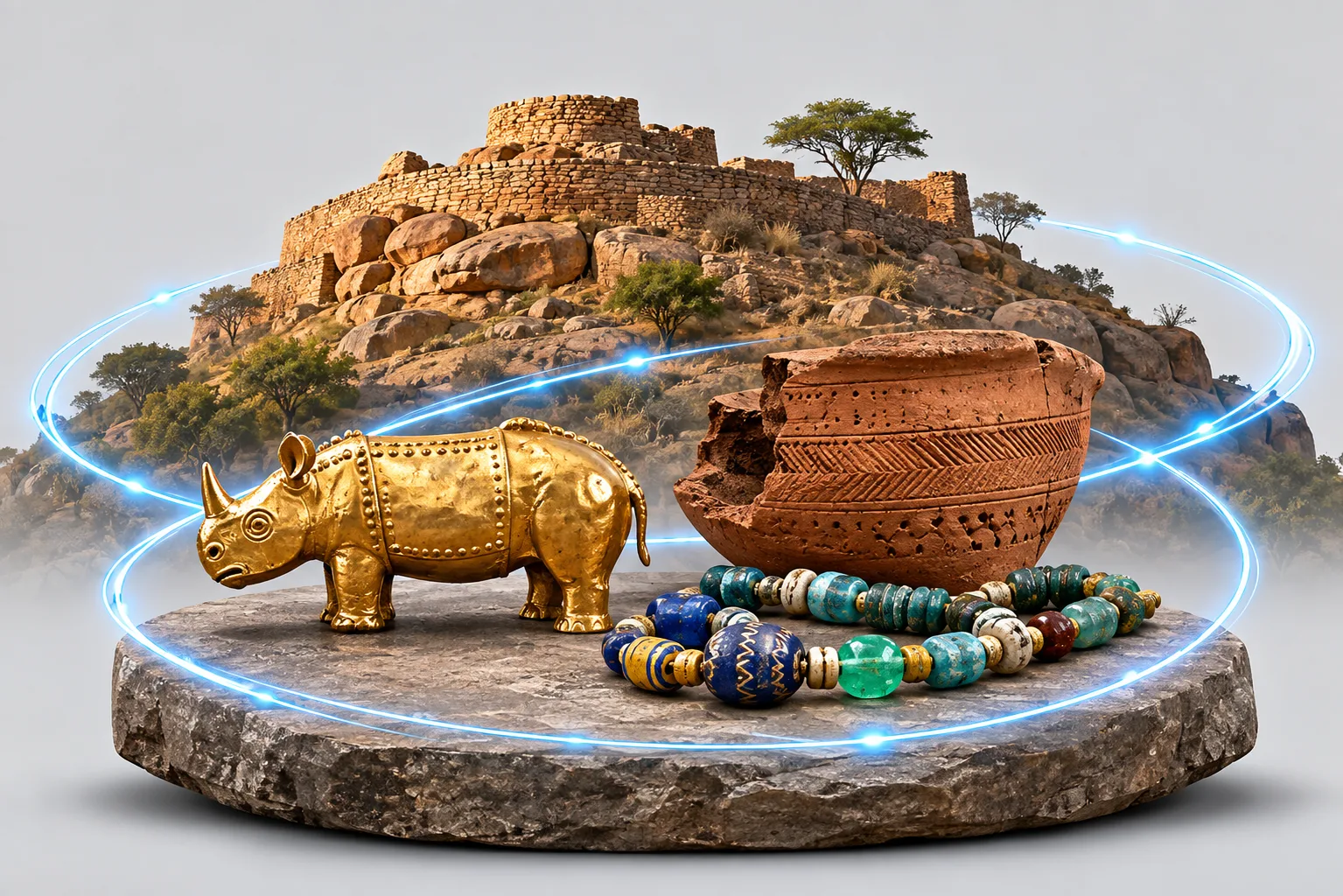
[Paragraph F] Beautifully decorated artefacts made of gold have also been found at Mapungubwe. A type of decoration, found nowhere else except Great Zimbabwe, involved the crafting of gold into small rectangular sheets and carving geometrical patterns into it. These sheets were then used to cover wooden objects (which have not survived) using small tacks, also made of gold. One such object that has been discovered may have been a sceptre, while additional evidence of local gold-working is a rhinoceros figurine made from small hammered sheets, and thousands of small gold beads. These objects were all found at the royal burial site and date to c. 1150. They are the first known indicators that gold had an intrinsic value of its own (as opposed to that of a currency) in southern Africa.
[Paragraph G] The kingdom of Mapungubwe was already in decline by the late 13th century, probably because overpopulation placed too much stress on local resources, a situation that may have been brought to a crisis point by a series of droughts. Trade routes may also have shifted northwards. Certainly, the areas that now prospered were to the north, such as Great Zimbabwe.
* palisade: a strong wooden fence built for military defense.
2. Original Questions
Questions 14–19
Reading Passage 2 has seven paragraphs, A–G.
Which paragraph contains the following information?
Write the correct letter, A–G, in boxes 14–19 on your answer sheet.
-
14. a mention of the uncertainty regarding the purpose of certain objects
-
15. the likelihood that a climatic factor increased the problems Mapungubwe faced
-
16. a mention of the location where members of the king’s family are thought to have lived
-
17. a reference to people who brought goods by ship
-
18. an estimate of the size to which the Mapungubwe community grew
-
19. a mention of agricultural produce being exchanged for other items
Questions 20–21
Choose TWO letters, A–E.
The archaeological record reveals information about gold and the kingdom of Mapungubwe. Which TWO pieces of information are mentioned by the writer?
-
A. Not everyone in Mapungubwe used gold as a form of payment.
-
B. Items of gold were placed close to where Mapungubwe kings were buried.
-
C. The most valuable item discovered in Mapungubwe was a sceptre made of gold.
-
D. The way gold was decorated in Mapungubwe was also practised in another kingdom.
-
E. Working with gold was a respected occupation in the Mapungubwe community.
Questions 22–26
Complete the summary below.
Choose ONE WORD ONLY from the passage for each answer.
Write your answers in boxes 22–26 on your answer sheet.
Archaeological discoveries
The Mapungubwe community’s 22. _______________ is indicated by the amount of professionally made pottery discovered at the site. Many of these objects, such as beakers and bowls, are highly decorated and have been marked with stamps. Other finds include round ceramic objects, 23. _______________ and figures of various animals, as well as models of people with stretched 24. _______________. It is possible that these had a role in ceremonies to honour 25. _______________. In addition, pieces of 26. _______________ made from a local metal have been found at the site.
3. Vivid and Natural Translation
[Paragraph A] Mapungubwe, one of the earliest states in southern Africa, was founded by Bantu-speaking farmers. The area controlled by the rulers of Mapungubwe centered on a vast sandstone plateau, which was easily defensible due to its rugged, inaccessible terrain. Much like other kingdoms in the southern African region, cattle herding and other forms of agriculture yielded abundant food supplies and surpluses that could be traded for essential goods. Archaeological excavations have uncovered thick layers of bones and manure, demonstrating that large cattle herds—the traditional bedrock of political power in southern African communities—existed as early as the 9th century CE. Tenth-century archaeological records indicate a sharp surge in domesticated livestock numbers, alongside cotton cultivation and weaving, as evidenced by large quantities of spindle whorls found at the site.
[Paragraph B] At its peak in the mid-13th century, Mapungubwe had a total population of roughly 5,000. The chief or king was likely the wealthiest individual in society, owning more livestock and valuables than anyone else. The king and his advisers lived in a heavily fortified stone enclosure built on the highest level of the community’s territory—a natural sandstone hill roughly 30 meters high and 100 meters long. Hillside habitation dates back to the 11th century, and the entire complex was surrounded by a defensive wooden palisade, as revealed by postholes drilled into the bedrock. The rest of the community inhabited mud-and-thatch dwellings spread out below the hill, although a single stone structure stood there as well. This settlement, known as Babandyanalo, spanned approximately 5 hectares (12.3 acres) and predated the hilltop structures.
[Paragraph C] The kings of Mapungubwe were buried atop the hill in a clearly demarcated area separate from the living quarters, whereas ordinary community members were interred in the surrounding valley. A wooden staircase linked the two levels, with socket holes for the steps still clearly visible on the sandstone cliff face. More grandiose residences dotted the outskirts of Babandyanalo and likely belonged to the king’s male relatives. Furthermore, numerous smaller yet impressive sites dotted the Mapungubwe plateau, situated anywhere from 15 to 100 kilometers from the main hill site. Featuring stone housing and walls, these likely belonged to local chieftains who served as vassals to the king.
[Paragraph D] The Mapungubwe plateau holds a remarkably high volume of carnivore remains and ivory fragments, suggesting that large animal hides and elephant tusks were stockpiled, likely for trade with coastal regions accessible via the Limpopo River. The presence of glass beads, almost certainly of Indian origin, points to commercial exchanges with coastal states that, in turn, traded with merchants arriving from India by sea. Mapungubwe also capitalized on locally sourced copper and the gold trade flowing from the northern kingdom of Great Zimbabwe (12th–15th centuries) down to the coastal city of Kosala. These lucrative trade connections likely strengthened political authority, enabling rulers to control and even monopolize these profitable interregional networks.
[Paragraph E] Archaeological finds reveal that pottery was manufactured on a scale large enough to indicate the presence of professional potters, serving as yet another testament to Mapungubwe’s societal prosperity. Recovered artifacts include spherical short-necked vessels, beakers, and bowls, many embellished with decorative stamps, alongside ceramic discs and whistles. Additionally, archaeologists uncovered figurines of cattle, sheep, and goats, as well as stylized human figures featuring elongated bodies and short limbs. While these figures may have served as ancestral offerings in rituals, their exact function remains unknown. Other discoveries include miniature jewelry pieces crafted from local copper.
[Paragraph F] Exquisitely decorated gold artifacts have also been unearthed at Mapungubwe. A unique decoration technique—found nowhere else except Great Zimbabwe—involved hammering gold into tiny rectangular sheets and carving geometric patterns onto them. These gold sheets were then fastened using tiny gold tacks to cover wooden objects that have since decomposed. One such recovered item may have been a scepter, while other evidence of local gold-working includes a small rhinoceros figurine fashioned from hammered gold sheets and thousands of minuscule gold beads. Found entirely within the royal burial site and dating to around 1150, these objects provide the earliest known evidence in southern Africa that gold possessed intrinsic value independent of currency.
[Paragraph G] By the late 13th century, the kingdom of Mapungubwe was already declining, likely because overpopulation strained local resources—a fragile situation potentially pushed to crisis point by consecutive droughts. Trade routes may have also shifted northward. Indeed, the regions that subsequently thrived lay to the north, such as Great Zimbabwe.
4. Core Academic Vocabulary
| Vocabulary / Phrase | Part of Speech | Contextual Meaning in Passage |
| Sandstone plateau | Noun phrase | Cao nguyên sa thạch |
| Agricultural surplus | Noun phrase | Lượng nông sản thặng dư (dùng để trao đổi/buôn bán) |
| Spindle whorls | Noun phrase | Con quay se sợi (dấu tích của nghề dệt vải cổ) |
| Demarcated burial site | Noun phrase | Khu lăng mộ được phân ranh giới rõ ràng |
| Lucrative trade links | Noun phrase | Các tuyến giao thương sinh lợi cao / béo bở |
| Monopolise | Verb | Độc quyền, thâu tóm toàn bộ quyền kiểm soát |
| Elongated bodies | Noun phrase | Thân hình thon dài / kéo dài cách điệu |
| Intrinsic value | Noun phrase | Giá trị tự thân (giá trị nội tại quý giá của kim loại) |
5. Detailed Answer Analysis
Questions 14–19: Matching Information
-
14. a mention of the uncertainty regarding the purpose of certain objects -> Answer: E
-
Evidence in Paragraph E: “The figures may have been used in ceremonies as offerings to ancestors, but their precise function is not known.”
-
Analysis: uncertainty aligns with precise function is not known, and purpose of certain objects refers to the function of the human and animal figures (the figures).
-
-
15. the likelihood that a climatic factor increased the problems Mapungubwe faced -> Answer: G
-
Evidence in Paragraph G: “…probably because overpopulation placed too much stress on local resources, a situation that may have been brought to a crisis point by a series of droughts.”
-
Analysis: Droughts (a series of droughts) constitute a climatic factor (climatic factor), which brought the situation to a crisis point (brought to a crisis point -> increased the problems).
-
-
16. a mention of the location where members of the king’s family are thought to have lived -> Answer: C
-
Evidence in Paragraph C: “There were some grander residences dotted around the outskirts of Babandyanalo, and these probably belonged to male relatives of the king.”
-
Analysis: male relatives of the king corresponds to members of the king’s family, and their living quarters are located at the outskirts of Babandyanalo (location where they lived).
-
-
17. a reference to people who brought goods by ship -> Answer: D
-
Evidence in Paragraph D: “…with other states on the coast who, in turn, traded with merchants travelling from India by sea.”
-
Analysis: Merchants traveling from India by sea (merchants travelling from India by sea) refer to people bringing goods by ship (people who brought goods by ship).
-
-
18. an estimate of the size to which the Mapungubwe community grew <span class="
Chia sẻ:



 Khai giảng Khóa học Hè cực HOT.
No comments yet!