


Tóm Tắt Nội Dung Bài Viết
The Aptis ESOL certificate, developed by the British Council, is a modern and flexible English proficiency assessment tool suitable for both academic and professional purposes. With its comprehensive test structure and fast turnaround time, Aptis is increasingly being adopted by educational institutions, corporations, and for civil service examinations in Vietnam. So, what makes Aptis special? What is the test structure like? Let’s dive into the details!
What is the Aptis ESOL Certificate?
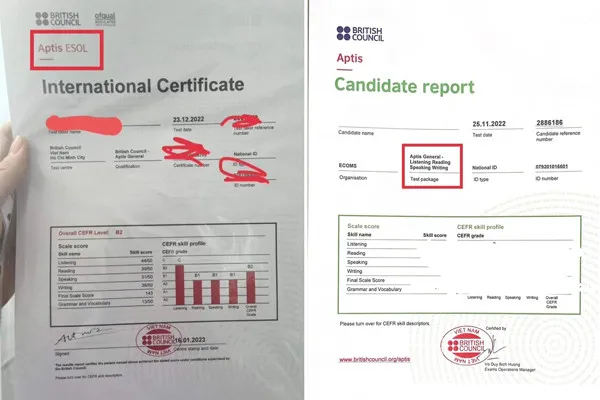
The Aptis ESOL certificate is an English proficiency test designed and administered by the British Council. It is a modern, flexible language assessment tool used widely for both academic and professional goals. Aptis does not just test basic skills; it focuses on the practical application of language in real-world contexts.
Aptis ESOL (English for Speakers of Other Languages) is specifically designed for non-native English speakers. The test accurately assesses a candidate’s language level through four core skills—Listening, Speaking, Reading, and Writing—along with a Grammar and Vocabulary component. Thanks to this flexibility, Aptis is widely used by educational institutions, businesses, and governments worldwide.
Is the Aptis Certificate Recognized?
Aptis is a globally recognized English certificate, particularly within educational and corporate environments. The British Council, the body that manages Aptis, is an internationally respected organization for education and culture. In Vietnam, this certificate has been adopted as an English assessment tool by many government agencies, businesses, and schools.
- In education: Many universities in Vietnam accept the Aptis certificate to assess students’ entry or exit proficiency. Some international training programs also use Aptis to verify the English levels of applicants.
- In the workplace: Businesses, especially multinational corporations, use Aptis to evaluate employees’ English skills, ensuring they can communicate and work effectively in international environments.
- In the civil service: Several local authorities and ministries in Vietnam have recognized Aptis as a standard for foreign language assessment in recruitment exams for civil servants, public employees, and teachers.
How Long Is the Aptis Certificate Valid?
The Aptis certificate is valid for two years from the date of issue. This duration is similar to other international English certificates like IELTS or TOEIC. However, in some cases, organizations or employers may require a more recent certificate, such as one issued within the last 12 months. Therefore, candidates should carefully check the specific requirements of the institution requesting the certificate.
Should You Take the Aptis Exam? Who Is It For?
Should You Take the Aptis Exam?
Aptis is an excellent choice for those who need an English certificate with reasonable costs, flexible scheduling, and a user-friendly structure. Some benefits of choosing Aptis include:
- Fast testing and results: Candidates can receive their Aptis results within 48 hours and the hard-copy certificate within 5–7 working days.
- Reasonable cost: Compared to IELTS or TOEIC, the Aptis exam fee is lower, making it accessible to a wider range of people.
- Clear test structure: Aptis features an easy-to-understand test format, suitable even for those just starting their English learning journey.
Who Should Take the Aptis Exam?

- Teachers and civil servants: Those who need a foreign language certificate to meet recruitment or promotion requirements.
- Students: Those who need an English certificate to meet graduation criteria or apply for scholarships.
- Employees: Those looking to enhance their career opportunities or advance in their current roles.
- Organizations: Businesses or schools that want to assess the English proficiency of their staff or students quickly and effectively.
What Is the Structure of the Aptis Exam?
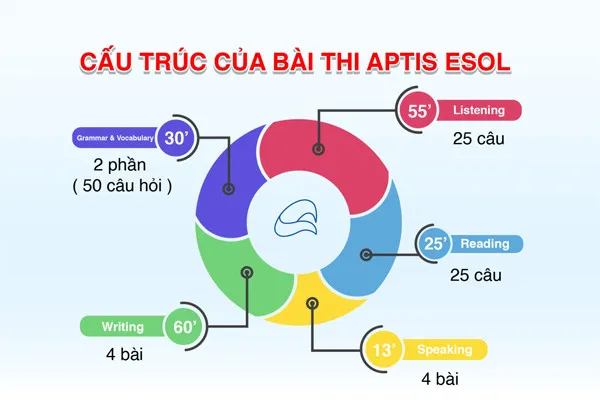
The Aptis exam is designed with 5 main parts, each focusing on a specific skill or area of language knowledge. Here are the details for each part:
1. Grammar and Vocabulary
Objective: To test knowledge of grammar and the ability to use vocabulary in real-world contexts.
Structure: 50 questions, divided into 2 parts:
- 25 grammar questions: Candidates must choose the correct answer to complete sentences or paragraphs.
- 25 vocabulary questions: Includes finding synonyms, antonyms, and filling in the blanks.
Time: 25 minutes.
2. Reading
Objective: To assess the ability to understand written texts at various levels.
Structure: Consists of 4 parts:
- Part 1: Matching sentences to appropriate paragraphs or headings.
- Part 2: Ordering sentences logically.
- Part 3: Reading short passages and answering questions.
- Part 4: Reading long passages and answering detailed questions.
Time: 30 minutes.
3. Listening
Objective: To test the ability to understand conversations, announcements, or monologues in real-world contexts.
Structure: Consists of 4 parts:
- Part 1: Listening to short conversations and choosing the correct answer.
- Part 2: Listening to short passages and identifying specific details.
- Part 3: Listening to longer conversations and answering related questions.
- Part 4: Listening to a monologue and choosing the correct answer.
Time: 30–40 minutes.
4. Writing
Objective: To assess the ability to express ideas clearly and accurately in writing.
Structure: Consists of 3–4 tasks, for example:
- Writing short messages or email responses.
- Describing information from tables or charts.
- Presenting personal opinions on a specific topic.
Time: 50 minutes.
5. Speaking
Objective: To test the ability to communicate in English in real-life situations.
Structure: Consists of 4 parts:
- Part 1: Personal introduction (answering simple questions).
- Part 2: Describing pictures (discussing details in an image).
- Part 3: Comparing and giving opinions (answering questions based on images).
- Part 4: Discussing a complex topic (presenting viewpoints and reasons).
Time: 12 minutes (recording responses).
How Does Aptis Differ from IELTS and TOEIC?
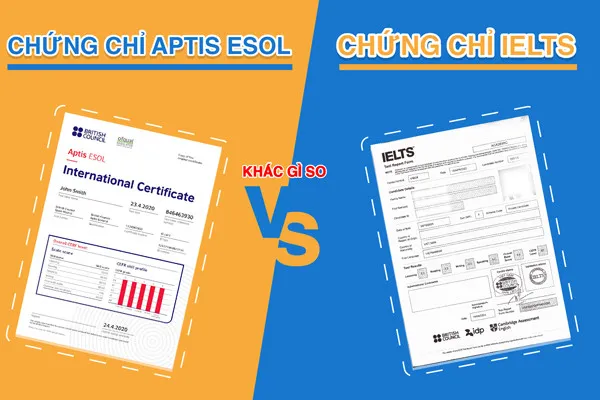
Aptis, IELTS, and TOEIC are all English proficiency tests, but each serves different purposes and has distinct characteristics, as follows:
1. Purpose
Aptis:
- Flexibly designed for both academic and professional purposes.
- Suitable for organizations wanting to assess staff or student proficiency, as well as individuals needing a certificate for work or study applications.
- Accepted in recruitment and promotion exams for civil servants in some Vietnamese agencies.
IELTS:
- Primarily for academic and immigration purposes.
- Usually required for study abroad applications, scholarships, or working overseas.
TOEIC:
- Focused on professional purposes, assessing English usage in international business environments.
- Suitable for individuals or organizations evaluating workplace communication skills.
2. Test Structure
| Criteria | Aptis | IELTS | TOEIC |
|---|---|---|---|
| Number of sections | 5 parts: Grammar & Vocabulary, Reading, Listening, Writing, Speaking. | 4 parts: Listening, Reading, Writing, Speaking. | 2 parts: Listening and Reading. |
| Grammar assessment | Yes (separate section) | No separate section, integrated into Writing | No separate section |
| Duration | 2–3 hours | Approx. 2 hours 45 minutes | Approx. 2 hours |
Aptis includes a separate Grammar and Vocabulary section, which helps reflect overall proficiency. IELTS and TOEIC do not have this section, instead testing language ability through academic or real-world contexts.
3. Scoring System
Aptis:
- Scores range from 0 to 50, mapped to CEFR levels from A1 (beginner) to C (advanced).
- Scores for each skill (Listening, Reading, Writing, Speaking) are converted to the CEFR framework, making it easy to compare levels.
IELTS:
- Overall and individual skill scores are graded on a 1.0–9.0 scale.
- Suitable for those needing detailed results to meet high academic requirements.
TOEIC:
- Scores range from 10 to 990, divided into two main parts (Listening and Reading).
- Not mapped to CEFR; better suited for evaluating workplace communication skills.
4. Exam Fees
Aptis: Lower cost, ranging from 1,000,000 to 2,000,000 VND depending on the test location.
IELTS: The most expensive of the three, approximately 4,500,000 to 5,000,000 VND.
TOEIC: Average cost, approximately 2,000,000 VND for the Listening and Reading test.
5. Target Audience
Aptis: People needing a flexible certificate for work or study, or organizations wanting to assess staff skills quickly and effectively.
IELTS: Students studying abroad, scholarship applicants, or those immigrating to English-speaking countries.
TOEIC: People working in international business environments who need to improve or prove their English communication skills.
6. Result Turnaround
Aptis:
- Results provided within 48 hours; hard-copy certificate within 5–7 working days.
- The fastest of the three certificates.
IELTS: Results available in 13 days for paper-based tests, 3–5 days for computer-delivered tests.
TOEIC: Relatively fast, usually 5–7 days.
7. Practical Application
Aptis:
- High flexibility, easily adjusted to the needs of the using organization.
- Widely applied in both study and work situations.
IELTS: Globally recognized, top priority in academic and immigration fields.
TOEIC: Better suited for the workplace, especially in multinational companies. Each certificate has its own advantages, and the choice depends on your personal goals or the specific requirements of the institution:
- Choose Aptis: If you need a low-cost, fast-result certificate suitable for both academic and professional needs.
- Choose IELTS: When you need to study abroad, immigrate, or participate in academic programs requiring high-level English.
- Choose TOEIC: If your goal is to work in an international business environment and you need a test focused on workplace communication.
Converting Aptis Scores to IELTS
When comparing your English proficiency between Aptis and IELTS, score conversion is very useful. Below is a conversion table for reference based on the CEFR (Common European Framework of Reference for Languages):
| Aptis Score (CEFR) | Proficiency Description | Equivalent IELTS Score |
|---|---|---|
| A1 (1 – 19 points) | Beginner | 1.0 – 2.0 |
| A2 (20 – 29 points) | Elementary | 2.5 – 3.5 |
| B1 (30 – 39 points) | Intermediate | 4.0 – 5.0 |
| B2 (40 – 44 points) | Upper-Intermediate | 5.5 – 6.5 |
| C (45 – 50 points) | Advanced | 7.0 – 9.0 |
Notes on Score Conversion:
1. Accuracy:
Conversion between Aptis and IELTS is not perfectly precise because the tests have different assessment goals. Aptis focuses on assessing practical skills in various contexts, while IELTS is designed for both academic and immigration purposes.
2. Using the CEFR scale:
Aptis scores are mapped to CEFR levels (A1, A2, B1, B2, C), which is the widely accepted standard for comparison with IELTS. Therefore, determine your CEFR level accurately before applying the conversion.
3. Purpose of use:
If you plan to apply to international universities or for a visa, check the specific requirements of the receiving institution. Most universities and immigration authorities require official IELTS scores rather than converted Aptis results.
4. Improving your score:
With the Aptis test, you can easily check your current level and focus on improving your weak skills before registering for IELTS or other international English exams. Aptis is an optimal stepping stone for larger exams.
5. Certificates and validity:
Although Aptis results can be converted to the IELTS scale, organizations usually require an official IELTS certificate. Therefore, if you need an IELTS certificate for academic or immigration purposes, plan to take the IELTS exam directly.
Why convert scores between these two certificates?
- Initial proficiency assessment: Conversion helps you visualize your level on the IELTS scale.
- Study roadmap preparation: Knowing the equivalent score helps you build a suitable study plan to reach specific goals (e.g., achieving 6.5 IELTS).
- Cost savings: If you are not yet ready for IELTS, Aptis is a lower-cost, more accessible alternative to assess your abilities.
This article provides a detailed overview of the Aptis certificate. If you need more specific information or advice on taking the Aptis or IELTS exams, you can contact the British Council or reputable test preparation centers like ECE English for guidance.




 Khai giảng Khóa học Hè cực HOT.
No comments yet!