


Tóm Tắt Nội Dung Bài Viết
Among the many IELTS preparation materials available today, *The Official Cambridge Guide to IELTS* stands out not only for its authoritative source but also for its comprehensive, scientific approach, which helps learners systematically improve their skills and reach their target scores.
In this article, the ECE language center provides a detailed analysis of the target audience, content structure, pros and cons, and effective study methods to help you make the most of this resource.
1. Introduction to The Official Cambridge Guide to IELTS
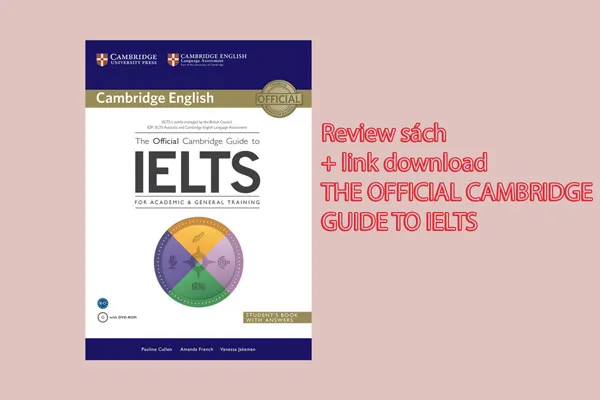
*The Official Cambridge Guide to IELTS* is the official study guide published by Cambridge University Press, designed to provide comprehensive preparation for the IELTS exam. The book is tailored for both Academic and General Training candidates, with the goal of helping learners achieve their best possible score.
Unlike standard textbooks, this guide focuses on explaining each exam task in detail, providing effective test-taking tips, and offering high-quality practice tests sourced directly from the official exam board.
Key Highlights:
- An official resource compiled by Cambridge, ensuring accuracy and up-to-date content.
- Covers all exam task types and strategies for every section of the IELTS test.
- Suitable for all learners, from beginners to those with a solid foundation looking to boost their scores.
2. Who is this book for?
- IELTS Beginners (Band 4.0 – 5.5):
The book is designed to be accessible to those just starting their IELTS journey. The “Skills Guide” section explains each question type in detail, helping learners get acquainted with the exam format and learn how to approach each section.
- Learners looking to improve specific skills:
The book divides skills (Listening, Reading, Writing, Speaking) into independent chapters, allowing you to focus on your weaker areas without needing to study the entire book.
- High-achieving candidates (Band 6.5 – 8.0):
With advanced practice exercises and detailed strategies, this book is also an excellent choice for those aiming for higher scores, particularly in the Writing and Speaking sections.
- IELTS Instructors:
The book serves as a standard reference for teachers to design lesson plans and support students through a structured path from basic to advanced levels.
- Candidates preparing for both Academic & General Training:
The book integrates content for both formats, helping learners save time by focusing on the material relevant to their specific goals.
3. Content Structure of The Official Cambridge Guide to IELTS
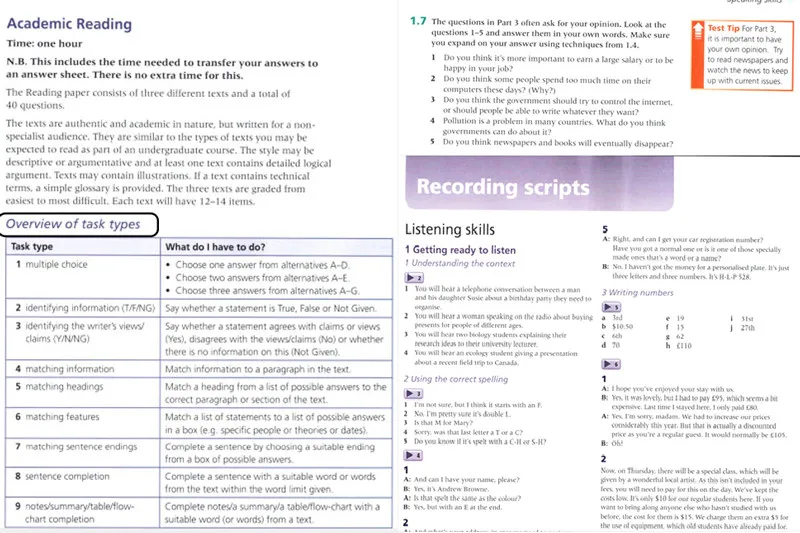
Part 1: Skills Guide
The book begins with a detailed guide for each skill: Listening, Reading, Writing, and Speaking.
- Listening:
- Comprises 4 chapters, each focusing on a common listening task type.
- Covers strategies for handling question types such as Multiple Choice, Matching, and Map/Diagram Labelling.
- Includes audio practice to help you get used to the standard accents used in the exam.
- Reading:
- Provides step-by-step guidance for handling question types like Matching Information, True/False/Not Given, and Sentence Completion.
- Features carefully curated reading passages with difficulty levels equivalent to the actual exam.
- Writing:
- Provides sample answers for Writing Task 1 and Task 2 (Academic and General Training).
- Includes strategies for brainstorming, paragraph development, and avoiding common mistakes.
- Features Band 7.0+ sample essays to help learners understand what high-scoring writing looks like.
- Speaking:
- Analyzes how to approach each part of the Speaking test (Part 1, Part 2, Part 3).
- Offers suggested responses, ways to expand ideas, and tips for developing a natural speaking style.
Part 2: Practice Tests
The Practice Tests section is one of the book’s greatest strengths, helping learners familiarize themselves with the actual exam structure and assess their current proficiency. This section includes 8 full-length practice tests: 4 for Academic and 4 for General Training.
Detailed Structure of Practice Tests
Each practice test is built according to the official IELTS format, covering all 4 skills:
1. Listening
Time: 30 minutes (+ 10 minutes to transfer answers to the answer sheet).
Structure: 4 recordings with increasing difficulty:
- Part 1: A conversation in an everyday social context.
- Part 2: A monologue on an everyday topic (e.g., a travel guide).
- Part 3: A conversation between multiple people in an academic context.
- Part 4: An academic monologue.
Question types: Multiple Choice, Matching, Map/Diagram Labelling, Sentence Completion, and Short Answer Questions.
2. Reading
Time: 60 minutes.
Structure:
+ Academic: 3 long passages extracted from books, journals, or newspapers. Content is academic or professional in nature.
+ General Training: 3 sections:
- Section 1: Short texts related to everyday situations.
- Section 2: Work-related texts, such as notices or contracts.
- Section 3: A long text of a general or persuasive nature.
Question types: True/False/Not Given, Matching Information, Multiple Choice, and Diagram/Table Completion.
3. Writing
Time: 60 minutes.
Structure:
- Academic:
Task 1: Write a report describing a chart, table, or process.
Task 2: Write an essay arguing or explaining a point of view.
- General Training:
Task 1: Write a letter (formal, semi-formal, or informal) based on a specific situation.
Task 2: Write an essay similar to the Academic task, but requiring a less formal tone.
4. Speaking
Time: 11 – 14 minutes.
Structure:
Part 1: Introduction and questions on familiar topics like family, work, or hobbies.
Part 2: A long turn on a given topic for 1–2 minutes, with 1 minute of preparation time.
Part 3: A two-way discussion based on the topic in Part 2.
Benefits of Practice Tests
- Self-assessment: Learners can use these tests to identify their strengths and weaknesses in each skill, allowing for a more targeted study plan.
- Time management: Practicing under timed conditions helps you get used to the pressure and improves your pacing for the real exam.
- Skill refinement: By analyzing answers and learning from mistakes, you can gradually improve your test-taking ability, especially for challenging question types like True/False/Not Given or Matching Headings.
Check out our related articles:
4. Pros of The Official Cambridge Guide to IELTS
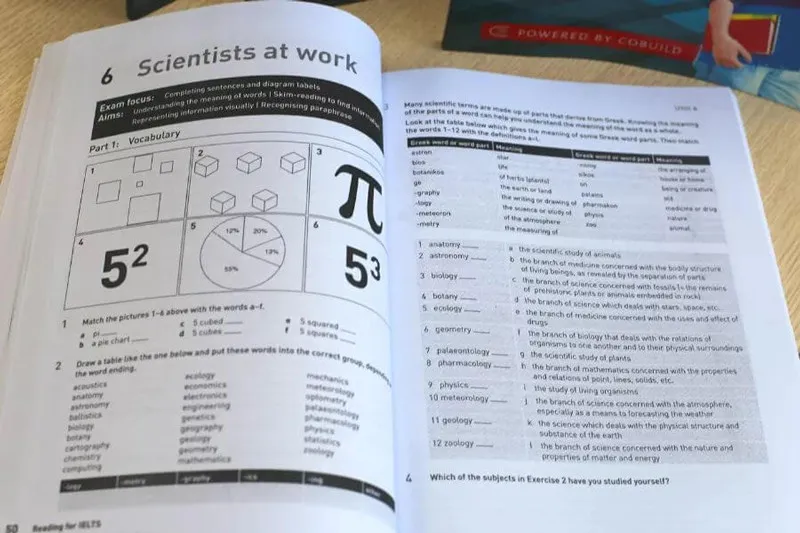
- Official and Reliable: Compiled by Cambridge, the exam organizers, ensuring the content is highly accurate and reflects the actual test.
- Comprehensive Coverage: Integrates theory, test-taking strategies, and practice tests, providing a structured learning path.
- Logical Organization: Skills and exercises are clearly divided, making it easy for learners to navigate.
- High-Quality Samples: Includes many high-scoring Writing and Speaking samples, helping learners understand grading criteria.
- Audio and Video Support: Comes with audio files and real-life videos for the Speaking section, providing authentic practice.
- Versatile: Designed for both Academic and General Training, catering to all study goals.
5. Cons of The Official Cambridge Guide to IELTS
- Not for absolute beginners: The book assumes a basic level of English proficiency to keep up with the content, especially in Reading and Writing.
- Heavy workload: The book is very comprehensive and requires time and patience to complete, which may be challenging for those on a crash course or those who struggle with self-discipline.
- Lack of in-depth vocabulary and grammar exercises: While it covers basic grammar and vocabulary, it does not provide intensive exercises for these areas.
6. How to Use The Official Cambridge Guide to IELTS Effectively
To get the most out of this book, you need a scientific study plan. Here is how to apply it effectively:
6.1. Define your goals
Before starting, ask yourself:
- What is your target IELTS score?
- Are you taking the Academic or General Training test?
- Which skill do you need to improve the most?
6.2. Allocate study time
- Skill building: Spend the first 3–4 weeks working through the Skills Guide.
- Practice: Once you have mastered the theory, move on to the Practice Tests.
- Review: Analyze your results, record your mistakes, and adjust your plan to address weaknesses.
6.3. Master the Skills Guide
- Study the theory: Take notes on steps, such as how to identify keywords in Reading or how to brainstorm for Writing Task 2.
- Practice: Complete the small exercises provided and check your answers to understand the logic behind them.
6.4. Practice with the tests
- Simulate exam conditions: Work in a quiet space, use a timer, and avoid using reference materials.
- Analyze results: After each test, review your answers and understand why you got them wrong.
6.5. Use supplementary resources
- Practice materials: Use the *Cambridge IELTS Practice Tests* (books 1–18).
- Tools: Use apps like *IELTS Official Practice* or *ELSA Speak* for Speaking, and listen to podcasts or TED Talks to improve Listening.
6.6. Smart study strategies
- Learn from mistakes: Keep a log of your errors and analyze why they happened.
- Vocabulary and Grammar: Learn at least 10 new words daily related to topics like Education, Environment, or Technology.
- Consistency: Maintain a regular study schedule of at least 2–3 hours per day.
6.7. Self-evaluation
Periodically retake tests to track your progress. If possible, have a teacher or a proficient friend review your Writing and Speaking tasks for feedback. Record your Speaking responses and compare them with the samples in the book to improve your pronunciation, intonation, and grammar.
6.8. Final advice
- Be patient: IELTS preparation takes time. Don’t get discouraged by challenges.
- Balance: Take breaks between study sessions to keep your mind fresh.
- Use all materials: Don’t forget to utilize the audio, video, and appendices provided.
Download The Official Cambridge Guide to IELTS PDF
*The Official Cambridge Guide to IELTS* is an essential resource for anyone aiming for a high score. With its scientific presentation, comprehensive content, and official backing from Cambridge, this book provides all the tools you need to prepare effectively. However, your success ultimately depends on how you integrate this book into your personal study plan and your daily consistency.




 Khai giảng Khóa học Hè cực HOT.
No comments yet!