


Tóm Tắt Nội Dung Bài Viết
Do you find yourself starting your IELTS essay sentences with “Nowadays” over and over again? You’re not alone! It’s a convenient, easy-to-remember habit, but repeating the same word makes your writing monotonous and makes it difficult to score high on the Lexical Resource criterion.
Don’t worry! In this article, the ECE language center will show you some excellent, easy-to-apply alternatives to “Nowadays.” We won’t just give you a list of words; we’ll teach you how to use them accurately and sophisticatedly in every context!
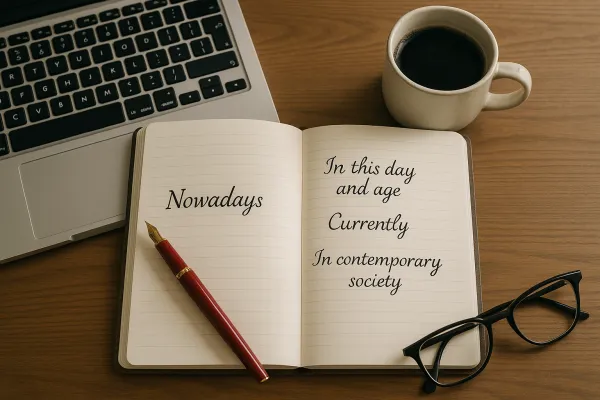
Categorizing alternatives to “Nowadays” by context
To use words accurately, you need to understand your purpose. Below are groups of words classified by specific usage, helping you make the most appropriate choice.
Group 1: When discussing a general, broad truth
Use these when you want to talk about a common situation or something that holds true for our current era.
- In this day and age:
- When to use? When discussing a major trend or an issue with widespread impact. It sounds very academic.
- Sophistication: Highly suitable for Writing Task 2.
- How to use: Usually placed at the beginning of a sentence; don’t forget the comma!
- Example: In this day and age, it’s almost impossible to imagine life without the internet.
- These days:
- When to use? This is the most natural and friendly alternative to “nowadays.”
- Sophistication: Perfect for Speaking, and also acceptable in Writing.
- How to use: Very flexible; can be placed at the beginning or end of a sentence.
- Example: These days, many people are choosing to work from home.
Group 2: When emphasizing a recently emerging trend
Use these when you want to point out a change that has been occurring over the last few years.
- In recent years:
- When to use? When talking about a trend that began in the near past and is still continuing. This phrase scores much higher than “nowadays.”
- Sophistication: Very formal, ideal for Writing Task 2.
- How to use: Placed at the beginning of a sentence, followed by a comma.
- Example: In recent years, there has been a huge increase in food delivery services.
Group 3: When writing in a very formal, academic style
These words convey a “professional” tone, often used in analytical essays or reports.
- Currently / At present:
- When to use? When you want to state the situation “right now” in a formal manner.
- Sophistication: Very formal, excellent for Writing Task 2.
- How to use: Can be placed at the beginning of a sentence (with a comma) or in the middle.
- Example: Currently, scientists are exploring new ways to generate clean energy.
Expanding beyond “Nowadays”: From synonyms to sentence structure
To reach a band score of 7.0 or higher, examiners don’t just want to see that you know many synonyms; they want to see you use grammar flexibly and intelligently. In this section, ECE will guide you on how to “transform” your sentences to express the idea of “nowadays” in the most natural and academic way possible. This is the difference between someone who “uses English” and someone who “masters English.”
Technique 1: Using the Present Perfect to emphasize results
Instead of just saying “nowadays, the situation is A,” this technique helps you express that “event B in the past has led to result A in the present.” This creates logical connections and adds depth to your writing.
- The secret: The Present Perfect tense (S + have/has + V3/ed) is inherently a bridge between the past and the present. When you use it, the meaning of “nowadays” is already implied.
- Original sentence: Nowadays, technology helps us connect easily.
- Upgraded sentence: Technology has made it easier for people to connect.
- Deep analysis: This sentence doesn’t just say technology helps with connection; it emphasizes that the development of technology (in the past) has created the result of easier connection (in the present).
- Another example: Instead of saying “Nowadays, pollution is a serious problem,” you can write:
- The rapid growth of industries has led to severe environmental pollution.
Technique 2: Using “Dynamic” verbs to describe trends
To describe a changing world, use verbs that convey “movement” and “transformation.” This style is much more vivid and engaging than using a static adverb like “nowadays.”
- Recommended verbs:
- become
- evolve
- transform
- witness
- shift
- Original sentence: Nowadays, cities are more crowded.
- Upgraded sentence: Cities are becoming increasingly crowded.
- Deep analysis: The phrase “are becoming” paints a picture of an ongoing process, showing constant change. It is much more vivid than simply describing a static state.
- Another example (advanced): Recent decades have witnessed a fundamental shift in family structures.
Technique 3: Incorporating the “Modern” context directly into the subject
This is a clever trick to set the timeframe for the entire sentence without needing an adverb. By choosing a subject that represents this era, you implicitly set the “nowadays” context.
- Recommended subjects:
- Today’s young people…
- The modern workforce…
- The current generation…
- Consumers in the 21st century…
- Original sentence: Nowadays, young people face a lot of pressure.
- Upgraded sentence: Today’s young people face a lot of pressure.
- Deep analysis: By using “Today’s young people,” you have packed both the “nowadays” idea and the “subject” into one phrase. The sentence becomes more concise and effective.
Practice: Upgrading a paragraph from band 6 to band 7.5+
Now, let’s apply all three techniques to a practical example to see their power.
Original paragraph (rushed) – Paragraph 1:
Nowadays, many people like online shopping. Nowadays, they can buy anything online. This is because nowadays the internet is very popular. So, nowadays, traditional stores are facing problems.
Improved version – Paragraph 2:
In this day and age, online shopping is extremely popular. These days, people can purchase almost anything with just a few clicks. This is mainly because the internet has become widely available. As a result, traditional stores are currently facing many problems.
Advanced version – Paragraph 3:
The 21st century has witnessed a major shift in how people shop. The ability to purchase goods online has become a game-changer for consumers. Because the internet is so accessible, many traditional stores are now struggling to compete.
Let’s analyze paragraph 3 with ECE:
- Sentence 1: “The 21st century has witnessed…”
Analysis: This sentence combines Technique 2 (using the verb ‘witness’) and Technique 3 (using the subject ‘The 21st century’). This opening is extremely impressive, setting a broad and highly academic context.
- Sentence 2: “The ability… has become…”
Analysis: This sentence applies Technique 1 (using the Present Perfect tense) and Technique 2 (using the verb ‘become’). It points out the current result of the online shopping revolution.
- Sentence 3: “…are now struggling…”
Analysis: Sometimes, a simple word like “now” is very effective when paired with a strong verb (“struggling”). It vividly describes the difficult situation of traditional stores.
Conclusion
Replacing “Nowadays” is not just about memorizing a few new words. It is about demonstrating your flexibility and rich vocabulary. Start applying these “tips” to your writing today. Good luck with your exam preparation and achieving your target score!





 Khai giảng Khóa học Hè cực HOT.
No comments yet!