


Tóm Tắt Nội Dung Bài Viết
Are you looking for a comprehensive, detailed, and scientifically structured IELTS preparation series to help you reach your target band score? The Mindset for IELTS series from Cambridge University Press is an excellent choice. In this article, ECE provides a comprehensive overview, objective review, and practical guide on how to use these books effectively.
A Brief Introduction to Mindset for IELTS
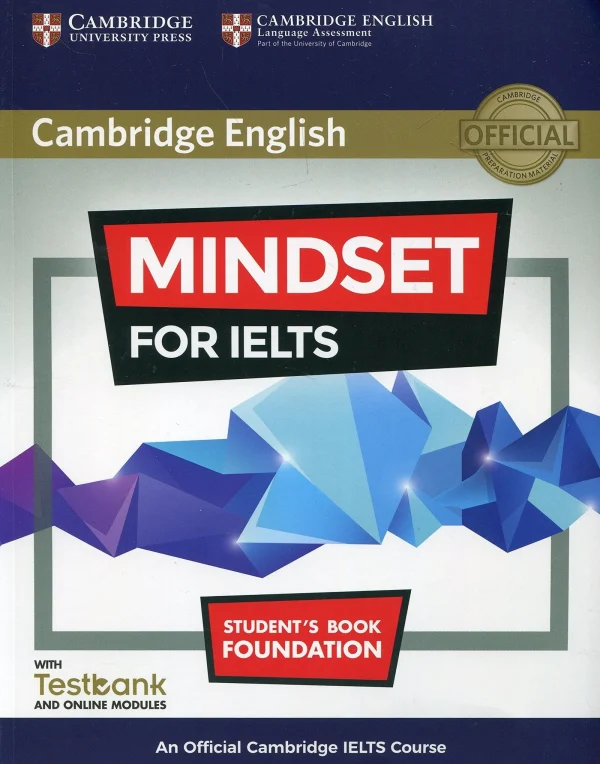
Mindset for IELTS is a comprehensive four-level series developed by the experts at Cambridge Assessment English—the co-owners and developers of the IELTS exam. The series is designed as a progressive roadmap, catering to various proficiency levels, from absolute beginners (Foundation) to those aiming for a band score of 7.5+ (Level 3).
Each book in the Mindset for IELTS series focuses on developing all four skills—Listening, Speaking, Reading, and Writing—while providing essential vocabulary, grammar, and effective test-taking strategies. The books also integrate practice exercises and mock tests to help learners become familiar with the actual IELTS exam structure.
Origins: This series was born from a close collaboration between two giants in the English language education sector:
- Cambridge Assessment English: A department of the University of Cambridge, UK. This organization specializes in designing and administering international English exams, including the globally recognized IELTS. As a co-owner and developer of the IELTS exam, Cambridge Assessment English possesses deep insights into the test structure, assessment criteria, and the skills required to achieve high scores.
- Cambridge University Press: The publishing arm of the University of Cambridge, one of the oldest and most prestigious academic publishers in the world. Cambridge University Press specializes in high-quality educational, research, and academic materials, including top-tier IELTS preparation resources.
Authors: The Mindset for IELTS series was compiled by a team of authors and experts with extensive experience in teaching and IELTS preparation. Notable authors include:
- Greg Archer: An IELTS expert with years of experience in teaching and developing test preparation materials. He is also the author of several other best-selling IELTS books.
- Claire Wijayatilake: An author with significant experience in developing English language curricula and teaching materials, particularly for IELTS.
- Peter Crosthwaite: An expert who has made significant contributions to applied linguistics, especially in the development of learning materials.
- Natasha De Souza: An English teaching and IELTS preparation specialist with deep knowledge of the skills required for the exam.
- Susan Hutchison: An experienced author and educator focused on developing effective learning methodologies.
- Jishan Uddin: Has contributed extensively to the content of Mindset for IELTS, including providing practice exercises and mock tests to help learners familiarize themselves with the IELTS format.
These authors combine deep academic knowledge of IELTS with practical experience in teaching and helping students reach their goals. They have leveraged their expertise to create a comprehensive, realistic series that meets the needs of learners at every level.
Target Audience
The Mindset for IELTS series is designed to suit a wide range of learners, as follows:
-
Mindset for IELTS Foundation:
Target Audience: For those just starting their IELTS journey or at an elementary English level (equivalent to A2 – B1 on the CEFR scale).
Goal: To help learners build a solid foundation in English and become familiar with basic IELTS question types.
-
Mindset for IELTS Level 1:
Target Audience: Suitable for learners at an intermediate English level (equivalent to B1 on the CEFR).
Goal: Aiming for an IELTS band score of 5.0 – 5.5.
-
Mindset for IELTS Level 2:
Target Audience: For learners at an upper-intermediate level (equivalent to B1 – B2 on the CEFR).
Goal: Aiming for an IELTS band score of 6.0 – 6.5.
-
Mindset for IELTS Level 3:
Target Audience: Suitable for advanced learners (equivalent to B2 – C1 on the CEFR).
Goal: Aiming for an IELTS band score of 7.0 – 7.5+.
Structure and Content of the Mindset for IELTS Series
Each book in the Mindset for IELTS series is divided into units with diverse topics and a consistent structure, including:
- Introduction: Introduces the unit topic and the skills to be practiced.
- Skills Practice:
- Listening: Practice with various IELTS listening formats, from understanding specific details to grasping main ideas and speaker perspectives.
- Reading: Practice with different reading formats, from understanding details and main ideas to identifying the author’s perspective and attitude.
- Writing: Guidance on Task 1 and Task 2, including analyzing the prompt, outlining, drafting, and proofreading.
- Speaking: Practice for IELTS Speaking Parts 1, 2, and 3, including pronunciation, vocabulary expansion, and idea development.
- Grammar and Vocabulary: Provides knowledge related to the unit topic, helping learners improve their accuracy and natural use of English.
- Exam Practice: Provides mock exercises modeled after the actual IELTS exam, helping learners get used to time pressure and various question types.
- Review: Summarizes the knowledge learned in the unit and provides additional exercises for reinforcement.
Differences between levels:
- Difficulty: The complexity of exercises and tests increases progressively from Foundation to Level 3.
- Topics: Topics are selected to match the learner’s level. For example, topics in the Foundation book are more familiar and accessible than those in Level 3.
- Test Strategies: Higher-level books (Level 2 and Level 3) focus more on providing effective test-taking strategies to help learners optimize their scores.
Review of Pros and Cons
General Pros
- Comprehensive: Covers all four skills—Listening, Speaking, Reading, and Writing—along with vocabulary, grammar, and test strategies.
- Clear Structure: Lessons are designed scientifically and logically, making it easy for learners to follow and absorb information.
- Updated Content: Compiled based on the latest Cambridge IELTS exam trends.
- Diverse Exercises: Practice and mock tests are closely aligned with the real exam, helping learners get used to the structure and time pressure.
- Develops Critical Thinking: The series not only improves English skills but also fosters critical thinking, analysis, and problem-solving abilities.
Pros and Cons by Level
| Book | Pros | Cons |
|---|---|---|
| Mindset for IELTS Foundation | – Builds a solid English foundation.
– Familiarizes learners with basic IELTS question types. – Accessible content, suitable for beginners. |
– May be too easy for those with a strong English background.
– Does not delve deeply into advanced test strategies. |
| Mindset for IELTS Level 1 | – Develops comprehensive English skills.
– Practices IELTS question types at an intermediate level. – Provides essential grammar and vocabulary. – Includes a mindset for ielts level 1 workbook for extra practice. |
– Less focus on advanced skills. – Some exercises may be too simple for those already experienced with the IELTS exam. |
| Mindset for IELTS Level 2 | – Enhances IELTS test-taking skills.
– Practices more complex question types. – Provides effective test-taking strategies. – Expands advanced vocabulary and grammar knowledge. |
– May be challenging for those without a solid English foundation.
– Requires high levels of focus and effort. |
| Mindset for IELTS Level 3 (PDF included) | – Focuses on advanced skills to reach a 7.5+ band score.
– Practices the most difficult IELTS question types. – Provides in-depth test-taking strategies. – Develops critical thinking and analytical skills. – mindset for ielts 3 pdf materials are easy to find. |
– Very difficult for beginners or those with intermediate English.
– Requires a strong foundation and high self-study capability. – Can be overwhelming for those not used to high-intensity study. |
How to Study Effectively with Mindset for IELTS
To get the most out of the Mindset for IELTS series, consider the following tips:
- Determine your current level: Before starting, take a placement test to identify the right book for you. You can find online tests or consult with a teacher.
- Create a study plan: Develop a specific study schedule, breaking down goals and time for each skill and unit.
- Follow the sequence: Start with the Foundation book (if you are a beginner) and gradually move to Levels 1, 2, and 3 as your proficiency improves.
- Integrate skills: Don’t focus on just one skill. Combine practice for all four—Listening, Speaking, Reading, and Writing—for balanced development.
- Utilize supplementary materials: Beyond the Mindset for IELTS series, look for other IELTS resources like grammar books, vocabulary lists, sample tests, and video lectures to broaden your knowledge.
- Seek support: If possible, find an experienced teacher or mentor to help answer questions, correct mistakes, and provide advice.
- Practice consistently: Dedicate time to practice every day, even if it’s just 15-30 minutes. Consistent practice helps retain knowledge and improves skills quickly.
- Self-assess: After each unit or test, evaluate your results. This helps identify strengths and weaknesses, allowing you to adjust your study methods accordingly.
- Join mindset for ielts groups and forums to exchange experiences.
- Use mindset book pdf versions for convenience while studying.
Download MINDSET FOR IELTS FOUNDATION PDF
Download MINDSET FOR IELTS LEVEL 1 (5.0-5.5 IELTS)
Download MINDSET FOR IELTS LEVEL 2 (6.5+ IELTS)
Download MINDSET FOR IELTS LEVEL 3 (7.5+ IELTS)
The Mindset for IELTS series is a high-quality resource that provides comprehensive knowledge and diverse practice. However, to achieve the best results, you must combine the books with a scientific study plan, effort, and perseverance. We hope this article has provided useful information and helped you feel more confident on your journey to conquering the IELTS exam!
 Khai giảng Khóa học Hè cực HOT.
No comments yet!