


Tóm Tắt Nội Dung Bài Viết
An IELTS score of 6.0 is one of the most sought-after benchmarks and a primary goal for English learners worldwide. Achieving this band signifies that your English proficiency has reached a new level, unlocking significant opportunities in education, career advancement, and even international immigration. So, what exactly does an IELTS 6.0 mean, what benefits does it offer, and how should you prepare to conquer this milestone? This article from ECE Language Center provides a comprehensive overview to guide you.
1. What is IELTS 6.0? How Does It Compare to Other Proficiency Levels?
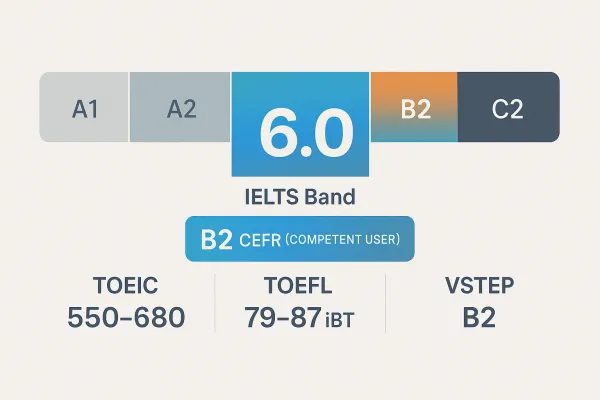
On the IELTS scale of 1.0 to 9.0, a 6.0 band is classified as Competent User. This is a significant level of proficiency, indicating that you can use English effectively in most situations, even if you occasionally make minor errors or struggle with highly complex topics.
According to the Common European Framework of Reference for Languages (CEFR), an IELTS 6.0 is considered equivalent to a B2 level.
When converted to other international certifications, IELTS 6.0 is roughly equivalent to:
- TOEIC: Approximately 550 – 680 points.
- TOEFL iBT: Approximately 79 – 87 points.
- TOEFL Paper-based (PBT): Approximately 450 – 550 points.
- TOEFL Computer-based (CBT): Approximately 153 – 180 points.
- VSTEP: Equivalent to Level B2.
- Cambridge English: Equivalent to the FCE (First Certificate in English) exam.
An IELTS 6.0 holder is capable of:
- Using English proficiently in situations ranging from familiar to complex, both in daily communication and certain academic contexts.
- Accessing information: Watching TV, reading news and academic materials in English, though occasionally facing challenges with highly specialized or complex language.
- Expressing ideas with relative fluency and coherence, with minor grammatical or vocabulary errors that generally do not hinder the communication of meaning.
- Writing essays and reports with clear structures, utilizing a wider variety of linking words and sentence structures.
In short, a 6.0 band indicates that you can use English independently and confidently across many aspects of life, study, and work.
2. Is Reaching Band 6.0 Difficult? Who Can Self-Study Effectively?
IELTS 6.0 is considered a feasible goal with moderate difficulty; it is not overly challenging if you have the right method and determination. It is a highly practical band score that helps elevate your English proficiency.
The difficulty level depends on:
- Starting level: If you are starting from scratch, the journey will require more time and persistence. If you already have a solid foundation (around 4.5 – 5.0), reaching 6.0 will be faster and easier.
- Study method: A clear roadmap, quality materials, and effective study techniques (balancing theory and practice, focusing on weaknesses) are key.
- Intensity and consistency: Dedicating time to study every day (e.g., 1-2 hours or more) is essential for sustainable progress.
Regarding effective self-study at home:
Learners can absolutely reach IELTS 6.0 through self-study, especially if they already have a good foundation. The keys are:
- Accurate self-assessment: Clearly understanding your strengths and weaknesses in all 4 skills.
- Building and sticking to a personalized roadmap: The plan must align with your time and goals.
- Discipline and proactivity: Being self-motivated to research, practice, and correct your own mistakes.
If you are starting from zero, self-study may be more challenging. In this case, guidance from a teacher or enrolling in a course at a center can provide a structured roadmap and the necessary feedback to optimize your learning process.
3. How Long Does It Take to Reach IELTS 6.0 From Scratch?
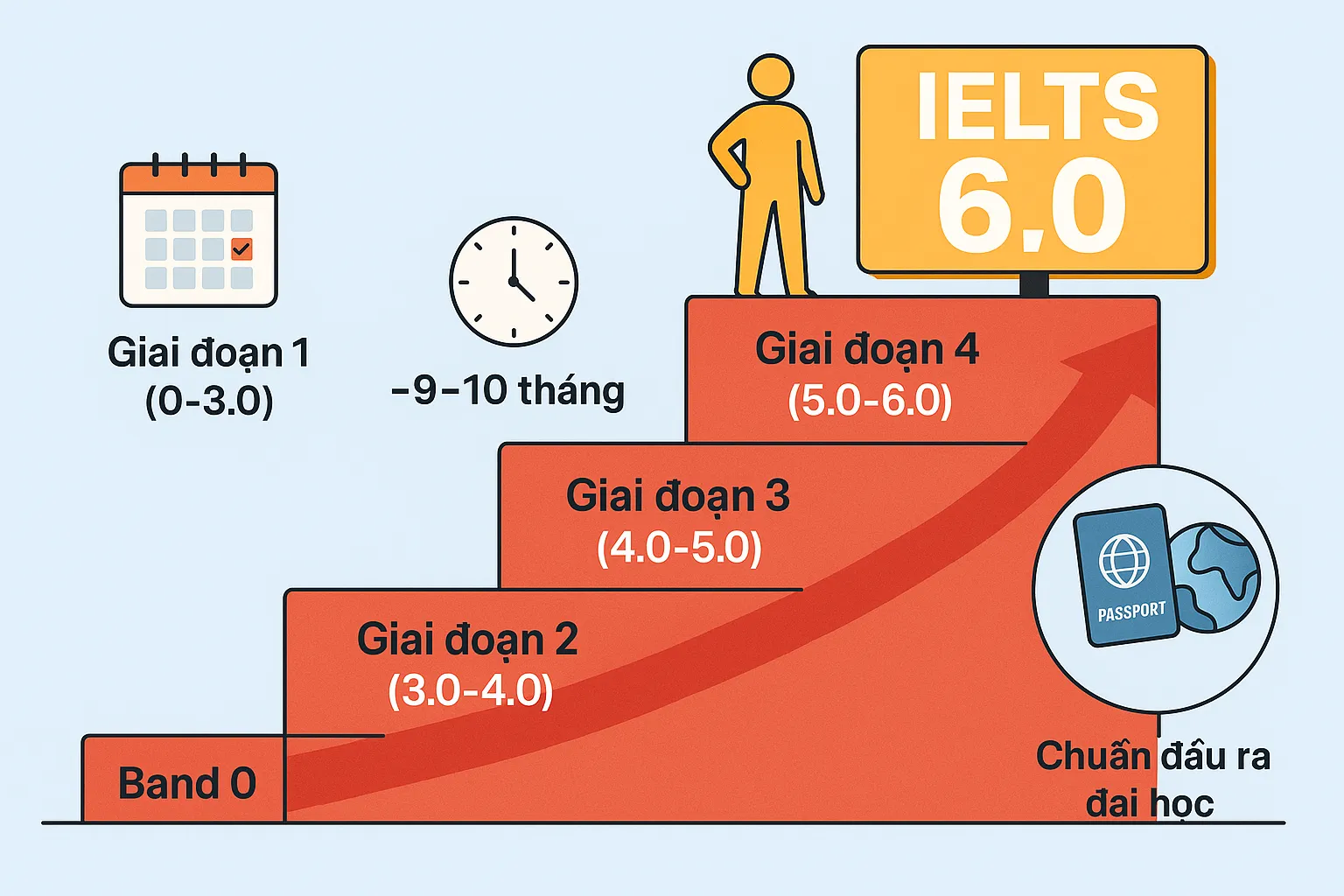
The time needed to go from zero to an IELTS 6.0 band depends on personal factors such as your starting level, study intensity, and methodology.
According to the roadmap shared in our internal ECE documents and corroborated by various reputable sources, the journey from zero to band 6.0 is typically divided into 4 main stages, totaling approximately 9.5 to 10 months with an estimated 213 study hours.
Below is the detailed reference roadmap:
- Stage 1: Reaching band 3.0 (from zero)
- Study duration: 3 months
- Estimated total study hours: 48 hours
- Goal: Build a foundation in grammar, basic vocabulary, and IPA-based pronunciation. Get familiar with simple listening and reading exercises.
- Stage 2: Reaching band 4.0 (from band 3.0)
- Study duration: 9 weeks (approx. over 2 months)
- Estimated total study hours: 45 hours
- Goal: Expand academic vocabulary, learn compound sentences. Familiarize yourself with simple IELTS task types across all 4 skills.
- Stage 3: Reaching band 5.0 (from band 4.0)
- Study duration: 10 weeks (approx. 2.5 months)
- Estimated total study hours: 60 hours
- Goal: Expand vocabulary through dictation/paraphrasing, gain deeper familiarity with IELTS task types (easy to medium level), and practice intensive pronunciation. Focus on Writing Task 1 and Speaking Part 2.
- Stage 4: Reaching band 6.0 (from band 5.0)
- Study duration: 10 weeks (approx. 2.5 months)
- Estimated total study hours: 60 hours
- Goal: Perfect Writing Task 2 and Speaking Part 3 skills. Improve Listening/Reading skills with longer/more difficult texts, apply test-taking strategies (skimming/scanning, identifying traps). Start getting used to time pressure.
Summary of time:
- From zero to 6.0: Usually takes about 9 months to 1 year of serious, consistent study.
- If you already have a good foundation (band 4.5 – 5.0): The time can be shortened to about 3 to 6 months.
To reach band 6.0, you need to accumulate about 5,500 – 6,000 words. This figure is for reference only; what matters is your ability to use vocabulary flexibly and accurately in context.
4. What Benefits Does IELTS 6.0 Offer?
Holding an IELTS 6.0 certificate opens doors to many opportunities in education, work, and immigration:
- Expanded Study Abroad Opportunities: IELTS 6.0 is the minimum score or a common requirement for undergraduate programs at many universities in English-speaking countries like the US, Australia, Canada, the UK, New Zealand, the Netherlands, Germany, Japan, and South Korea. This score also boosts your chances of securing scholarships.
- Priority Admission & Course Exemptions at Vietnamese Universities:
- Many top-tier universities in Vietnam offer direct admission or priority selection by combining IELTS scores (usually 5.5 or 6.0+) with high school transcripts/exam results.
- Students with an IELTS 6.0 are often exempt from basic English courses at university and meet the foreign language graduation requirements.
- International Immigration Opportunities: Some countries like the US, UK, Canada, Australia, and New Zealand (depending on the region and program) have English requirements for immigration, and a 6.0 band can meet most of these language criteria.
- Career Potential:
- IELTS 6.0 is a major plus on your resume, helping you stand out to employers, especially for roles requiring English communication in an international environment.
- You can apply for diverse roles such as English teacher/tutor, flight attendant, legal professional, international relations officer, or positions requiring the ability to read specialized documents and scientific research.
- Strong English proficiency can increase your chances of promotion and higher income.
- Access to Information and Integration: You can easily read and understand academic materials, research, and international news, staying updated on the latest industry knowledge without waiting for translations. Furthermore, you can communicate confidently with native speakers, expand your network, and explore different cultures while traveling.
5. Specific Criteria to Reach Band 6.0 in Each Skill
To achieve an Overall 6.0, your average score across the 4 skills must reach this level. Below are the specific requirements for each skill at band 6.0:
- Listening: You need to answer approximately 23-25/40 questions correctly. At band 6.0, you have the ability to understand conversations, lectures, and longer information, grasping both main ideas and important details. You should focus on practicing Part 3 and 4, which have higher difficulty levels.
- Reading:
- Academic: You need to answer approximately 23-26/40 questions correctly.
- General Training: You need to answer approximately 30-31/40 questions correctly. At band 6.0 Reading, you can understand more complex texts, identify arguments, specific details, and the relationships between pieces of information. You need to be proficient in skimming and scanning techniques.
- Speaking: Evaluated based on 4 criteria. To reach 6.0 Speaking:
- Fluency & Coherence: You can speak relatively fluently and coherently, using linking words effectively to connect ideas. Although there may be occasional hesitation, repetition, or self-correction, it generally does not disrupt communication significantly.
- Lexical Resource: Your vocabulary is broad enough for familiar topics and some abstract ones. You can express ideas successfully, even if you occasionally use words inaccurately or repeat yourself.
- Grammatical Range & Accuracy: You can use a mix of simple and complex sentences (compound sentences, relative clauses). While you may still make some grammatical errors, they usually do not cause misunderstanding or hinder communication.
- Pronunciation: Your pronunciation is clear and easy to understand. You can control features like stress, intonation, and ending sounds, though not always with perfect accuracy.
- Writing: Evaluated based on 4 criteria. To reach 6.0 Writing:
- Task Achievement/Response: You fulfill the requirements of the prompt, clearly presenting main information (Task 1) or providing arguments and developing ideas (Task 2). You include relevant supporting evidence.
- Coherence & Cohesion: The writing has a clear layout, with ideas presented in a logical order and linked together. You use linking words effectively, even if sometimes mechanically or with minor errors.
- Lexical Resource: Your vocabulary is sufficiently broad and varied for many topics. You attempt to use academic language and paraphrasing, even if you occasionally make spelling or word-form errors that do not affect the main meaning.
- Grammatical Range & Accuracy: You use both simple and complex sentences, showing flexibility. You may still make some grammatical and punctuation errors, but they generally do not hinder readability.
6. Common Challenges When Aiming for Band 6.0
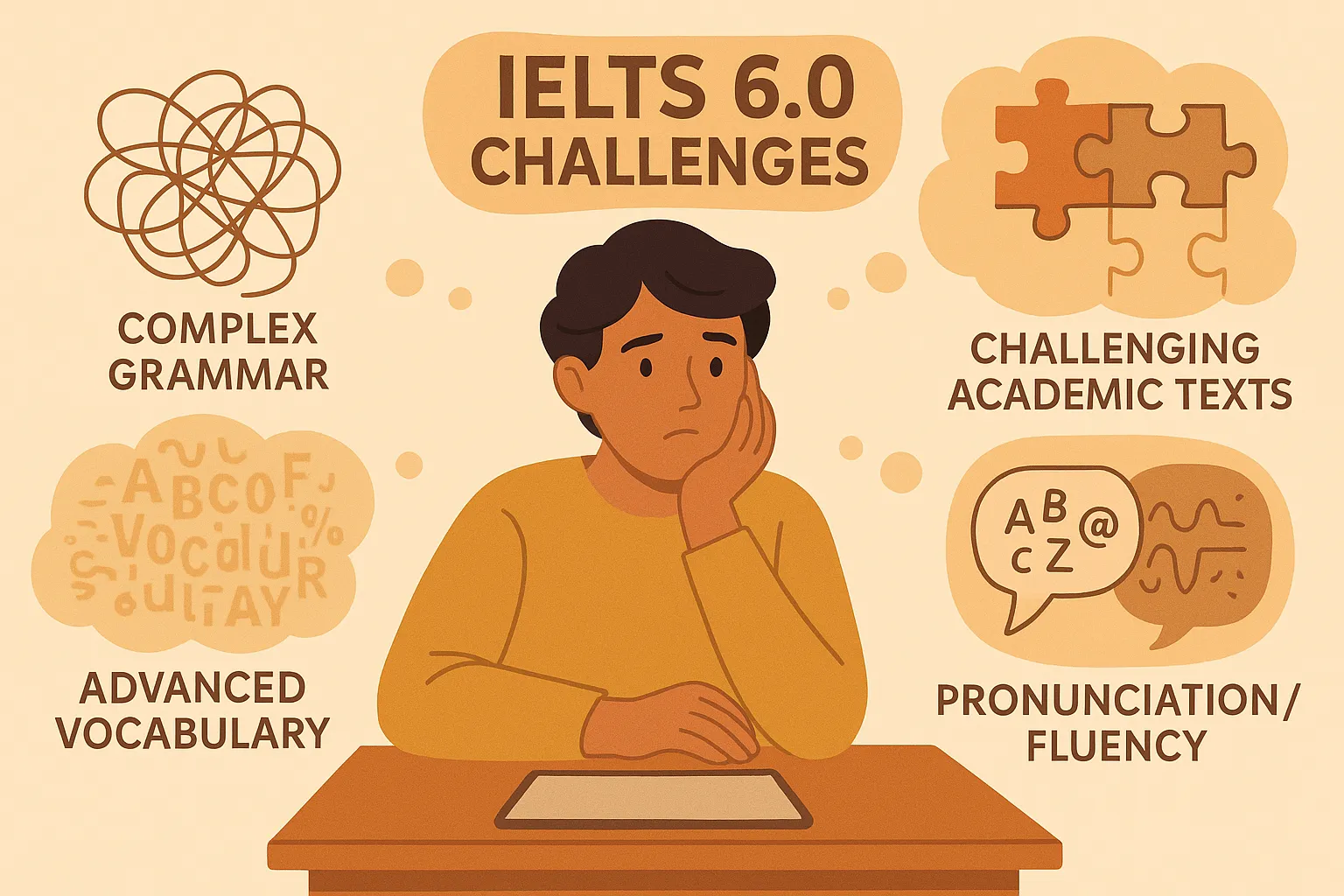
To reach band 6.0 (from 5.0 or below), learners often face the following difficulties:
- Moving beyond basic vocabulary and grammar: You need to expand into academic vocabulary and more complex grammatical structures while maintaining accuracy.
- Controlling minor errors: Even with a foundation, minor errors in grammar, vocabulary, and pronunciation often persist, affecting scores in criteria like Accuracy.
- Developing ideas and coherence: Difficulty in developing ideas in depth, providing evidence, and linking thoughts fluently and naturally in speaking/writing.
- Time pressure: During the actual exam, time pressure can make candidates flustered, preventing them from showing their full potential.
- Getting used to advanced task types: Difficult tasks in Reading (Matching Headings, complex True/False/Not Given) and Listening (Part 3, 4 with fast speed and academic vocabulary) require specialized skills.
- Improving polish and academic tone: Writing and speaking need to be more precise, coherent, and natural, using language appropriate for an academic context.
7. Roadmap & Effective Study Tips to Reach IELTS 6.0
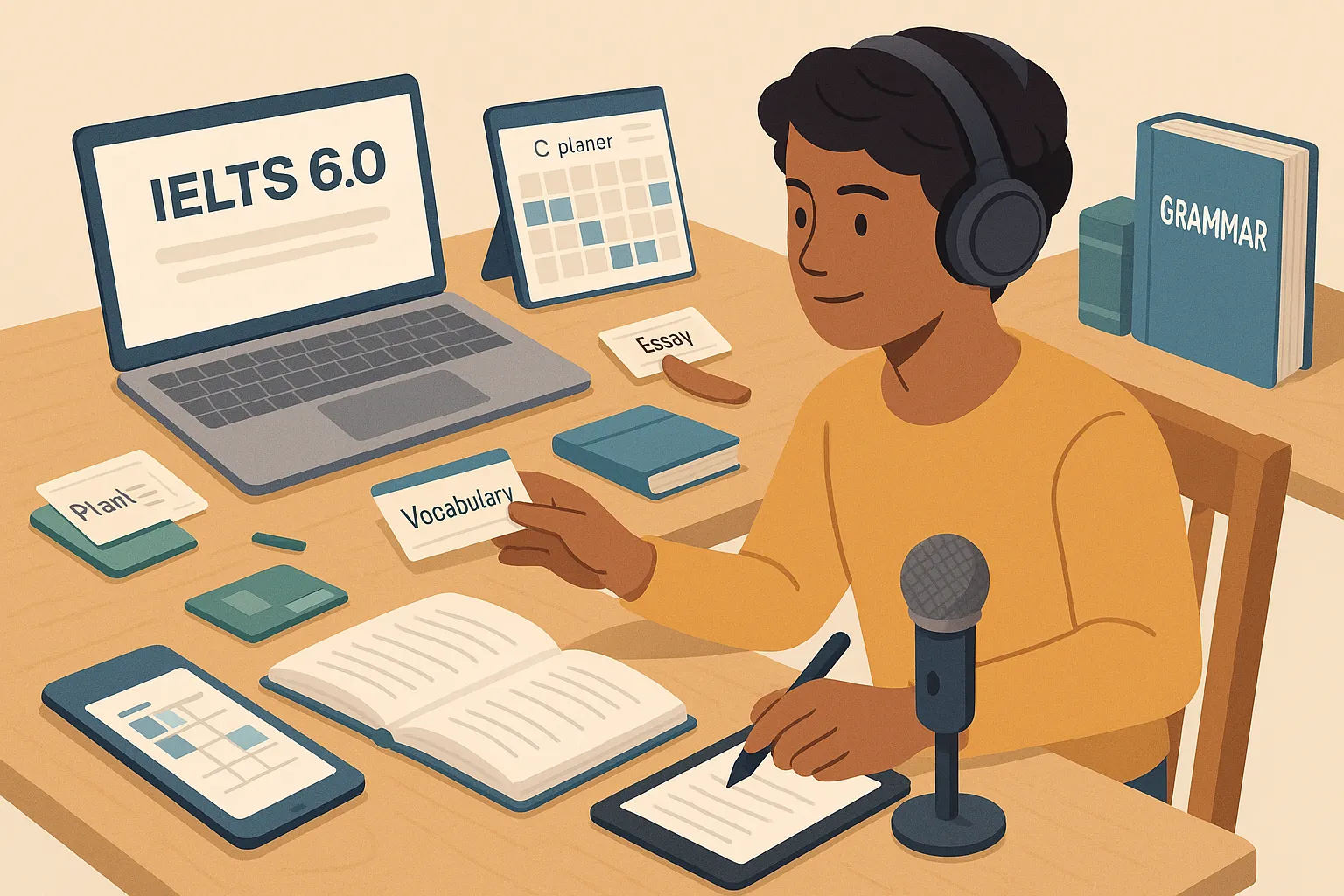
To conquer band 6.0, you need a scientific study plan, persistence, and the right methodology:
- Assessment & Detailed Planning: Start with a placement test to identify your strengths/weaknesses. Then, build a study roadmap (approx. 9.5-10 months if starting from zero, or 3-6 months if you have a good foundation) with specific goals for each stage and reasonable total study hours.
- Strengthening & Improving Foundations:
- Grammar: Master and use basic structures accurately, while practicing more complex ones like complex sentences, inversions, conditionals, and perfect tenses.
- Vocabulary: Expand academic vocabulary based on common IELTS topics (education, environment, health, technology, society…). Learn common collocations, phrasal verbs, and idioms to use them flexibly and naturally. Aim to accumulate about 5,500 – 6,000 words.
- Pronunciation: Continue practicing standard pronunciation, paying attention to ending sounds, word stress, sentence stress, and intonation. Practice speaking at a natural, clear pace and minimize hesitation.
- Intensive Skill Practice:
- Listening/Reading: Familiarize yourself with all IELTS task types. Practice doing complete tests under time pressure. Improve your ability to identify specific information, main ideas, and inferences. Focus on reviewing your work, analyzing mistakes, and understanding the “why.”
- Writing: Master the structure for Task 1 (all types of charts, tables, maps, processes) and Task 2 (argumentative, cause-effect, pros-cons…). Practice developing logical ideas, using varied linking words, and more complex sentence structures. Ensure your writing is coherent, accurate, and stays on topic.
- Speaking: Practice answering questions comprehensively for Parts 1, 2, and 3. Focus on expanding your ideas, providing examples, and explaining. Try to use a diverse range of vocabulary and flexible grammatical structures. Improve your confidence and reflexes during communication.
- Using Appropriate Materials: Choose study books for B2/Intermediate/Upper-Intermediate levels (e.g., Destination B2/C1, Cambridge IELTS books from 7 onwards, Complete IELTS Band 5-6.5/6.5-7.5, IELTS Advantage). Utilize reputable online sources, podcasts, videos, and academic journals for listening/reading practice.
- Consistent Practice & Mock Tests: Dedicate time to study every day, balancing the skills. Regularly take mock tests to assess your progress, get used to time pressure, and identify weaknesses to improve. If possible, seek feedback from teachers or experienced individuals.
Conclusion
IELTS 6.0 is a very important band score, marking a competent level of English proficiency and opening up a wide range of opportunities for international education, employment, and immigration. While it requires effort and persistence, reaching band 6.0 is a completely feasible goal. By building a scientific study roadmap, strengthening your foundation, practicing skills intensively, and maintaining discipline, you can absolutely conquer this milestone and continue your journey toward higher English proficiency.




 Khai giảng Khóa học Hè cực HOT.
No comments yet!