


Tóm Tắt Nội Dung Bài Viết
The topic of Business & Company often makes IELTS Speaking candidates nervous, as they fear a lack of specialized economic terminology. However, for the prompt “Describe a successful small company that you know,” the examiner does not expect you to be a financial expert. The key is to use language flexibly to describe the company’s operations, its unique selling points, and the value it provides.
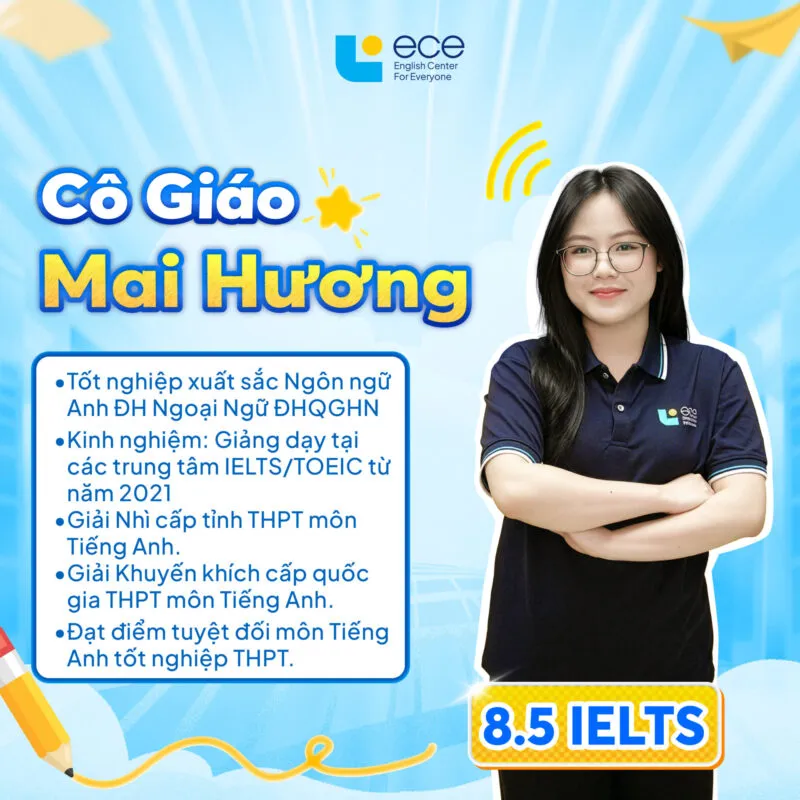
To help you confidently secure a high score, this article has been detailedly prepared by Ms. Nguyen Mai Huong (an 8.5 IELTS instructor at ECE Language Center). Let’s “pocket” some high-level vocabulary and analyze excellent sample answers for all three parts of the test!
Vocabulary & High-Scoring Structures
Instead of repeatedly using phrases like “good company” or “make money,” upgrading your Lexical Resource with basic business terminology will make your speech sound more academic and professional.
Topic Vocabulary
| Vocabulary / Phrase | Meaning | Usage in Context |
| Startup / Small business | A new or small-scale enterprise. | Used to define the company model. |
| Family-run business | A business owned/operated by a family. | Suitable for describing traditional shops or eateries. |
| Niche market | A specialized segment of the market. | Refers to a small, specific target audience. |
| Competitive edge | A distinct advantage over rivals. | Strengths that help a company outperform others. |
| Nurture customer loyalty | Building long-term customer relationships. | How a business retains its buyers. |
| Turn a profit | To generate financial gain. | An academic alternative to “make money.” |
| Initial capital | Starting funds. | The money required to launch a business. |
| Word-of-mouth marketing | Referral-based promotion. | Advertising based on customer recommendations. |
| Fierce competition | Intense market rivalry. | Describing market challenges. |
| Scalability | Potential for growth. | The capacity of a business to expand. |
Useful Structures
To improve coherence and showcase your Grammar, apply these lead-in structures:
-
What sets this business apart is… -> Used to emphasize a competitive edge.
-
Against all odds, they managed to… -> Adds drama to your story.
-
It started out as a modest operation, but… -> Describes development.
-
One of the major hurdles small businesses face is… -> An excellent structure for Part 3.
-
To survive in a saturated market, a company needs to… -> Demonstrates analytical thinking.
IELTS Speaking Part 1 – Business & Entrepreneurs
In Part 1, answer naturally and skillfully incorporate 1-2 business terms to make a strong first impression.
Question 1: Do you know any people who run their own business?
“Yes, I do. One of my close friends runs a small online bakery shop. She started it during her university years, and now it has grown into a very popular local brand that specializes in custom birthday cakes.”
Question 2: Would you like to start your own business in the future?
“To be honest, I’ve thought about it a few times. Having my own business would give me the freedom to pursue my passion and make my own decisions. However, I realize it requires a lot of initial capital and risk tolerance, so I want to gain more work experience first.”
Question 3: What qualities are necessary to be a successful entrepreneur?
“In my opinion, resilience is the most crucial quality. Running a business involves many ups and downs, so an entrepreneur must be able to bounce back from failures. Besides that, having sharp market intuition and strong management skills is also essential.”
-
Analysis: Using words like resilience and sharp market intuition demonstrates a rich vocabulary.
IELTS Speaking Part 2
Cue card: Describe a successful small company that you know.
You should say:
-
What company it is and how you know about it
-
What product or service it offers
-
Why you think it is successful
-
And explain how you feel about this company.
Sample Answer:
The small company I’d like to talk about is a local coffee roastery and cafe called “Origin Brew,” located just a few blocks away from my house. I first discovered it about three years ago through a recommendation from a friend, and it has since become my favorite place to work and meet up with people.
Origin Brew specializes in specialty coffee made from locally sourced beans, alongside a selection of artisanal pastries. Unlike big coffee chains, they focus heavily on high-quality ingredients and sustainable sourcing, directly partnering with farmers in the Central Highlands of Vietnam.
What makes this business so successful, in my view, is their focus on a niche market and customer experience. Rather than competing on price with big brands, they build strong relationships with their customers through exceptional service and a cozy, quiet atmosphere. Their success relies heavily on word-of-mouth marketing, as satisfied customers constantly recommend the spot to others.
I deeply admire this company because it demonstrates how a small operation can thrive in a saturated market through passion and authenticity. Seeing a local business maintain high ethical standards while turning a steady profit is truly inspiring to me.
IELTS Speaking Part 3 – Small Business & The Economy
Part 3 is where the examiner tests your critical thinking. Use clear argumentative structures to analyze the challenges and benefits of businesses.
Question 1: What are the main challenges that small businesses face nowadays?
“One of the primary hurdles is securing sufficient initial capital and maintaining cash flow. Small companies often struggle to obtain loans from traditional banks compared to large corporations. Additionally, facing fierce competition from multinational brands with massive marketing budgets makes it extremely difficult for small businesses to retain customers.”
-
Analysis: The answer addresses two core business issues: cash flow and competition from multinational brands.
Question 2: Why do some small companies succeed while others fail?
“Success often comes down to having a clear competitive edge and adaptability. Companies that thrive usually find a unique value proposition, such as exceptional customer service or specialized products catering to a niche market. Conversely, businesses that fail often suffer from poor financial management or a failure to adapt to changing consumer trends.”
Question 3: How do small businesses contribute to the local economy?
“Small businesses play a vital role in community development. Firstly, they generate local employment opportunities, helping to reduce unemployment rates. Secondly, they foster innovation by bringing unique products and services to the market. Finally, they help keep money circulating within the local community rather than sending profits off to distant corporate headquarters.”
-
Analysis: The three-layered argument (Firstly, Secondly, Finally) is very tight. The phrase keep money circulating within the local community demonstrates a deep understanding of macroeconomics.
In summary, to master the “Small Company” topic, you don’t need to understand complex financial reports. The focus is on knowing how to use phrases that describe business strategies (niche market, word-of-mouth marketing) and analyzing the reasons behind their success. Save this vocabulary and structure set from Ms. Mai Huong to practice regularly. Good luck with your exam preparation and achieving a high score with ECE Language Center!



 Khai giảng Khóa học Hè cực HOT.
No comments yet!