


Tóm Tắt Nội Dung Bài Viết
Global Warming is a challenging topic, but it is also a “golden” opportunity to boost your IELTS Speaking score if you are well-prepared. This is your chance to showcase your academic vocabulary, sharp critical thinking, and a fluent, natural delivery. Join Ms. Thao Nhi—an 8.0 IELTS instructor at ECE Language Center—as she explores how to master this topic!
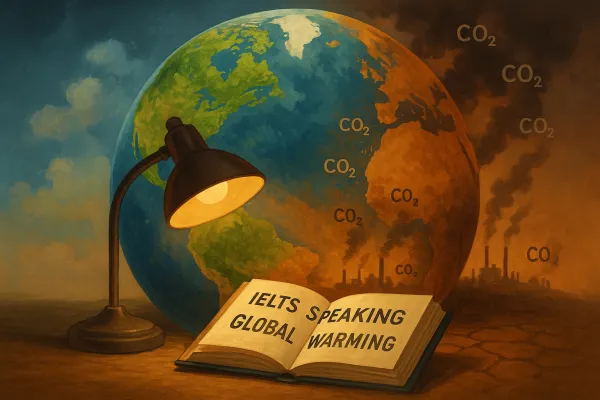
1. Essential Vocabulary & Structures for Global Warming
Core Vocabulary:
| Vocabulary | Definition |
| global warming | The gradual increase in the Earth’s overall temperature. |
| greenhouse gases | Gases that trap heat in the atmosphere, such as CO2. |
| carbon footprint | The total amount of greenhouse gases generated by our actions. |
| climate change | Long-term shifts in temperatures and weather patterns. |
| deforestation | The purposeful clearing of forested land. |
| fossil fuels | Natural fuels such as coal or gas, formed from organic remains. |
| renewable energy | Energy from a source that is not depleted when used, like solar. |
| sustainability | The ability to be maintained at a certain rate or level. |
| biodiversity loss | The decline in the number and variety of species in an area. |
| sea level rise | An increase in the level of the world’s oceans due to global warming. |
High-scoring structures to elevate your response:
“One major cause of global warming is…”
→ Use this to introduce a primary factor contributing to the issue.
“If we don’t take action now, the consequences could be irreversible.”
→ A strong conditional sentence to emphasize the urgency of the situation.
“It’s our responsibility to reduce our carbon footprint.”
→ A phrase used to discuss individual or collective duty toward the environment.
“Governments should implement stricter environmental regulations.”
→ A formal way to suggest policy-level solutions and government intervention.
2. IELTS Speaking Part 1 Sample – Global Warming
Question 1: Have you ever learned about global warming?
Answer:
Yes, I have. I first learned about global warming in school, but I’ve also read articles and watched documentaries about it. What struck me most is how much human activity—like burning fossil fuels and cutting down forests—contributes to the problem. It’s a global issue, and I think we all have a role in addressing it.
Key Vocabulary Used:
| Vocabulary | Definition |
| documentaries | Factual films or television programs. |
| what struck me most | What I found most impressive or surprising. |
| human activity | Things that people do that impact the world. |
| burning fossil fuels | Using coal, oil, or gas for energy. |
| cutting down forests | The act of clearing large areas of trees. |
| contributes to the problem | Helps cause or worsen the issue. |
| addressing it | Dealing with or solving the problem. |
Question 2: Are people in your country concerned about global warming?
Answer:
I’d say awareness is growing, especially among younger generations. Many people are starting to adopt eco-friendly habits, like recycling, reducing plastic use, or switching to electric vehicles. But at the same time, some still don’t take it seriously, either because of lack of education or because they feel their actions won’t make a difference.
Key Vocabulary Used:
| Vocabulary | Definition |
| awareness is growing | More people are becoming informed about the issue. |
| younger generations | People who are currently young (Gen Z, Alpha, etc.). |
| eco-friendly habits | Behaviors that do not harm the environment. |
| recycling | Processing waste into new materials. |
| reduce plastic use | Using less plastic to protect the environment. |
| electric vehicles | Cars or bikes powered by electricity instead of fuel. |
| take it seriously | To treat something as important and urgent. |
| make a difference | To have a positive effect on a situation. |
Question 3: What have you done to help reduce global warming?
Answer:
I try to be more mindful of my lifestyle. I take public transportation instead of driving, avoid single-use plastics, and turn off appliances when they’re not in use. I also support local businesses that focus on sustainability. These things may seem small, but I believe they add up over time.
Key Vocabulary Used:
| Vocabulary | Definition |
| be mindful of | To be conscious or aware of something. |
| single-use plastics | Plastic items intended to be used only once. |
| turn off appliances | To switch off electronic devices when not needed. |
| support local businesses | Buying from shops or companies in your area. |
| focus on sustainability | Prioritizing methods that don’t deplete resources. |
| add up over time | To accumulate and result in a significant total. |
3. IELTS Speaking Part 2 Sample – Describe an environmental problem
Describe a problem related to the environment in your country.
You should say:
- What the problem is
- What causes this problem
- What effects it has had
- And explain what could be done about it
Answer:
One serious environmental issue in my country is global warming. Over the years, temperatures have risen significantly, and this has led to more frequent heatwaves, unpredictable rain, and severe flooding in certain regions.
The main causes are the burning of fossil fuels for electricity and transportation, as well as large-scale deforestation. Unfortunately, industrial development often comes at the expense of the environment.
The effects are widespread: coastal communities are experiencing rising sea levels, farmers are struggling with poor crop yields due to erratic weather, and biodiversity is under threat.
To combat this, I think both government and individual action is necessary. The government should invest in renewable energy, tighten environmental regulations, and promote green technologies. On a personal level, people should reduce their carbon footprint by making sustainable choices in daily life.
📘 Key Vocabulary Used:
| Vocabulary | Definition |
| heatwaves | Periods of abnormally hot weather. |
| unpredictable rain | Rainfall that does not follow normal patterns. |
| flooding | An overflow of water onto normally dry land. |
| large-scale deforestation | The clearing of forests on a massive level. |
| comes at the expense of | Happens by harming or sacrificing something else. |
| poor crop yields | Low amounts of agricultural production. |
| biodiversity is under threat | The variety of life forms is at risk of disappearing. |
| combat this | To take action to stop or reduce something bad. |
| tighten environmental regulations | Making laws about the environment more strict. |
| carbon footprint | The amount of CO2 emissions produced by a person or group. |
4. IELTS Speaking Part 3 Sample – Global Warming (Discussion)
Question 1: What do you think are the main causes of global warming?
Answer:
In my opinion, the biggest contributors are the burning of fossil fuels and deforestation. Fossil fuels are used for electricity, transportation, and manufacturing, all of which release carbon dioxide. Deforestation makes the situation worse because trees absorb CO₂, and without them, the concentration of greenhouse gases increases even more.
Key Vocabulary Used:
| Vocabulary | Definition |
| contributors | Factors that help bring about a result. |
| manufacturing | The large-scale production of goods in factories. |
| release carbon dioxide | To emit CO2 into the atmosphere. |
| absorb CO₂ | To take in carbon dioxide (like trees do). |
| <span style="
Chia sẻ:
Loading... LoginContact AdvisorError: Contact form not found. |





 Khai giảng Khóa học Hè cực HOT.
No comments yet!