


Tóm Tắt Nội Dung Bài Viết
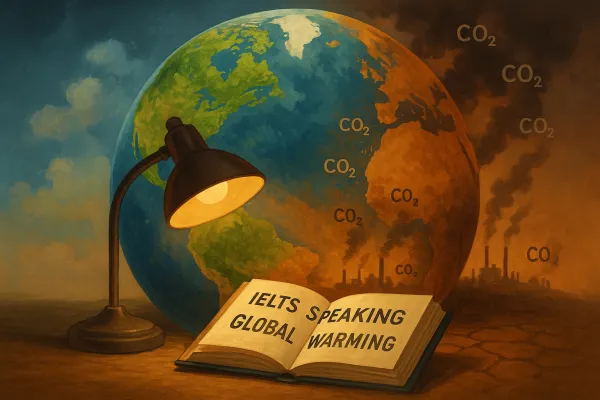
Global Warming is a challenging topic, but it’s a “golden” opportunity to score high in IELTS Speaking if you prepare thoroughly. This is your chance to showcase your academic vocabulary, sharp reasoning skills, and a natural, fluent speaking style. Let’s join Ms. Thao Nhi, an 8.0 IELTS instructor at ECE, to discover how to conquer this topic!
1. Essential Vocabulary & Structures for Global Warming
Core Vocabulary:
| Term | Meaning |
| global warming | the gradual increase in Earth’s temperature |
| greenhouse gases | gases that trap heat in the atmosphere |
| carbon footprint | the amount of CO2 emitted by an individual or organization |
| climate change | long-term shifts in temperatures and weather patterns |
| deforestation | the large-scale clearing of forests |
| fossil fuels | non-renewable energy sources like coal, oil, and gas |
| renewable energy | energy from sources that are naturally replenished |
| sustainability | the ability to maintain ecological balance |
| biodiversity loss | the decline in the variety of life on Earth |
| sea level rise | the increase in the level of the world’s oceans |
High-scoring structures to boost your performance:
“One major cause of global warming is…”
“If we don’t take action now, the consequences could be irreversible.”
“It’s our responsibility to reduce our carbon footprint.”
“Governments should implement stricter environmental regulations.”
2. IELTS Speaking Part 1 Sample – Global Warming
Question 1: Have you ever learned about global warming?
Answer:
Yes, I have. I first learned about global warming in school, but I’ve also read articles and watched documentaries about it. What struck me most is how much human activity—like burning fossil fuels and cutting down forests—contributes to the problem. It’s a global issue, and I think we all have a role in addressing it.
Vocabulary used:
| Term | Meaning |
| documentaries | non-fiction films providing factual information |
| what struck me most | what impressed or affected me the most |
| human activity | actions performed by people |
| burning fossil fuels | combusting coal, oil, or gas for energy |
| cutting down forests | deforestation |
| contributes to the problem | plays a part in causing the issue |
| addressing it | tackling or dealing with the issue |
Question 2: Are people in your country concerned about global warming?
Answer:
I’d say awareness is growing, especially among younger generations. Many people are starting to adopt eco-friendly habits, like recycling, reducing plastic use, or switching to electric vehicles. But at the same time, some still don’t take it seriously, either because of a lack of education or because they feel their individual actions won’t make a difference.
Vocabulary used:
| Term | Meaning |
| awareness is growing | people are becoming more informed |
| younger generations | people of a younger age group |
| eco-friendly habits | environmentally conscious behaviors |
| recycling | reprocessing waste materials |
| reduce plastic use | cutting down on plastic consumption |
| electric vehicles | cars powered by electricity |
| take it seriously | giving the issue proper importance |
| make a difference | having a positive impact |
Question 3: What have you done to help reduce global warming?
Answer:
I try to be more mindful of my lifestyle. I take public transportation instead of driving, avoid single-use plastics, and turn off appliances when they’re not in use. I also support local businesses that focus on sustainability. These things may seem small, but I believe they add up over time.
Vocabulary used:
| Term | Meaning |
| be mindful of | being conscious of one’s impact |
| single-use plastics | disposable plastic items |
| turn off appliances | switching off electrical devices |
| support local businesses | buying from nearby, sustainable shops |
| focus on sustainability | prioritizing long-term environmental health |
| add up over time | accumulate to create a larger impact |
3. IELTS Speaking Part 2 Sample – Describe an environmental problem
Describe a problem related to the environment in your country.
You should say:
- What the problem is
- What causes this problem
- What effects it has had
- And explain what could be done about it
Answer:
One serious environmental issue in my country is global warming. Over the years, temperatures have risen significantly, and this has led to more frequent heatwaves, unpredictable rain, and severe flooding in certain regions.
The main causes are the burning of fossil fuels for electricity and transportation, as well as large-scale deforestation. Unfortunately, industrial development often comes at the expense of the environment.
The effects are widespread: coastal communities are experiencing rising sea levels, farmers are struggling with poor crop yields due to erratic weather, and biodiversity is under threat.
To combat this, I think both government and individual action is necessary. The government should invest in renewable energy, tighten environmental regulations, and promote green technologies. On a personal level, people should reduce their carbon footprint by making sustainable choices in daily life.
📘 Vocabulary used:
| Term | Meaning |
| heatwaves | periods of excessively hot weather |
| unpredictable rain | erratic rainfall patterns |
| flooding | overflowing of water onto land |
| large-scale deforestation | extensive clearing of forests |
| comes at the expense of | achieved by sacrificing something else |
| poor crop yields | low agricultural production |
| biodiversity is under threat | variety of life is in danger |
| combat this | fight against this issue |
| tighten environmental regulations | make environmental laws stricter |
| carbon footprint | total greenhouse gas emissions |
4. IELTS Speaking Part 3 Sample – Global Warming (Discussion)
Question 1: What do you think are the main causes of global warming?
Answer:
In my opinion, the biggest contributors are the burning of fossil fuels and deforestation. Fossil fuels are used for electricity, transportation, and manufacturing, all of which release carbon dioxide. Deforestation makes the situation worse because trees absorb CO₂, and without them, the concentration of greenhouse gases increases even more.
Vocabulary used:
| Term | Meaning |
| contributors | factors that help cause something |
| manufacturing | industrial production |
| release carbon dioxide | emitting CO₂ into the atmosphere |
| absorb CO₂ | taking in carbon dioxide |
| greenhouse gases | gases trapping heat |
| concentration | the amount of a substance in a given area |
Question 2: What can individuals do to reduce global warming?
Answer:
Individuals can make simple yet powerful changes. For example, they can conserve energy, switch to reusable products, plant more trees, and support eco-conscious companies. More importantly, they can raise awareness in their communities, which often leads to collective action. Small steps, when multiplied by millions of people, can lead to significant progress.
Vocabulary used:
| Term | Meaning |
| conserve energy | using energy efficiently |
| reusable products | items designed to be used multiple times |
| eco-conscious companies | environmentally friendly businesses |
| raise awareness | educating others about an issue |
| collective action | people working together for a goal |
| significant progress | meaningful advancement |
Question 3: Do you think governments or individuals should take more responsibility?
Answer:
Both have vital roles, but I think governments should lead the way. They have the resources and authority to implement environmental policies, support green innovation, and regulate harmful industries. However, individuals shouldn’t wait for policy changes to act. People’s daily habits and attitudes towards nature also play a huge part. It’s really a partnership—without both sides, real change won’t happen.
Vocabulary used:
| Term | Meaning |
| lead the way | taking the initiative |
| implement policies | putting laws into effect |
| green innovation | new environmentally friendly technology |
| regulate industries | controlling industrial practices |
| daily habits | everyday routines |
| partnership | collaboration |
Conclusion
The topic of Global Warming is an ideal opportunity to demonstrate your academic vocabulary, deep thinking, and ability to connect ideas coherently. Combine “high-value” vocabulary with personal experiences and your own perspective to make your answers vivid and natural.





 Khai giảng Khóa học Hè cực HOT.
No comments yet!