


Tóm Tắt Nội Dung Bài Viết
Understanding the IELTS test structure is the first and most crucial step in building an effective study plan. With the IELTS exam in Vietnam transitioning entirely to a computer-delivered format starting in 2025, mastering the test format will not only help you manage your time but also optimize your technical skills for the highest possible score.
IELTS Test Structure Overview
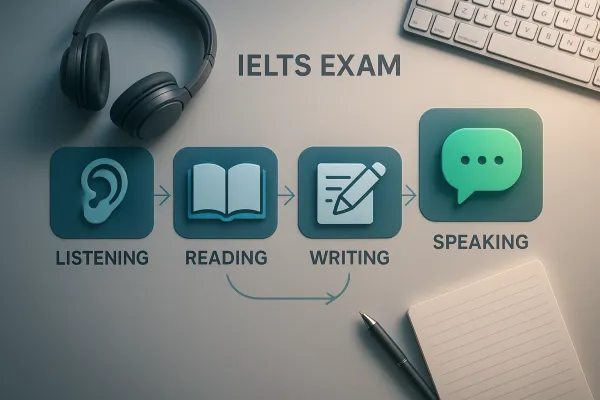
IELTS (International English Language Testing System) is the world’s most popular international English language test, jointly owned by the British Council, IDP: IELTS Australia, and Cambridge Assessment English.
The test is designed to assess a candidate’s four language skills: Listening, Reading, Writing, and Speaking. Depending on your purpose, you will choose one of two modules:
-
IELTS Academic: For individuals applying for higher education or professional registration in an English-speaking environment.
-
IELTS General Training: For those migrating to English-speaking countries, seeking work experience, or undertaking non-degree training programs.
According to the latest data from IELTS.org, over 12,000 organizations worldwide recognize this certification, including government agencies, educational institutions, and professional bodies.
How are the test sections structured?
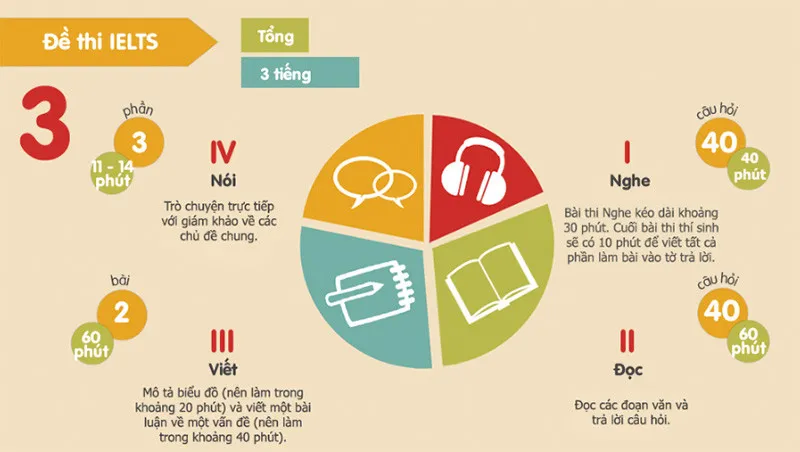
The total test time for IELTS is approximately 2 hours and 45 minutes. The sections are administered in the following order:
Listening, Reading, and Writing skills: These are always taken on the same day, in the fixed order of Listening -> Reading -> Writing. There is no break between these sections. Candidates need to be mentally and physically prepared to concentrate continuously for over 160 minutes.
Speaking skill: This section may take place on the same day as the other three skills, or up to 7 days before or after, depending on the test center’s schedule. In Vietnam, with the computer-delivered format, candidates can often choose to take the Speaking test on the same day for convenience.
Detailed Time Allocation Table:
| Skill | Test Duration | Number of Questions |
| Listening | Approx. 30 minutes (+ 2 minutes for computer-based review or 10 minutes for paper-based transfer) | 40 questions (4 parts) |
| Reading | 60 minutes | 40 questions (3 parts) |
| Writing | 60 minutes | 2 tasks (Task 1 & Task 2) |
| Speaking | 11 – 14 minutes | 3 parts (Face-to-face interview) |
Are the Computer-delivered and Paper-based IELTS tests the same?
Since 2025, the paper-based test format in Vietnam has been largely replaced by computer-delivered testing to ensure transparency and faster result delivery. In essence, the test content, difficulty level, question types, and scoring criteria are identical for both formats.
However, there are important technical differences that candidates should be aware of:
-
Listening Answer Transfer Time: This is the biggest difference. Paper-based test takers have 10 minutes to transfer their answers from the question paper to the Answer Sheet. Computer-delivered test takers only have 2 minutes to review their answers, as they have been entered directly during the listening.
-
Reading Interface: The computer-delivered test allows for a split-screen view (text on one side, questions on the other), eliminating the need to turn pages as in the paper-based test. The Highlight and Note tools facilitate faster scanning.
-
Writing Convenience: The computer-delivered test automatically counts words, helping candidates manage their writing length without manual counting. Editing and copy-pasting text is much faster than erasing on paper.
-
Results: Computer-delivered tests typically provide results in just 3-5 days, whereas paper-based tests take 13 days.
IELTS Listening Test Structure
The Listening section is the first part of the IELTS test (for the Computer-delivered IELTS – CDI). It’s considered both “easy and difficult”: easy because the information is always in the audio, but difficult because you only get to hear it once.
1. Overview of Structure and Test Time
The Listening test assesses your ability to understand main ideas, specific factual information, opinions and attitudes of speakers, and to follow the development of an argument.
-
Total Duration: Approximately 30-34 minutes (depending on the length of the recordings).
-
Number of Questions: 40 questions, divided equally among 4 parts (10 questions per part).
-
Number of Listenings: Only 01 time.
-
Review Time: * Computer-delivered (CDI): You have the final 2 minutes to review all your answers.
-
Paper-based: You have 10 minutes to transfer your answers to the Answer Sheet.
-
2. Detailed Analysis of the 4 Parts
Since 2020, the testing board has officially changed the name from “Section” to “Part.” Each part represents an increasing level of difficulty and a different context of language use.
Part 1: Everyday Conversation (Social Semi-formal)
This is a conversation between two people about everyday topics.
-
Context: Registering for a club membership, booking a hotel room, inquiring about a short course.
-
Task: Filling in factual information such as names, addresses, phone numbers, dates.
-
Common Pitfalls (Distractors): Speakers provide information and then immediately correct themselves (Self-correction).
Example: “My office is on 15th Street… Oh wait, sorry, it’s actually 50th Street.”
Part 2: Social Monologue
A single speaker talks about a familiar social topic.
-
Context: A tour guide describing a tourist attraction, a speech about the schedule of a community event.
-
Specifics: Often includes Map/Plan Labelling tasks. You need to listen and identify directions based on given landmarks.
Part 3: Educational/Training Discussion
A discussion between a group of people (2 to 4), usually students and a teacher, or among students.
-
Context: Discussing a research project, an essay, or a scientific phenomenon.
-
Challenge: You not only need to understand the information but also identify the opinions and attitudes of each speaker. The examiner will check if you can recognize who agrees or disagrees with a particular point.
Part 4: Academic Lecture
A lengthy lecture delivered by an expert or professor on a scientific topic.
-
Context: Lectures on history, archaeology, biology, new technology, etc.
-
Characteristics: There are no pauses between segments (unlike Parts 1, 2, and 3, which have short pauses after the first 5 questions).
-
Technique: You must rely on Signposting Language, such as: “Moving on to…”, “Another aspect is…”, “To conclude…” to know which question the audio is addressing.
3. Detailed Task Types
To achieve a perfect score, you need to master these 6 task types according to IELTS.org standards:
1. Multiple Choice: Select 1 correct answer from 3 options (A, B, C) or select multiple correct answers from a longer list. This type tests your ability to understand both detailed and general information.
2. Matching: Match items from a list in the audio with a list of options on the test paper (e.g., matching locations with their features).
3. Plan/Map/Diagram Labelling: Complete the labels on a map (e.g., a building plan, a town map) or a diagram of a device.
4. Form/Note/Table/Flow-chart/Summary Completion: Fill in the blanks in a summary form. This is the most common type.
Form: Usually in Part 1 (recording customer information).
Flow-chart: Summarizes the stages of a process (with directional arrows).
5. Sentence Completion: Fill in the blanks to complete a sentence summarizing the main idea of the audio.
6. Short-answer Questions: Answer questions about specific details heard in the audio (e.g., “What was found at the bottom of the sea?”).
4. “Hidden” Rules for Answering Questions
-
Word Count Rule: Strictly adhere to the question’s requirement (e.g., NO MORE THAN TWO WORDS AND/OR A NUMBER).
-
A year = 2 words.
-
1995 = 1 number.
-
Full-time = 1 word (hyphenated words count as one).
-
Abbreviations: Not recommended unless they are common units of measurement (e.g., kg, cm).
-
-
Spelling: A single incorrect letter will result in the entire answer being marked wrong. IELTS accepts both British English (Colour) and American English (Color), but you should be consistent throughout the test.
-
Singular/Plural: This is the most common reason for losing points. If the audio says “The animals” but you write “The animal”, that answer will be marked incorrect.
-
Capitalization: You can write answers entirely in capital letters (e.g., APPLE) to avoid errors with proper noun capitalization. This is advice from examiners to maximize your score.
5. Scoring and Band Score Conversion Table
Each correct answer is worth 1 point. The total score out of 40 is converted to a band score from 1.0 to 9.0.
| Number of Correct Answers | Band Score | Equivalent Level (CEFR) |
| 39 – 40 | 9.0 | C2 (Expert) |
| 35 – 36 | 8.5 | C1+ |
| 32 – 34 | 8.0 | C1 |
| 30 – 31 | 7.5 | C1 |
| 26 – 29 | 7.0 | B2+ |
| 23 – 25 | 6.5 | B2 |
| 18 – 22 | 6.0 | B2 |
6. Effective Test-Taking Strategies (Expert Tips)
1. Utilize preparation time: Always read the questions beforehand to identify the type of word needed (noun, verb, or adjective) and predict the information (person’s name, number, or location).
2. Tracking skill: In Part 4, if you miss a question, move on immediately to follow the next one. Do not stop to think, as you will get lost for the rest of the section.
3. Computer-based test technique: Use the Tab key to quickly move between answer boxes and the Review key to flag questions you are unsure about.
Note: “In Listening, your ears must listen, but your eyes must be at least one question ahead of the audio. If you only focus on the question you are currently hearing, you will always be at a disadvantage when the audio changes pace.”
IELTS Reading Test Structure
The Reading test takes place immediately after the Listening test. You must process nearly 3,000 words in 60 minutes. Unlike Listening, Reading requires more Information Extraction skills than word-by-word comprehension.
1. Overview of Structure and Test Time
The Reading test assesses your ability to skim for main ideas, scan for details, understand logical arguments, and identify the author’s opinions and intentions.
-
Total Duration: Exactly 60 minutes.
-
Number of Passages: 03 passages, increasing in difficulty.
-
Number of Questions: 40 questions (divided into various task types).
-
Review Time: None. You must enter your answers directly into the system (computer-based) or write them on the answer sheet (paper-based) within the 60 minutes.
-
Computer-delivered (CDI) Feature: The split-screen display allows you to read the text on the left and answer questions on the right very conveniently.
2. Detailed Analysis of the 3 Passages
The content of the texts will differ depending on the test module you choose:
IELTS Academic
-
Passage 1, 2 & 3: Long texts ranging from descriptive and factual to analytical and argumentative.
-
Sources: Excerpts from books, scientific journals, and specialized magazines (e.g., New Scientist, The Economist).
-
Characteristics: At least one passage will contain logical arguments and specialized terminology (with small annotations if a word is particularly difficult).
IELTS General Training
-
Section 1: Contains 2-3 short texts related to daily life (announcements, advertisements).
-
Section 2: Contains 2 texts related to the workplace (job descriptions, company policies).
-
Section 3: One long text on a common social topic, requiring the highest level of analysis.
3. Detailed Task Types
To achieve a high score, you need to master these 11 task types:
-
Identifying Information (True/False/Not Given): Determine if the information is true, false, or not mentioned in the passage.
-
Identifying Writer’s Views (Yes/No/Not Given): Determine the author’s opinion.
-
Matching Headings: Match headings to paragraphs.
-
Matching Information: Find the paragraph containing specific information.
-
Matching Features: Match features with subjects (e.g., scientist’s name with their invention).
-
Matching Sentence Endings: Complete sentences.
-
Sentence/Note/Table/Flow-chart Completion: Fill in the blanks.
-
Diagram Label Completion: Label a process diagram.
-
Multiple Choice: Select the correct answer from multiple options.
-
Short-answer questions: Answer questions with short responses.
4. “Hidden” Rules for Answering Questions
-
Word Limit Rule: If the question asks for “ONE WORD ONLY,” writing “A car” will be considered incorrect (as it contains two words).
-
Computer-based Test Technique: You can highlight keywords directly on the screen and right-click to select “Note” if you wish to make quick annotations.
-
Copy-Paste: In the computer-based test, you can highlight keywords in the passage, use keyboard shortcuts
Ctrl + CandCtrl + Vinto the answer box to ensure you never misspell. -
Answer Order: For most question types (like TFNG, Multiple Choice), the answers appear in the order they are found in the text, except for Matching tasks.
Score and Band Score Conversion (Academic Reading)
| Number of Correct Answers | 15-18 | 23-26 | 30-32 | 35-36 | 39-40 |
| Band Score | 5.0 | 6.0 | 7.0 | 8.0 | 9.0 |
5. Effective Test-Taking Strategies (Expert Tips)
-
The 15-20-25 Rule: Allocate 15 minutes for Passage 1, 20 minutes for Passage 2, and 25 minutes for Passage 3. The last passage is always the most difficult and longest.
-
Read the questions first: Do not start by reading the passage. Read the questions, underline keywords that are unlikely to change (proper nouns, numbers), and then return to the passage to find them (Scanning).
-
Expert advice from ECE: “In Reading, you are not looking for the exact answer; you are looking for paraphrased information. The answer in the passage will, 90% of the time, not use the exact same wording as the question.”
>>> Related article: Is Grammar Important in IELTS? A Comprehensive Guide to Essential Grammar Topics
IELTS Writing Test Structure
The Writing test requires grammatical accuracy and logical thinking. This section often lowers the scores of Vietnamese candidates if they do not fully understand the scoring criteria.
1. Overview of Structure and Test Time
The test assesses your ability to present ideas, use a diverse vocabulary, and employ accurate grammar to address a specific prompt.
-
Total Duration: 60 minutes.
-
Number of Tasks: 02 Tasks.
-
Weighting: Task 2 accounts for 2/3 of the total score, while Task 1 accounts for 1/3.
-
Computer-delivered (CDI) Feature: The system has an automatic word count displayed in the corner of the screen, eliminating the need for manual counting.
2. Detailed Analysis of the 2 Tasks
Task 1: Describe Data/Write a Letter (Minimum 150 words)
-
Academic: Describe a graph (bar, line, pie, table), map, or process. You need to highlight trends and compare data.
-
General Training: Write a letter (requesting information, explaining a situation). You must identify the correct tone: Informal or Formal.
Task 2: Essay (Minimum 250 words)
-
Content: Write an essay responding to an opinion, argument, or social issue.
-
Requirements: Provide evidence, real-life examples, and fully address all parts of the prompt.
3. Common Task 2 Essay Types
-
Agree or Disagree: State your agreement or disagreement with an opinion.
-
Discussion: Discuss both sides of an issue and give your own opinion.
-
Advantages & Disadvantages: Analyze the benefits and drawbacks.
-
Causes & Solutions: Identify the causes of a social problem and propose solutions.
4. Scoring Criteria (Band Descriptors)
Examiners score based on 4 equally weighted criteria (25% each):
1. Task Response: Addresses the prompt fully, meets word count requirements, and covers all necessary points.
2. Coherence and Cohesion: The writing is logical and well-linked with natural transitions.
3. Lexical Resource: Possesses a rich vocabulary, used accurately and appropriately in context.
4. Grammatical Range and Accuracy: Uses a wide range of grammatical structures (simple, complex, compound) with accuracy.
5. Effective Test-Taking Strategies (Expert Tips)
-
The 20/40 Rule: Allocate 20 minutes for Task 1 and 40 minutes for Task 2. Never spend time from Task 2 on Task 1.
-
Spend 5 minutes planning: Do not start writing immediately. Spend 5 minutes outlining your main ideas and vocabulary.
-
ECE Note: “Writing is not a competition for literary flair, but a demonstration of logical thinking. Maintain a clear paragraph structure: 1 topic sentence – 2 supporting sentences – 1 example.”
2.4. IELTS Speaking Test Structure
Duration: 11 – 14 minutes.
Format: A one-on-one face-to-face interview with an examiner. The entire test will be recorded for internal review or appeals.
Structure: Consists of 3 Parts, identical for both IELTS Academic and General Training. The 3-part structure assesses the candidate’s communication ability from familiar topics (Part 1) to the ability to speak continuously on a topic (Part 2), and finally, the ability to discuss and analyze abstract issues (Part 3), simulating communication situations in both daily life and academic settings.
Detailed Breakdown of Parts:
Part 1: Introduction and Interview (4 – 5 minutes)
- The examiner introduces themselves and asks you to confirm your personal details.
- Short, familiar questions about yourself, family, work/studies, hobbies, hometown, etc.
- Objective: To help candidates get comfortable with the interview atmosphere and assess their ability to answer personal questions naturally.
Part 2: Long Turn (Cue Card) (3 – 4 minutes)
- You receive a cue card with a specific topic and prompts to guide your talk.
- You have 1 minute to prepare (with scratch paper and a pen for notes).
- You need to speak continuously on the topic for 1-2 minutes.
- The examiner may ask 1-2 brief follow-up questions after you finish to transition to Part 3.
- Objective: To assess your ability to organize ideas, speak at length, and develop a topic.
Part 3: Discussion (4 – 5 minutes)
- The examiner asks more abstract and in-depth discussion questions related to the topic from Part 2.
- Objective: To assess your ability to analyze, expand on ideas, and present and defend your opinions on complex issues.
Speaking Scoring Criteria (25% for each criterion):
- Fluency and Coherence: Ability to speak fluently with minimal hesitation, logical flow, and clear connections between ideas.
- Lexical Resource: Ability to use a wide range of vocabulary accurately and appropriately in context, including natural use of idioms and phrases.
- Grammatical Range and Accuracy: Ability to use a variety of grammatical structures (simple, complex, compound) accurately.
- Pronunciation: Is your pronunciation clear and easy to understand? Does it affect the communication of your message?
Strategies for Maximizing Speaking Score:
- Practice speaking English regularly: Speak English as much as possible, even when practicing alone.
- Do not memorize answers: Examiners can easily detect this, which will reduce your naturalness score. Prepare ideas, vocabulary, and structures, but answer flexibly.
- Expand your answers: Always try to explain your ideas, provide examples, and develop your answers rather than just saying “yes” or “no.”
- Utilize the 1-minute preparation time in Part 2: Outline key points, vocabulary, and structures you want to use.
- Listen carefully to the question: Ensure you understand the examiner’s question correctly to answer on topic.
- Stay calm and confident: Confidence is crucial for performing at your best.
References:
IELTS.org (2026) – Official Test Format.
Cambridge Assessment English – Examiner’s Handbook.
British Council Vietnam – Computer-delivered IELTS guide.
ECE Advice: To achieve a breakthrough in your score, besides mastering the test structure, candidates need to practice with real test materials and receive detailed feedback from highly qualified instructors. At ECE, we focus on personalizing learning paths based on each student’s strengths and weaknesses in every section of the IELTS test structure.
We hope this article has provided you with the most detailed and comprehensive overview of the 2026 IELTS test structure. We wish you an effective study process and the results you desire!
Find out more here: IELTS Courses at ECE Language Center.




 Khai giảng Khóa học Hè cực HOT.
No comments yet!