


Tóm Tắt Nội Dung Bài Viết
Do you find the IELTS Speaking test intimidating? Do you feel like no matter how much you study, you still sound awkward and lack confidence? Rest assured, you are not alone in finding it challenging to achieve a high score in the IELTS Speaking section.
The IELTS exam tests candidates on four skills: Listening, Reading, Writing, and Speaking. Listening and Reading are “Receptive Skills,” which require you to process input and identify information provided in the test. Conversely, Speaking and Writing are “Productive Skills,” which require you to use your existing knowledge (input) to form your own responses, express opinions, and share personal stories (output). This is likely why many candidates find it more difficult to boost their scores in Speaking and Writing.
In this article, the ECE language center will provide you with a comprehensive overview of the IELTS Speaking test and share some tips to help you feel more confident during your preparation.
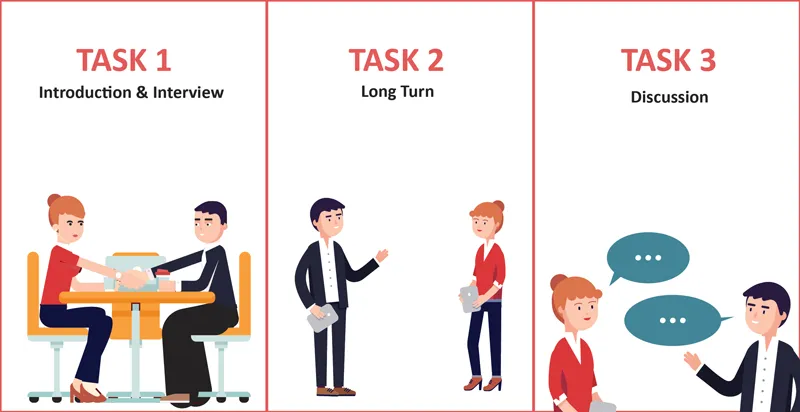
1. IELTS Speaking Test Structure
| IELTS Speaking | Duration | Content | Example Questions |
| Part I | 4 – 5 minutes | You will answer questions on 3 topics, with 3 – 4 questions per topic.
The questions are personal, focusing on you and familiar topics such as your hometown, family, studies, work, or where you live. |
Topic: Where you live now
1. Do you live in a house or an apartment? 2. What is your favourite room in your home? (Why?) 3. What things make your home pleasant to live in? (Why?) 4. Are the people in your neighbourhood nice and friendly? |
| Part II | 3 – 4 minutes | You will be given a topic card with 4 guiding questions.
You have 1 minute to think and make notes, then you must speak for up to 2 minutes. After your 2-minute turn, the examiner may ask 1 – 2 follow-up questions about what you just shared. |
Describe a lesson that you remember well
You should say: What the course was about Where you had it Why you remember it And explain why it impressed you a lot |
| Part III | 4 – 5 minutes | You will be asked 1 – 2 topics related to the theme of your Part II talk. You will answer 2 – 4 questions per topic.
These questions are more abstract and require a broader social awareness to develop your ideas. |
1. Which can help you remember things better, words or photos?
2. Why do some people have better memory? 3. Why can some people remember some little things in life? |
2. IELTS Speaking Assessment Criteria
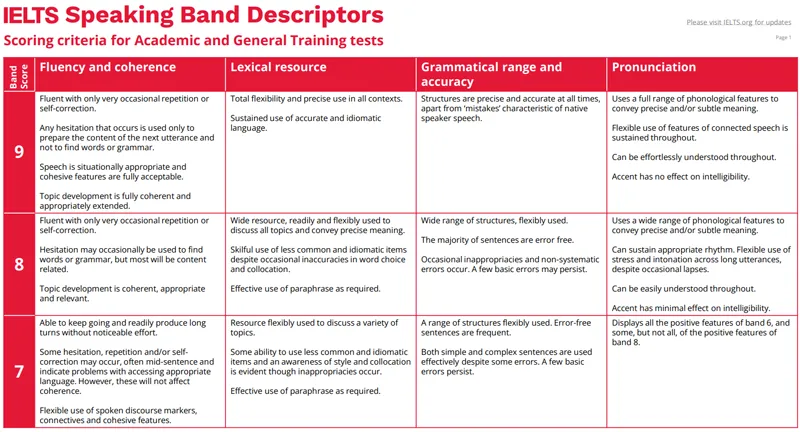
Examiners grade candidates based on four main criteria. To help you self-assess and improve, ECE has compiled a list of guiding questions that summarize the core requirements of each criterion. You can use these to review your own responses and adjust your practice accordingly.
Criterion 1: Fluency and Coherence
- Can you speak at length, or do you only provide short, fragmented answers?
- Do you hesitate often? Are you pausing to find vocabulary or to organize your thoughts?
- Are the ideas within your response logically connected, or are they disjointed?
Criterion 2: Lexical Resource
- Is your vocabulary range broad across various topics?
- Do you use words accurately in context?
- Do you use fixed phrases (e.g., phrasal verbs, idioms, collocations)?
- Are you able to express yourself flexibly, or do you simply repeat the wording from the question or your previous points?
Criterion 3: Grammatical Range and Accuracy
- Do you use a variety of sentence structures?
- Are your sentences grammatically correct?
- If you make grammatical errors, do they hinder the listener’s understanding?
- Do you make systematic errors (repeating the same mistake across multiple structures)?
Criterion 4: Pronunciation
- Is your pronunciation clear and easy to understand?
- Do you use word and sentence stress correctly?
- Is your intonation natural and expressive?
3. How to achieve a high score in IELTS Speaking?
As shown above, the more criteria you meet, the higher your score will be.
- For those who have already taken the test and are unhappy with their score: You should request a breakdown of your results from the testing board to identify which specific criteria need improvement.
- For those currently preparing who are at an intermediate level or higher: You already know the test structure and how to handle tricky situations in the exam room. You need an experienced partner to practice with and point out your areas for improvement. This could be a friend who has already achieved a good score, or a teacher, tutor, or instructor at a language center.
- For those new to IELTS Speaking: If you are feeling overwhelmed and don’t know where to start, what the examiner will ask, or what you need to do, don’t obsess over achieving a 9.0 on every single practice question. You shouldn’t just learn to speak English for the sake of the exam.
What matters most is having a clear study strategy, an encouraging environment, and like-minded study partners. This allows you to use English as a tool to express your personal views, rather than feeling self-conscious or afraid of being judged every time you speak.
4. Recommended IELTS Speaking Study Roadmap
Step 1: Determine your current level
You can take mock tests at your school (if available), at reputable IELTS testing centers, or participate in a placement test at an IELTS preparation center to receive professional feedback.
Step 2: Create a personalized study plan
Once you know your current level, you can follow a roadmap suggested by a center or create your own based on your target test date and desired band score.
For example, if you are self-studying at home, currently at a 3.0 – 4.0 level, and aiming for a 6.0 – 6.5 within a year, you should study the Band Descriptors carefully and plan as follows:
- First 4 months: Aim for band 4.0 – 5.0
- Next 4 months: Aim for band 5.0 – 6.0
- Final 4 months: Aim for band 6.0 – 6.5
For each 4-month block, cross-reference your target band with the assessment criteria to find suitable materials and practice accordingly.
Alternatively, if you prefer studying at a center, you can follow the roadmap provided by your instructors. ECE offers IELTS English courses with personalized roadmaps to help students improve and boost their scores.
5. Methods for self-studying IELTS Speaking at home
- Learn from sample answers by high-scoring instructors at reputable centers
There are many resources available to read or watch sample answers for IELTS Speaking topics by band level, such as IELTS preparation websites or mock test videos on YouTube. Spend time analyzing how the speakers brainstorm ideas, structure their responses, and express their personal opinions.
- Use AI to improve your answers
You can use AI tools like ChatGPT or Gemini to practice. After providing your answer to an IELTS question, ask the AI to suggest a better version based on fluency, vocabulary, grammar, or pronunciation. You can even prompt the AI for specific targets, such as: “Suggest vocabulary band 7.0 for my IELTS speaking answer above.”
- Practice with a study partner
This ensures you have a companion with a shared goal who can support you. Schedule one or two sessions per week to practice difficult topics, brainstorm vocabulary together, and provide constructive feedback to one another.
- Dedicate at least 2 minutes every day to speaking practice
Remember, IELTS is just a standardized test of your language proficiency. Approaching it solely as an exam can be stressful. Why not try treating English as a language for daily communication? Try speaking for at least 2 minutes a day—recount your day to a friend or describe something interesting you saw. This will help you identify vocabulary gaps and encourage you to learn more.
We hope this overview of the IELTS Speaking test and the tips provided help you on your journey. If you have any questions, feel free to email ECE at info@ece.edu.vn or call our hotlines: 0982166634 (Tran Duy Hung branch), 0971.217.556 (Hoang Minh Giam branch), or 0384090708 (Nguyen Khanh Toan branch) for consultation. Good luck with your studies!



 Khai giảng Khóa học Hè cực HOT.
No comments yet!