


1. Definition and Classification of English Collocations
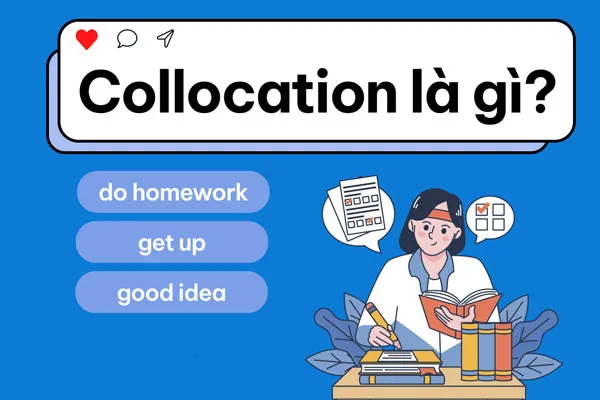
A collocation is a natural combination of two or more words that native English speakers frequently use together. They make your language sound more natural and idiomatic. Simply put, collocations are how words “go together” to form meaningful and common expressions.
For example, a native speaker would say “strong coffee” (referring to its intensity or flavor) rather than “powerful coffee,” even though both words have similar meanings.
Collocations are essential not only for daily communication but also for English proficiency tests like IELTS, where they contribute significantly to the Lexical Resource criteria.
Common Types of Collocations in English
1. Verb + Noun
Examples:
- Make a decision: To reach a conclusion or choose between options. This is commonly used when someone needs to decide between various alternatives.
- Take a break: To rest temporarily or pause an activity, such as resting after a period of intense work or study.
- Do homework: To complete assignments given by teachers or professors related to school or university subjects.
2. Adjective + Noun
Examples:
- Strong coffee: Coffee with a high concentration or intense flavor. This phrase describes coffee that makes the drinker feel alert and energized.
- Heavy rain: Intense or torrential rainfall. This describes a large volume of rain that could cause flooding or impact traffic and travel.
- Serious problem: A significant or severe issue. This phrase refers to problems that require immediate attention or have a major impact on a situation.
3. Noun + Noun
Examples:
- A surge of interest: A sudden and significant increase in attention or excitement regarding something. It often refers to many people suddenly noticing an event, topic, or product.
- A sense of achievement: The feeling of accomplishment after reaching a goal or completing a task. It expresses satisfaction and pride in overcoming a challenge.
- A ray of hope: A small sign that something positive might happen in a difficult or bleak situation. It represents a small but promising start.
4. Verb + Adverb
Examples:
- Deeply regret: To feel profound sorrow or remorse about something. It is often used to express sincere regret over a past action or decision.
- Strongly recommend: To suggest or propose something with great enthusiasm and conviction. This phrase shows firm encouragement for a specific action.
- Completely agree: To be in full agreement with an opinion, statement, or viewpoint. It expresses total and absolute consensus.
5. Adverb + Adjective
Examples:
- Highly unlikely: Very improbable or almost impossible to happen. This phrase describes a situation with a very low probability.
- Completely satisfied: To be entirely happy or content with something. It shows maximum satisfaction with a product, service, result, or situation.
- Perfectly normal: Entirely usual or natural, with nothing strange or out of the ordinary. This is used to describe behavior or situations that are standard.
6. Noun + Preposition
Examples:
- A need for: The necessity or requirement for something. This phrase indicates a demand that must be met or a problem that needs solving.
- An interest in: Curiosity or excitement about something. It is used to point out attention or passion for a specific field, topic, or activity.
- A reason for: The cause or justification for an action, decision, or state. This phrase explains why something happened.
2. Why Should You Use Collocations in IELTS?
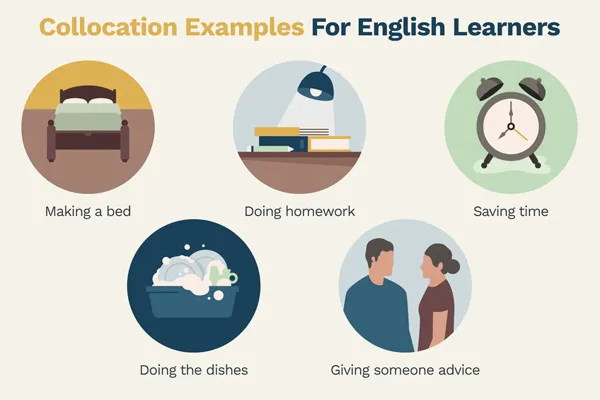
- Boost Your Lexical Resource Score: Using collocations is a key indicator that a candidate can use vocabulary naturally and accurately. When you use collocations, you are combining words the way native speakers do, creating precise and specific meanings.
This demonstrates that you don’t just understand individual words, but also how they function together to convey meaning effectively. Mastering collocations helps improve your score in Lexical Resource, a critical criterion for both the Writing and Speaking modules.
- Make Your Writing and Speaking More Natural: Collocations are the standard way of expressing ideas in native English. By using them, your language sounds more authentic, providing a sense of fluency and natural flow.
This not only makes your output easier to understand but also signals to the examiner that you have a rich vocabulary and a deep understanding of the language. This is a vital factor in achieving a high band score.
- Avoid Structural Errors: Memorizing collocations as pairs reduces the risk of using vocabulary in the wrong context. Once you have mastered these pairings, you can avoid common mistakes like using words that don’t fit the situation or are semantically incorrect.
This is particularly important because even a small error in word choice can significantly impact the examiner’s assessment. By mastering collocations, you will feel more confident and minimize the risk of making avoidable mistakes.
Recommended reading: Effective ways to learn IELTS vocabulary
3. Skills Requiring Collocations in IELTS
Writing
Task 1: Using collocations in Writing Task 1 is essential for describing data clearly and specifically. For example, using phrases like “experience a significant increase” allows you to describe a clear change in numbers or proportions with precision.
This makes your report more coherent and easier to follow, highlighting the trends you are describing. Correct collocation usage in Task 1 enhances the flow of your writing and helps you score higher for Coherence and Cohesion.
Task 2: In Writing Task 2, collocations help build stronger and more professional arguments. For instance, using phrases like “pose a threat” or “lead to a significant impact” not only clarifies your ideas but also proves your ability to use diverse, context-appropriate vocabulary.
This makes your essay more persuasive and easier for the reader to follow. Collocations allow you to express yourself with accuracy and naturalness, thereby improving your Lexical Resource score.
Speaking
Using collocations in the Speaking test is vital for sounding natural and fluent. When you use phrases like “grab an opportunity” or “make a decision,” you demonstrate comfort with English idioms and expressions.
These phrases help you score higher in Fluency & Coherence because they make your speech more logical, natural, and easy to understand. By using the right collocations, you can avoid common errors and ensure your speech flows smoothly.
Reading and Listening
In the Reading and Listening modules, recognizing collocations helps you process information faster and more accurately. Common phrases found in texts or conversations allow you to grasp the meaning of a passage or dialogue instantly.
When you recognize collocations, you don’t need to translate word-for-word; you can understand the content within its context, helping you answer questions more accurately and efficiently. This is especially helpful during timed tests.
4. Common IELTS Collocations by Topic
4.1. Education
- Broaden horizons: To expand one’s knowledge or experience.
Example: “Studying abroad helps students broaden their horizons.”
- Encourage creativity: To foster imaginative thinking.
Example: “Teachers should encourage creativity in the classroom.”
- Enhance critical thinking: To improve the ability to analyze information objectively.
Example: “Debating activities enhance critical thinking skills.”
- Acquire knowledge: To gain or learn information.
Example: “Reading books is a good way to acquire knowledge.”
- Academic performance: How well a student is doing in their studies.
Example: “Regular attendance improves academic performance.”
- Pursue higher education: To continue studying at a college or university level.
Example: “Many students move abroad to pursue higher education.”
- Educational opportunities: Chances to receive an education.
Example: “Improving infrastructure increases educational opportunities in rural areas.”
4.2. Environment
- Adopt eco-friendly practices: To start using methods that do not harm the environment.
Example: “Many companies are adopting eco-friendly practices to reduce waste.”
- Generate renewable energy: To produce energy from natural sources like wind or sun.
Example: “Solar panels are used to generate renewable energy.”
- Impose strict regulations: To introduce firm rules or laws.
Example: “The government needs to impose strict regulations on industrial waste.”
- Deplete natural resources: To use up natural wealth like water or minerals.
Example: “Overfishing depletes natural resources in the ocean.”
- Combat climate change: To take action against global warming.
Example: “Global efforts are needed to combat climate change.”
- Reduce carbon footprint: To lower the amount of greenhouse gases produced.
Example: “Switching to public transport helps reduce carbon footprints.”
4.3. Health
- Suffer from obesity: To be affected by the condition of being very overweight.
Example: “Many children suffer from obesity due to poor diet and lack of exercise.”
- Develop healthy habits: To form routines that are good for one’s health.
Example: “Parents should encourage children to develop healthy habits.”
- Prevent health issues: To stop medical problems before they start.
Example: “Regular check-ups can prevent health issues.”
- Maintain a balanced diet: To eat a variety of healthy foods in the right proportions.
Example: “Maintaining a balanced diet is essential for good health.”
- Access healthcare services: To be able to use medical facilities and care.
Example: “Everyone should have the right to access healthcare services.”
- Improve mental well-being: To enhance one’s psychological health.
Example: “Meditation can improve mental well-being.”
4.4. Work and Career
- Climb the career ladder: To get promoted and move up in a professional hierarchy.
Example: “She worked hard to climb the career ladder.”
- Land a job: To successfully get a job offer.
Example: “It is not easy to land a job in today’s competitive market.”
- Work under pressure: To perform tasks effectively in stressful situations.
Example: “Employees in the finance sector often work under pressure.”
- Strike a work-life balance: To find an equal distribution between professional and personal life.
Example: “Striking a work-life balance is important for mental health.”
- Earn a competitive salary: To receive a high pay rate compared to others in the same field.
Example: “He chose a career in tech to earn a competitive salary.”
- Gain work experience: To get practical knowledge in a job.
Example: “Internships are a great way to gain work experience.”
4.5. Technology
- Keep up with technology: To stay updated with the latest technological trends.
Example: “It’s important to keep up with technology in the modern world.”
- Revolutionize communication: To completely change how people talk to each other.
Example: “The internet has revolutionized communication globally.”
- Over-reliance on technology: Depending too much on digital tools.
Example: “Over-reliance on technology can reduce critical thinking skills.”
- Enhance productivity: To increase the amount of work done.
Example: “Technology can enhance productivity in the workplace.”
- Face technological challenges: To deal with problems related to technology.
Example: “Small businesses often face technological challenges.”
4.6. Travel and Tourism
- Experience local culture: To learn about and participate in the traditions of a place.
Example: “Traveling allows tourists to experience local culture.”
- Escape from daily routine: To get away from everyday life and chores.
Example: “Vacations are a great way to escape from the daily routine.”
- Boost the local economy: To help a community’s financial situation through tourism.
Example: “Tourism helps boost the local economy.”
- Preserve historical sites: To protect and maintain old buildings or landmarks.
Example: “Governments should invest in preserving historical sites.”
- Travel on a budget: To travel while spending as little money as possible.
Example: “Backpackers often travel on a budget.”
4.7. Family and Relationships
- Build strong relationships: To create lasting and healthy connections with others.
Example: “Open communication helps build strong relationships.”
- Spend quality time: To dedicate meaningful time to someone.
Example: “Families should spend quality time together.”
- Maintain family ties: To keep a close relationship with family members.
Example: “Living abroad makes it difficult to maintain family ties.”
- Resolve conflicts: To find a solution to disagreements.
Example: “Counseling helps couples resolve conflicts effectively.”
- Provide emotional support: To give comfort and encouragement to someone.
Example: “Parents need to provide emotional support to their children.”
4.8. Economy
- Boost economic growth: To increase a country’s wealth and production.
Example: “Investing in infrastructure can boost economic growth.”
- Create job opportunities: To provide more employment for people.
Example: “Foreign investment creates job opportunities for local residents.”
- Face financial difficulties: To experience money problems.
Example: “Many small businesses face financial difficulties during the recession.”
- Generate revenue: To produce income.
Example: “Tourism generates revenue for many countries.”
- Implement economic policies: To put financial plans or laws into action.
Example: “Governments need to implement effective economic policies.”
Related article: 5,000 IELTS vocabulary words by topic
5. Recommended Books and Resources for Learning Collocations
5.1. “English Collocations in Use” by Michael McCarthy and Felicity O’Dell
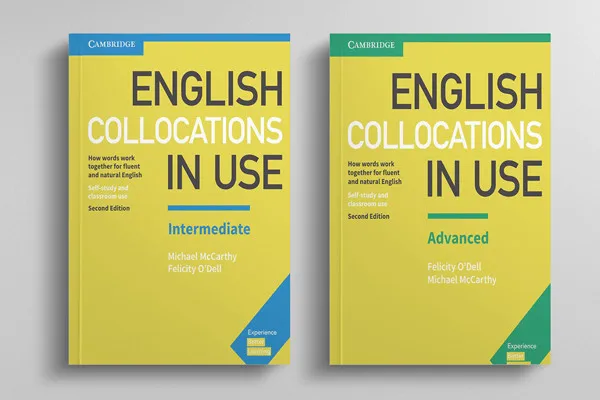
Overview: This is one of the most highly-regarded books for academic English and IELTS collocations. It doesn’t just provide practice exercises; it clearly explains how to use common collocations, helping you understand and retain them longer.
Content: The book is divided into lessons based on various topics, such as work, emotions, time, and the environment. Each lesson includes specific examples showing how collocations are used in real-world contexts, followed by exercises to test your knowledge.
Pros: It provides deep insight into how collocations are used in natural English, making it applicable for both general learning and IELTS preparation.
5.2. “Cambridge Vocabulary for IELTS” by Pauline Cullen
This book covers more than just collocations; it encompasses various aspects of vocabulary, making it ideal for candidates looking for comprehensive vocabulary improvement.
Content: It features lessons on collocations alongside practical exercises and examples. It helps learners understand how to use vocabulary naturally and accurately within the context of the IELTS exam. The book also provides strategies and tips for effective vocabulary acquisition.
Pros: Offers a holistic view of vocabulary and collocation usage in academic English, benefiting all four test modules.
5.3. “Mastering Collocations” by Mark Hancock
This resource focuses on learning and practicing collocations through practical exercises and real-life examples.
Content: It includes numerous exercises to help you identify and use collocations correctly. Each lesson features clear illustrations and examples, making them easy to memorize. It also includes sample dialogues and essays to show how collocations function in real situations.
Pros: Highly visual and accessible, making it ideal for reviewing and applying collocations in the IELTS exam.
5.4. “IELTS Preparation Books with Collocations Sections”
Content: Many general IELTS prep books include dedicated sections with examples, exercises, and tips for using collocations effectively. They often provide lists of common collocations related to frequent IELTS topics.
Pros: Helps learners understand how to use collocations naturally to improve their Lexical Resource score.
See more: Common idioms by topic and how to use them in IELTS Speaking
6. Key Considerations When Using Collocations in IELTS
Collocations are powerful tools for boosting your IELTS score, but they must be used strategically and carefully. Here are some detailed tips for applying them:
5.1. Avoid Overusing Collocations
The Issue: Using too many collocations in a single sentence or paragraph can make your writing sound forced or difficult to understand.
Advice:
- Use collocations at key points, such as to emphasize a main idea or express a thought naturally.
- Prioritize quality over quantity, ensuring each collocation fits the context perfectly.
Example:
Avoid: “This poses a serious problem that requires an urgent solution with immediate action.”
Better: “This poses a serious problem that requires an urgent solution.”
5.2. Pay Attention to Accompanying Grammar
The Issue: Some collocations require specific prepositions or fixed grammatical structures. Using them incorrectly will lower your score for Grammatical Range & Accuracy.
5.3. Focus on Clear Pronunciation in Speaking
The Issue: In the Speaking test, if you mispronounce words within a collocation, the examiner may misunderstand your point.
Advice:
- Practice the pronunciation of each word in the collocation and learn the natural word stress.
Example: “Take a break” should be pronounced clearly; avoid rushing it so much that it sounds like a single unintelligible word.
- Record yourself speaking to check for clarity and accuracy.
5.4. Understand the Deeper Meaning
The Issue: Rote memorization without understanding the context can lead to serious errors.
Advice: Learn each collocation along with real-world examples to fully grasp its meaning and usage.
Example:
“Make a decision” is used when choosing between options.
Avoid saying “do a decision,” as it is unnatural in English.
5.5. Use Level-Appropriate Vocabulary
The Issue: Attempting to use overly complex or unfamiliar collocations can lead to mistakes and point deductions.
Advice:
- Stick to collocations you fully understand.
- Prioritize simple, familiar, yet natural collocations over overly academic ones if you aren’t confident in their use.
Example: Use “face difficulties” instead of “encounter insurmountable obstacles” if you are not yet comfortable with the latter.
5.6. Ensure Contextual Naturalness
The Issue: A collocation might work in one context but not another.
Advice: Always consider the context before using a phrase.
Example: “Heavy rain” is perfect for describing weather, but you cannot use “heavy” for emotions (e.g., “heavy emotion” is incorrect).
5.7. Diversify Your Collocations
The Issue: Repeating the same collocation makes your language seem limited.
Advice:
- Practice a variety of collocations for different topics.
- In Writing Task 2, instead of repeating “pose a problem,” try “create an issue” or “lead to challenges.”
By following these suggestions, you can enhance your use of collocations in IELTS, making your writing and speaking more natural and coherent while improving your overall band score. Good luck!
For more information, please refer to the IELTS preparation courses at ECE Language Center. We offer courses suitable for all levels with personalized roadmaps for every student.




 Khai giảng Khóa học Hè cực HOT.
No comments yet!